







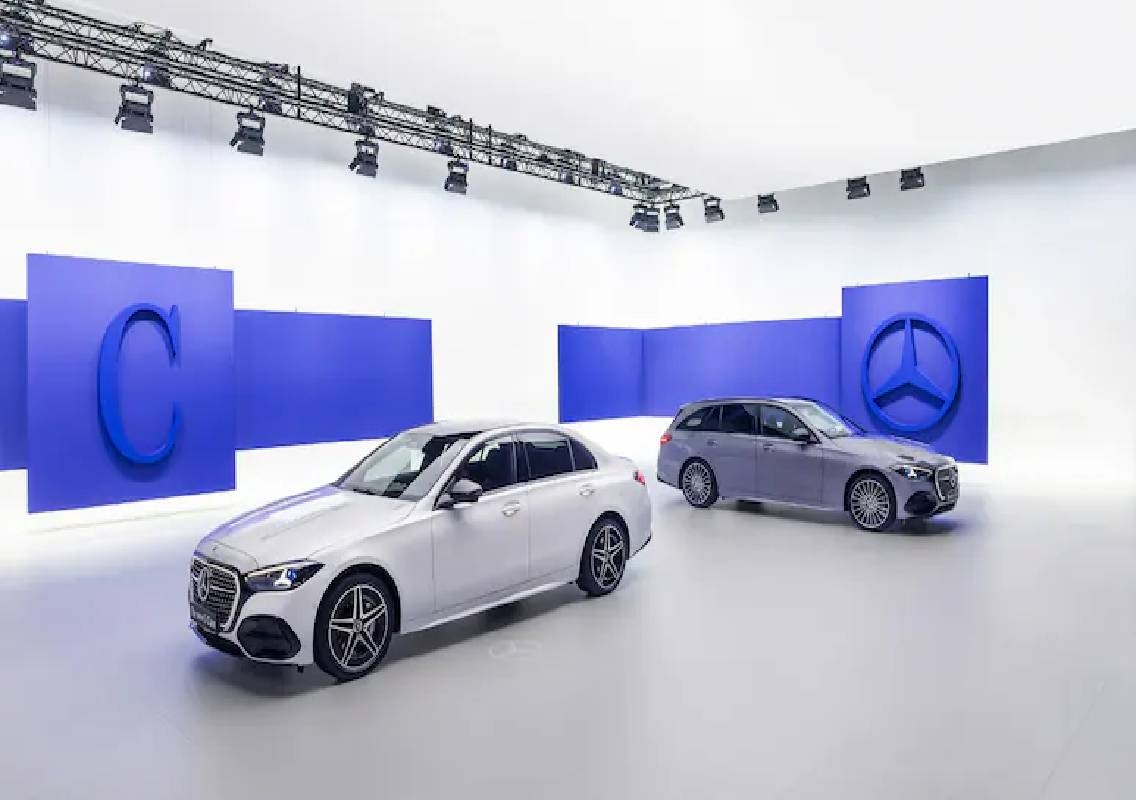


New Delhi: Mercedes-Benz has unveiled the updated 2027 C-Class, bringing refreshed styling, upgraded powertrains and a longer list of technology and comfort features to its popular luxury sedan. The facelift is the first major update for the current fifth-generation C-Class, which was introduced in 2021.
The updated model retains petrol, diesel and plug-in hybrid powertrain options in international markets, while receiving revisions to its exterior design, cabin technology and driving dynamics. The C-Class has been part of Mercedes-Benz’s global line-up since 1982 and has crossed 12 million units in worldwide sales.
Mercedes-Benz C-Class gets a sharper design
The biggest visual changes are concentrated at the front of the updated C-Class.
The sedan gets redesigned LED headlights featuring Mercedes-Benz’s distinctive three-pointed-star daytime running light signatures. These flank a larger grille with a prominent three-pointed-star emblem and chrome detailing.
In some markets, the grille can also feature an illuminated surround, giving the sedan a more distinctive appearance at night.
The front bumper has been redesigned as well, with enclosed air intakes replacing some of the visual elements of the outgoing model. The overall design brings the C-Class closer to Mercedes-Benz’s latest styling language, particularly that seen on newer S-Class and electric models.
New alloy wheels and exterior details
Changes along the side are relatively subtle.
The updated C-Class gets new alloy-wheel designs, with 17-inch wheels offered as standard and larger 18- and 19-inch options available depending on the variant and market.
The exterior mirrors now incorporate cameras, while the overall proportions and silhouette remain largely familiar.
At the rear, the sedan receives revised tail-lamp signatures incorporating Mercedes-Benz’s three-pointed-star lighting theme. The changes are intended to make the facelift immediately recognisable without substantially altering the C-Class’s established design.
Interior gets more technology
Mercedes-Benz has retained the basic dashboard layout but introduced several technology upgrades.
The updated C-Class continues with a 12.3-inch digital instrument cluster and an 11.9-inch portrait-oriented central infotainment display.
Unlike some newer Mercedes-Benz models, the C-Class does not receive a separate passenger-side screen.
The facelift instead focuses on software and connectivity upgrades, including the latest MB.OS operating system, which supports over-the-air updates and a broader range of connected functions.
AI-powered features added
One of the most notable technology additions is a more advanced voice assistant.
The updated system integrates AI capabilities and can draw on services including ChatGPT, Microsoft Bing and Google Gemini, depending on the market and feature availability.
The aim is to make the digital assistant more capable of handling conversational requests rather than relying solely on fixed voice commands.
The system can also provide personalised functions and support additional connected services through Mercedes-Benz’s updated software architecture.
New steering wheel and premium audio
The cabin also receives a redesigned steering wheel featuring a physical volume control, replacing some of the touch-sensitive controls seen on the outgoing model.
Mercedes-Benz has also expanded the audio options.
A new Burmester sound system with Dolby Atmos and 15 speakers is available, giving the C-Class a more premium in-car entertainment experience.
There are also new upholstery choices, ambient-lighting options and updated trim finishes to differentiate the refreshed cabin from the earlier model.
Updated petrol and diesel engines
Under the bonnet, Mercedes-Benz has upgraded the C-Class’s combustion-engine range.
The updated petrol and diesel engines receive revisions aimed at improving efficiency and meeting increasingly stringent emissions regulations.
The petrol range includes Mercedes-Benz’s latest-generation M254 EVO four-cylinder engine technology, supported by a 48-volt mild-hybrid system.
The system can provide additional electric assistance during acceleration while also improving efficiency during everyday driving.
The updated C-Class therefore continues Mercedes-Benz’s strategy of combining conventional internal-combustion engines with electrification rather than moving the entire range immediately to battery power.
Plug-in hybrid versions offer up to 395 hp
International markets will also receive plug-in hybrid versions of the refreshed C-Class.
The C 300e and C 400e combine the updated M254 EVO petrol engine with a 19.53kWh battery and an electric motor.
The combined output can reach 395 hp and 650 Nm, depending on the variant.
The plug-in hybrid models are claimed to offer approximately 100 km of electric-only range under the WLTP cycle.
Charging capability extends to up to 11kW using AC and 55kW using DC, giving owners more flexibility when using the car primarily for shorter electric journeys.
C 300e available with all-wheel drive
The C 300e plug-in hybrid will be available in both rear-wheel-drive and all-wheel-drive configurations in markets where these versions are offered.
The more powerful C 400e comes exclusively with all-wheel drive.
This gives buyers a wider range of choices depending on whether they prioritise efficiency, performance or additional traction.
The availability of individual powertrains, however, varies by market.
Suspension gets revised
Mercedes-Benz has also worked on the C-Class’s chassis.
The suspension has been retuned with a stiffer setup and revised damping characteristics.
The changes are intended to reduce body movement and make the car respond more precisely to steering inputs while maintaining the comfort expected from a Mercedes-Benz sedan.
The updated suspension is particularly aimed at improving the balance between everyday comfort and sharper handling.
Rear-wheel steering remains available
The facelift retains Mercedes-Benz’s optional rear-wheel steering system.
The rear wheels can turn by up to 2.5 degrees, helping improve manoeuvrability at lower speeds and stability at higher speeds.
At speeds below 100 kmph, the rear wheels can turn in the opposite direction to the front wheels, effectively reducing the turning radius.
At higher speeds, they turn in the same direction as the front wheels to improve stability.
Quieter and more refined cabin
Mercedes-Benz has also focused on refinement.
The updated C-Class receives measures aimed at reducing noise and improving the overall cabin experience.
Combined with the revised suspension and upgraded infotainment system, the changes are intended to make the C-Class feel more sophisticated without radically altering its basic character.
The facelift is therefore more of a comprehensive technology and powertrain update than a completely new-generation model.
When will the updated C-Class arrive?
The refreshed C-Class has been revealed for international markets, with sales expected to begin in overseas markets as the updated model enters production.
In Germany, prices for the facelifted C-Class reportedly start at around €41,045, equivalent to roughly ₹45.4 lakh at current conversion rates, before taxes and other market-specific costs.
Mercedes-Benz’s India plans and variant-specific specifications will determine how closely the Indian-market car mirrors the international version.
C-Class continues as a key Mercedes model
The C-Class remains one of Mercedes-Benz’s most important global products.
With more than 12 million units sold since its introduction in 1982, the model has played a major role in the company’s luxury sedan portfolio.
The latest facelift arrives as the luxury-car market undergoes a significant transition towards electrification.
Mercedes-Benz is consequently keeping multiple powertrain technologies in the C-Class family, including conventional petrol and diesel engines, mild-hybrid assistance and plug-in hybrid systems.
Conclusion
The 2027 Mercedes-Benz C-Class facelift brings a substantial package of styling, technology and mechanical updates while retaining the familiar fifth-generation platform.
The biggest changes include redesigned LED headlights and grille, new alloy wheels, upgraded infotainment, AI-powered digital assistance, a new steering wheel and a more premium Burmester audio system.
The powertrain range also gets important upgrades, with revised petrol and diesel engines alongside plug-in hybrid versions producing up to 395 hp and 650 Nm. The chassis has been retuned as well, while rear-wheel steering continues to be offered.
With the facelift, Mercedes-Benz is aiming to keep the C-Class competitive against rivals such as the BMW 3 Series and Audi A4 while giving its long-running luxury sedan more technology and electrified powertrain options.