







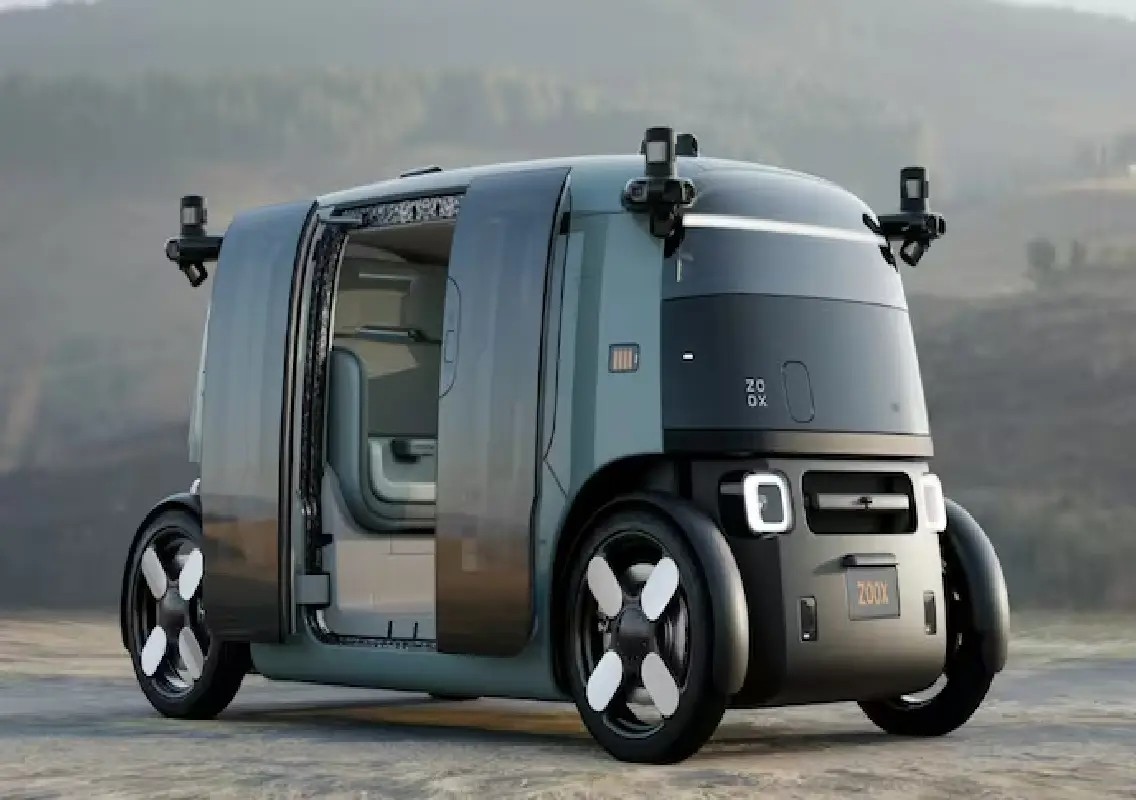


California: Self-driving vehicles are steadily moving from science fiction to reality, and Amazon-owned autonomous vehicle company Zoox has taken another step towards commercialising its technology by unveiling a redesigned version of its robotaxi ahead of launching paid ride services in the United States.
The company has introduced several upgrades to its distinctive, rectangular-shaped autonomous vehicle, popularly nicknamed the “toaster” because of its unconventional design. The updated model is expected to enter large-scale production as Zoox prepares to expand its commercial operations.
Unique design remains largely unchanged
The redesigned robotaxi retains Zoox’s signature carriage-style cabin, with both ends of the vehicle appearing almost identical from the side profile.
Unlike conventional cars, the vehicle is capable of driving in either direction and can reach speeds of up to 75 miles per hour, or approximately 120 kilometres per hour.
While the overall appearance remains familiar, Zoox has introduced several modifications aimed at improving usability and safety.
The company has enlarged and repositioned the bidirectional reflectors, making it easier for passengers, emergency responders and law enforcement personnel to distinguish the front of the vehicle from the rear.
It has also added a speaker, microphone and two-way audio communication system to the vehicle’s door interface.
High-tech sensors power autonomous driving
The robotaxi continues to feature a sophisticated suite of technologies that enable autonomous driving.
These include multiple cameras, radar systems, lidar sensors and infrared sensors that help the vehicle perceive and navigate its surroundings.
The vehicle also retains design features such as its moonroof and ambient starry-night lighting.
Unlike traditional vehicles, the robotaxi does not feature a steering wheel or pedals, as it is designed to operate entirely autonomously.
Interior upgraded for passenger comfort
Inside, the vehicle offers a minimalist cabin with four seats arranged to face one another.
Zoox says the updated version comes with a more responsive touchscreen, improved seating comfort and additional padding in the headrests.
The company has also introduced a lighter colour scheme featuring aloe-green seating and stone-grey interior trim.
Other changes include larger cup holders and a grooved wireless charging pad designed to prevent smartphones from sliding while the vehicle is in motion.
According to the company, these changes are intended to improve passenger comfort and make it easier for riders to locate items such as phones, wallets and keys that may otherwise be forgotten inside the vehicle.
Preparing to launch paid services
Currently, Zoox operates free robotaxi rides in select American cities, including Las Vegas, San Francisco, Miami and Austin.
The company says it has served more than 5 lakh riders since opening its service in Las Vegas last September.
Earlier this year, Zoox entered into a partnership with Uber to make its robotaxis available through the ride-hailing platform in Las Vegas.
The Amazon subsidiary now plans to launch paid services, possibly before the end of the year.
Awaiting regulatory approval
Zoox is currently awaiting approval from the US National Highway Traffic Safety Administration to operate up to 2,500 self-driving vehicles on public roads for commercial purposes.
Under existing federal regulations in the United States, vehicles are generally required to have standard driver controls, making regulatory approval a crucial step for the company’s expansion plans.
The company stated that its application remains under review following the conclusion of the public consultation process in April.
Zoox also plans to ramp up manufacturing at its facility in Hayward, California. The factory, which opened last year, has the capacity to eventually produce 10,000 vehicles annually and could initially manufacture up to 100 vehicles a week, subject to regulatory approvals.
Waymo recently announced that it had surpassed 5 lakh paid rides every week across 10 cities in the United States and plans to expand its commercial operations to additional international markets, including London and Tokyo.
As competition in the autonomous mobility sector intensifies, Zoox’s redesigned robotaxi represents another significant milestone in the race to bring self-driving transportation into the mainstream.