







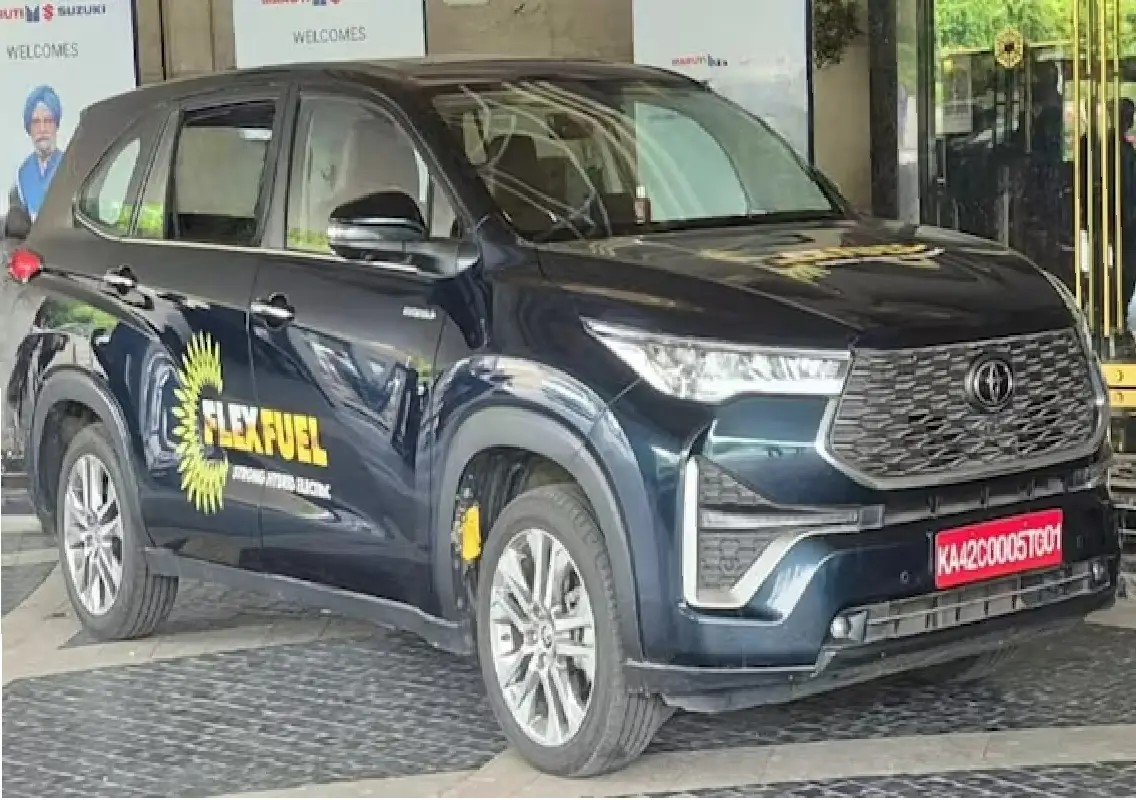


New Delhi: As India accelerates its transition towards cleaner and more sustainable transportation, flex-fuel hybrid vehicles are gaining attention as a promising solution that could reduce dependence on imported crude oil while supporting the country’s ethanol ecosystem.
The technology combines the benefits of ethanol-based fuels with hybrid powertrains, offering a potential pathway towards lower emissions and improved fuel efficiency without relying entirely on battery-electric vehicles.
With the government expanding ethanol infrastructure and automobile manufacturers testing new technologies, flex-fuel hybrids are increasingly being viewed as an important component of India’s broader mobility strategy.
What is a flex-fuel hybrid vehicle?
A flex-fuel vehicle is designed to operate on petrol as well as higher concentrations of ethanol-blended fuel.
Unlike conventional petrol vehicles, which are generally compatible with fuel blends containing up to 20 per cent ethanol, flex-fuel vehicles can run on ethanol-rich blends such as E85, which contains 85 per cent ethanol and 15 per cent petrol. Some specialised applications can even operate on E100 fuel.
A flex-fuel hybrid combines this capability with a hybrid powertrain consisting of:
- An internal combustion engine capable of running on varying ethanol-petrol blends
- An electric motor
- A battery pack
This combination enables the vehicle to improve fuel efficiency, lower fuel consumption and reduce emissions compared to traditional petrol-powered vehicles.
Ethanol’s role in India’s energy strategy
Ethanol has emerged as a key component of India’s efforts to reduce its reliance on imported fossil fuels.
The fuel is primarily produced from agricultural feedstocks such as:
- Sugarcane
- Maize
- Agricultural biomass
- Other renewable organic materials
Because ethanol is produced domestically, greater adoption can help reduce foreign exchange expenditure on crude oil imports while creating additional income opportunities for farmers.
The Indian government has already made significant progress in expanding ethanol blending programmes, with fuel retailers increasingly supplying higher ethanol blends across various regions.
Officials view the development of flex-fuel-compatible vehicles as the next logical step in expanding ethanol usage within the transport sector.
Toyota showcases flex-fuel hybrid technology
Among automakers exploring the technology, Toyota Kirloskar Motor has emerged as one of the strongest advocates of multiple decarbonisation pathways.
The company has promoted a combination of technologies including:
- Hybrid electric vehicles
- Flex-fuel vehicles
- Hydrogen-powered vehicles
- Battery electric vehicles
A flex-fuel strong-hybrid prototype based on the Toyota Innova HyCross was recently showcased in Delhi, highlighting the potential of the technology for Indian conditions.
The prototype demonstrates how hybrid systems and ethanol-rich fuels can work together to reduce emissions while maintaining driving range and convenience.
Advantages of flex-fuel hybrids
Supporters of the technology point to several potential benefits.
Reduced crude oil imports
India imports a substantial portion of its crude oil requirements. Increased use of ethanol can reduce dependence on imported fossil fuels and improve energy security.
Lower emissions
Ethanol-based fuels generally produce lower net carbon emissions compared to conventional petrol, particularly when sourced from renewable agricultural feedstocks.
Improved fuel efficiency
The hybrid component allows the vehicle to recover energy during braking and utilise electric power during certain driving conditions, improving overall efficiency.
Support for farmers
Higher ethanol demand can create additional markets for agricultural produce, benefiting farmers and strengthening rural economies.
Fuel flexibility
Consumers can continue using petrol-ethanol blends while benefiting from expanding ethanol infrastructure.
Infrastructure expansion underway
One of the major challenges facing widespread adoption has been the limited availability of higher ethanol blends such as E85.
However, the government has begun expanding fuel infrastructure to support future demand.
Recently, Delhi received its first E85 fuel dispensing station on Pusa Road.
At present, E85 fuel is priced at approximately Rs 82.12 per litre in Delhi, making it significantly cheaper than E20 petrol, which costs around Rs 20 more per litre.
To help consumers identify the fuel, E85 dispensing stations will feature dedicated branding and clear signage.
Ambitious rollout plans
Authorities have announced plans for a substantial expansion of E85 fuel infrastructure over the next two years.
During the initial phase, between 50 and 100 E85 stations are expected to be established across key transport corridors, including:
- Delhi-NCR
- Mumbai-Pune corridor
- Nagpur region
The expansion is expected to accelerate significantly, with nearly 500 E85 dispensing stations targeted by the end of 2026.
By the end of 2027, the government aims to increase the network to around 5,000 outlets across major cities nationwide.
This infrastructure growth is expected to play a critical role in encouraging manufacturers and consumers to adopt flex-fuel vehicles.
Challenges to adoption
Despite its potential, the technology faces several hurdles.
Automakers must ensure that engines and fuel systems remain durable when operating on ethanol-rich fuels, which have different chemical characteristics than petrol.
Additionally, widespread adoption will depend on:
- Expansion of E85 fuel availability
- Consumer awareness
- Competitive vehicle pricing
- Long-term policy support
Industry experts believe that addressing these challenges will be essential for achieving large-scale adoption.
Conclusion
Flex-fuel hybrid vehicles are emerging as a significant part of India’s strategy to reduce oil imports, lower emissions and promote energy security. By combining ethanol-compatible engines with hybrid technology, these vehicles offer a practical middle path between conventional internal combustion engines and fully electric mobility. With expanding E85 infrastructure and growing industry interest, flex-fuel hybrids could play an important role in India’s clean transportation future.