







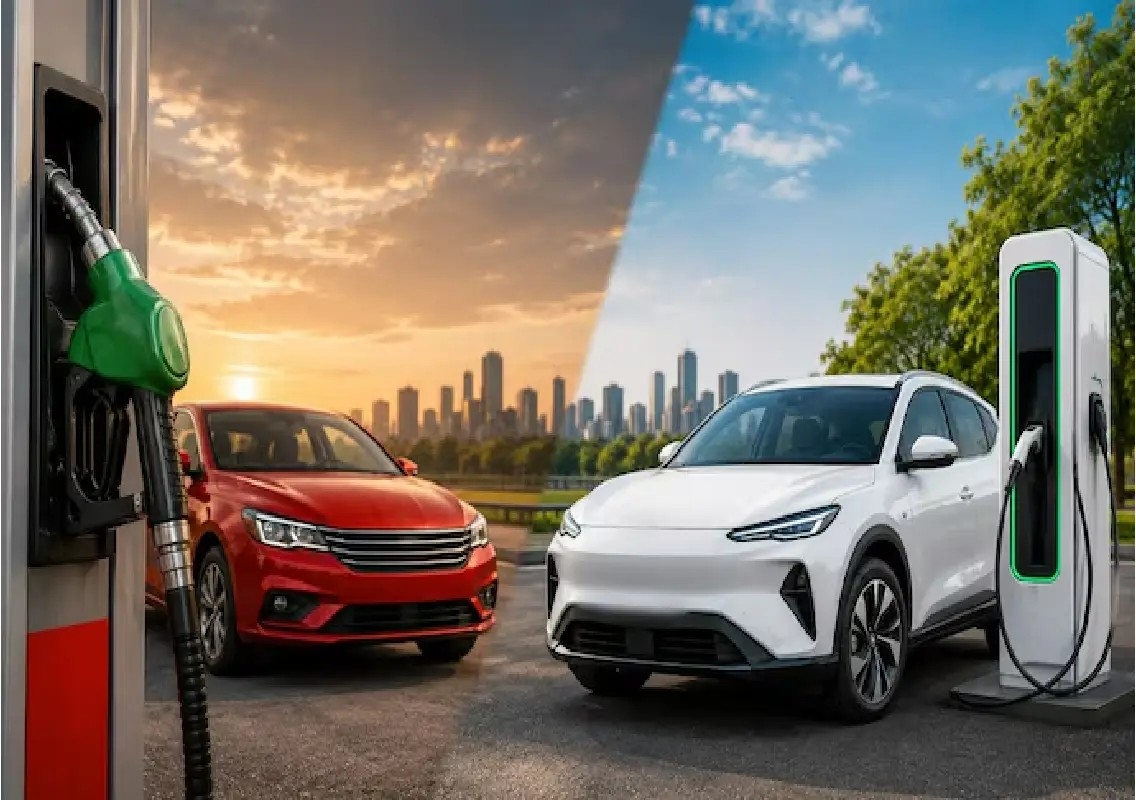


New Delhi: Growing indications that India may eventually move beyond E20 petrol have sparked concerns among prospective vehicle buyers, with many questioning whether current petrol vehicles will remain compatible with future fuel standards.
Recent policy measures by the government, including the notification of fuel standards for higher ethanol blends and tax incentives for blended fuels, have fuelled speculation that E20 may only be an intermediate milestone in India’s ethanol-blending programme.
Government notifies higher ethanol fuel standards
In May, the government officially notified fuel specifications for higher ethanol-petrol blends, including E22, E25, E27 and E30.
Although these fuels are not yet available at retail fuel stations, the notification establishes the technical framework required for their future rollout. Industry observers view the move as a strong indication that the government is exploring the possibility of increasing ethanol content beyond the current E20 target.
The development has attracted attention from both automakers and consumers, who are closely monitoring future policy decisions.
Excise exemption strengthens signals
The government’s recent decision to exempt petrol blended with 22 to 30 per cent ethanol from excise duty has further strengthened expectations of a gradual transition towards higher ethanol blends.
The measure is widely seen as an incentive for oil marketing companies to eventually introduce fuels with greater ethanol content.
While no official timeline has been announced, the policy has prompted discussions about the future direction of India’s fuel strategy and its implications for vehicle owners.
Delhi gets first E85 dispensing station
Another significant milestone came on June 5 when Union Petroleum and Natural Gas Minister Hardeep Singh Puri inaugurated Delhi’s first E85 fuel dispensing station at an Indian Oil outlet on Pusa Road.
E85 fuel contains up to 85 per cent ethanol and is designed specifically for flex-fuel vehicles capable of operating on varying ethanol concentrations.
Although E85 remains relevant only to a limited category of vehicles at present, the launch is viewed as another step in the government’s broader push towards greater ethanol adoption.
Lack of roadmap creates uncertainty
Despite these developments, the government has not provided a clear roadmap regarding future ethanol-blending targets beyond E20.
Questions remain over whether India will eventually adopt E25, E27 or E30 as mainstream fuels and how existing vehicles will be accommodated under such a transition.
The absence of definitive guidance has led to uncertainty among prospective car buyers, particularly those planning to purchase petrol-powered vehicles in the near future.
Survey highlights consumer concerns
A recent survey conducted by LocalCircles suggests that fuel-related uncertainty is influencing purchasing decisions.
According to the survey, 43 per cent of respondents considering a vehicle purchase may postpone or reconsider their decision due to concerns about E20 fuel and the possibility of a future transition to higher ethanol blends.
The survey reportedly gathered responses from more than 28,000 prospective buyers across 311 districts, indicating widespread interest in the issue.
Industry experts believe consumer confidence could be affected unless greater clarity is provided regarding future fuel policies.
Why higher ethanol blends raise concerns
Most petrol vehicles currently sold in India are certified for E20 fuel compatibility, meaning they have been engineered and tested to operate with petrol containing up to 20 per cent ethanol.
However, this certification does not automatically guarantee compatibility with E25, E27 or E30 fuels.
Experts point to several potential challenges associated with higher ethanol concentrations.
Reduced fuel efficiency
Ethanol contains less energy than conventional petrol. As the proportion of ethanol increases, fuel economy generally declines, potentially resulting in higher fuel consumption.
Material compatibility issues
Higher concentrations of ethanol can be more corrosive than petrol and may affect components such as fuel lines, seals, gaskets and certain rubber or plastic parts not specifically designed for higher blends.
Engine calibration challenges
Modern engines are calibrated for specific fuel compositions. Increased ethanol content can alter combustion characteristics, potentially affecting vehicle performance, drivability and emissions.
Long-term durability concerns
Prolonged use of fuels exceeding a vehicle’s certified blend level may increase wear on fuel-system components and emission-control equipment, potentially leading to higher maintenance costs over time.
Electric vehicles gain attention
The uncertainty surrounding future fuel policies appears to be benefiting the electric vehicle (EV) segment.
Dealerships across several brands report growing consumer interest in EVs, with waiting periods for some popular models extending to a month or longer.
Many buyers are reportedly considering electric vehicles as a way to avoid concerns about changing fuel compositions, compatibility issues and future regulatory shifts.
Unlike petrol-powered vehicles, EVs are unaffected by ethanol-blending policies and offer predictable operating costs regardless of future fuel reforms.
Future-proofing becomes key factor
Industry analysts note that environmental benefits and lower running costs have traditionally been the primary reasons for purchasing electric vehicles.
However, evolving fuel policies may now be creating an additional incentive. For some consumers, the appeal of EVs increasingly lies in the certainty they offer amid an evolving automotive and energy landscape.
Until authorities provide greater clarity regarding the future of ethanol blending and the treatment of existing E20-compatible vehicles, questions are likely to persist among prospective buyers.
Conclusion
India’s move towards higher ethanol blends signals the government’s continued commitment to reducing fossil fuel dependence and increasing the use of renewable fuels. However, the lack of a clear roadmap beyond E20 has created uncertainty among vehicle buyers. As policymakers evaluate the next phase of the ethanol-blending programme, consumers and automakers alike will be seeking greater clarity on fuel compatibility, regulatory timelines and long-term implications for vehicle ownership.