







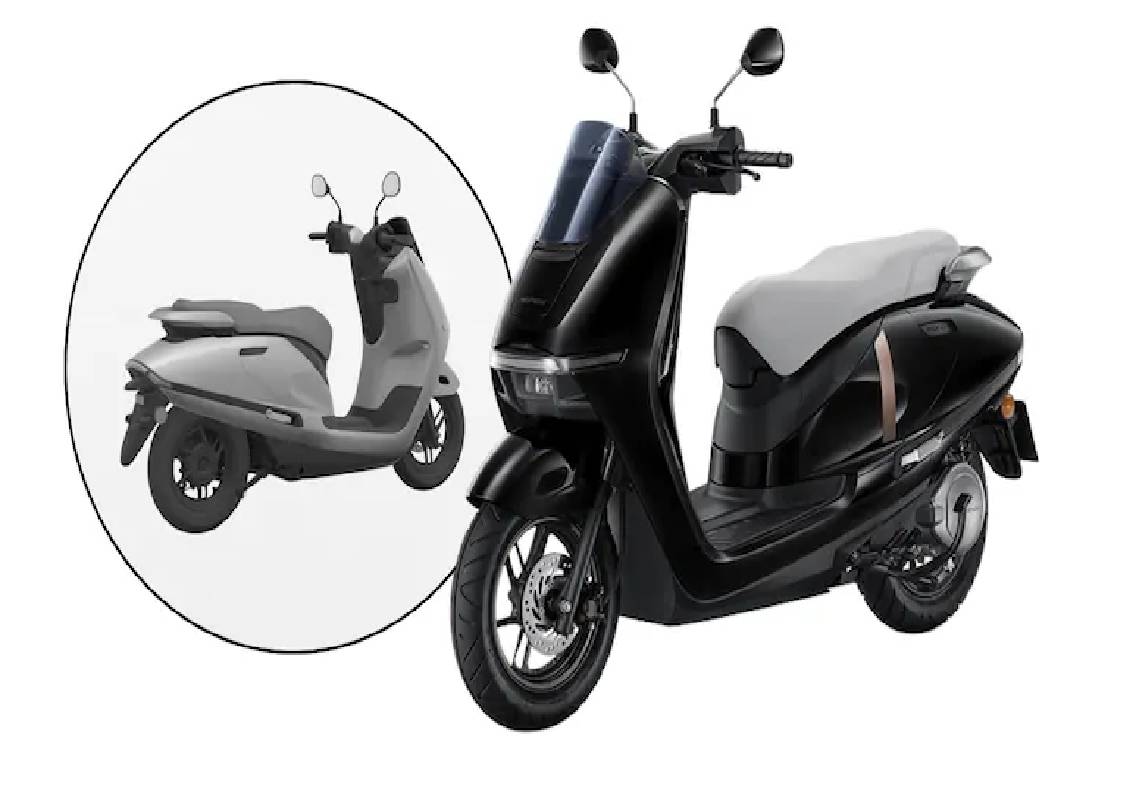


The Honda UC3 is already sold in markets such as Thailand and Vietnam. It has a more spacious design and a different riding position compared with conventional urban-focused electric scooters. If introduced in India, the UC3 could expand Honda’s electric scooter portfolio and take on products such as the TVS iQube.
Honda UC3 gets India patent
Honda’s patent filing covers the UC3 electric scooter, which is positioned as a larger and more premium offering in the company’s overseas EV range. The model features cruiser-inspired styling with flowing bodywork and a relatively spacious layout.
The filing is notable because Honda is strengthening its electric two-wheeler line-up in India. The company has recently unveiled the QC3 electric scooter for the Indian market, and the UC3 patent could provide another option for Honda as it expands its EV portfolio.
However, a patent should not be interpreted as a confirmation of a product launch. Automakers frequently register patents in markets to protect designs and intellectual property, even when there is no immediate plan to introduce the product.
Honda has not officially announced an India launch timeline or confirmed that the UC3 will be sold here.
Honda UC3: Battery and motor
In overseas markets, the Honda UC3 uses a fixed Lithium Iron Phosphate (LFP) battery. This would make it particularly notable if the same technology is retained for an eventual Indian version.
The electric scooter is powered by a wheel-side electric motor developed in-house. It produces a peak output of 6.0 kW. In Thailand, Honda claims a range of 122 km on a single charge under the WMTC Mode 1 test cycle.
The UC3 comes with three riding modes — Standard, Sport and Econ. These modes allow riders to choose between different performance characteristics depending on riding conditions.
It also gets a reverse mode, which can make parking and low-speed manoeuvring easier, particularly given the scooter’s larger dimensions.
Charging options
Honda offers two charger options for the UC3 in overseas markets.
The more powerful 1,200 W charger can charge the battery from 0 to 100 per cent in approximately four hours. The 450 W charger takes around nine hours for a full charge. The availability of two charging options allows users to choose a setup based on their charging requirements and infrastructure.
The charging specifications could be an important consideration if Honda eventually brings the UC3 to India, although the company could make changes to the model or its equipment for the local market.
Design and practicality
Unlike many compact electric scooters designed primarily for city commuting, the UC3 has a larger, more substantial appearance.
The scooter uses 12-inch wheels at both ends and has a 779 mm seat height. Its kerb weight is 129 kg, while the under-seat storage capacity is 26 litres, according to overseas specifications.
The combination of a larger body, cruiser-style proportions and a different riding position could help Honda target customers looking for an electric scooter with a more premium and distinctive design.
The three riding modes and reverse function further add to its practicality for everyday use.
Honda’s QC3 electric scooter
The UC3 patent comes shortly after Honda’s introduction of the QC3 electric scooter for India.
The QC3 is designed as a family-oriented electric scooter and uses a 3.0 kWh fixed lithium-ion battery. Honda claims an IDC-certified range of 145 km on a single charge. Its battery can reach 80 per cent charge in about 2 hours and 40 minutes, while a full charge takes approximately four hours.
The QC3 also offers 32 litres of under-seat storage and features a 5-inch TFT display with Honda RoadSync connectivity, turn-by-turn navigation and smartphone integration.
With the UC3 patent, Honda appears to be keeping the door open for a broader electric scooter portfolio in India, although its actual product strategy will depend on market requirements and launch decisions.
Will Honda UC3 launch in India?
For now, there is no official confirmation of the Honda UC3’s India launch.
The patent filing indicates that Honda has taken steps to protect the scooter’s design and intellectual property in the Indian market. It does not necessarily mean that the model will enter production or go on sale soon.
If Honda does decide to introduce the UC3, its larger format, 6.0 kW motor, LFP battery and claimed 122 km range could position it differently from smaller urban electric scooters.
The model could also add more variety to Honda’s EV line-up at a time when India’s electric two-wheeler market is becoming increasingly competitive.
For now, buyers should treat the Honda UC3 as a potential future product rather than a confirmed upcoming launch. Honda’s next official announcement will determine whether the patented scooter eventually reaches Indian showrooms.