







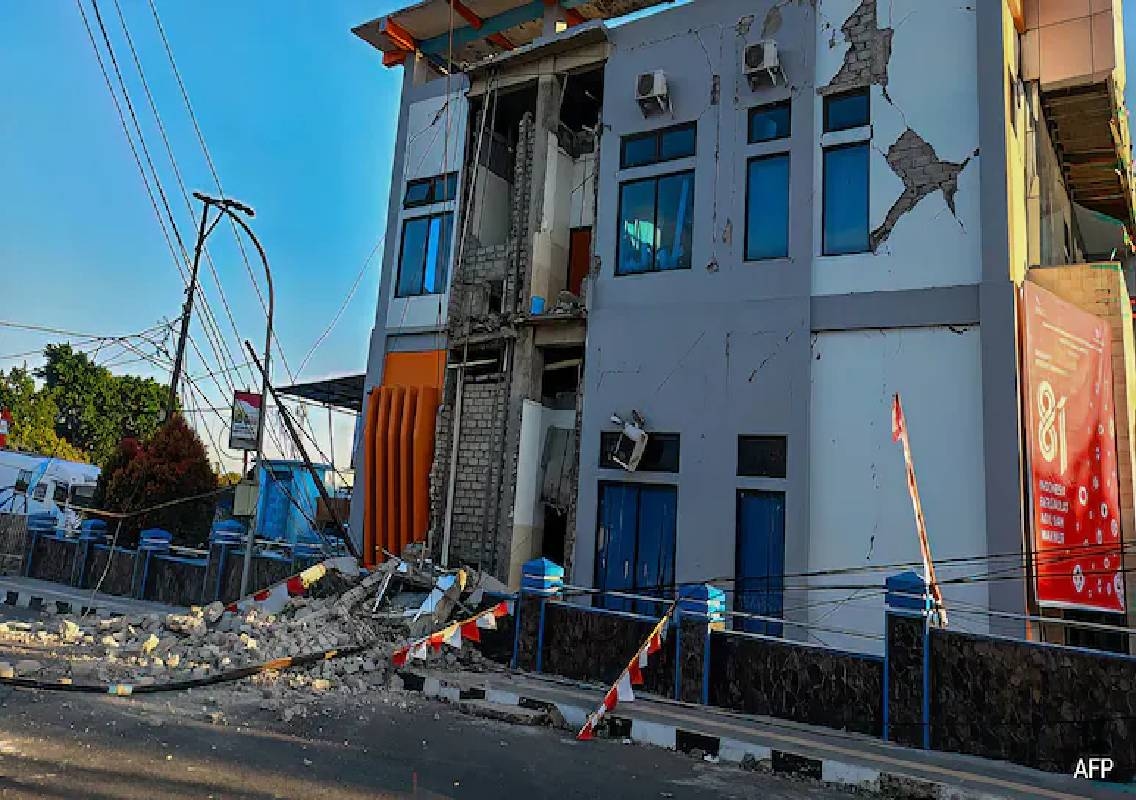


Jakarta: A powerful 7.7-magnitude earthquake struck off Indonesia’s Flores Island early Saturday, killing at least two people, damaging buildings and sending residents fleeing to safer areas. The shallow earthquake also triggered a brief tsunami warning, which was later lifted after authorities found no significant tsunami threat.
Videos circulating after the earthquake showed buildings shaking violently, walls cracking and parts of structures collapsing as residents ran outdoors to escape falling debris. The tremor was followed by several strong aftershocks, adding to the panic across parts of eastern Indonesia.
7.7-magnitude quake strikes near Flores
According to the US Geological Survey, the earthquake struck at around 5:58 am local time at a shallow depth of about 10 kilometres. Its epicentre was approximately 68 kilometres north-northwest of Ende, in East Nusa Tenggara province.
The shallow depth contributed to the intensity of the shaking felt across the region.
The initial earthquake was followed by strong aftershocks, including tremors measured at 5.6 and 5.9 magnitude, while another aftershock was reported at around 6.1 magnitude.
At least two people killed
Indonesia’s disaster authorities confirmed two deaths following the earthquake.
The victims were a man and a woman, according to disaster agency spokesperson Berton Suar Pelita Panjaitan. Authorities said they were still assessing the overall extent of casualties and structural damage.
Reports also indicated injuries and damage to homes and other buildings in affected areas.
The casualty figure could change as emergency teams reach areas that were affected by the strongest shaking.
Buildings shake as residents flee
The earthquake caused widespread panic in several communities.
Video footage showed structures swaying violently while residents rushed into open spaces. Some buildings were seen collapsing, while walls and other parts of structures sustained visible damage.
At a hospital in the region, patients reportedly fled outside when the building began shaking.
A hospital employee described seeing cracked walls after the strong jolt. The incident forced people to leave buildings temporarily as authorities assessed their safety.
In Maumere, residents reported damage to buildings, including the collapse of part of a port terminal waiting area.
Tsunami warning briefly issued
The earthquake occurred beneath the sea near Flores, prompting Indonesia’s Meteorology, Climatology, and Geophysics Agency (BMKG) to issue a tsunami warning.
Authorities warned that potentially dangerous waves could affect parts of East Nusa Tenggara, South Sulawesi and West Nusa Tenggara.
Residents along vulnerable coastlines were urged to move away from the shore and seek higher ground. Some people evacuated towards hills and inland areas as officials monitored sea levels.
The warning was later lifted after authorities determined that a significant tsunami threat had not materialised. Reported waves were small, with measurements of less than one metre.
Residents report strong shaking
People living in affected areas described a sudden and intense jolt.
One resident in Nagekeo said he was at a market when the earthquake struck. People began running in different directions as the shaking intensified, with many choosing to evacuate towards higher ground.
Another resident described patients fleeing a hospital after the building shook strongly.
The suddenness of the earthquake left residents with little time to react, particularly because it occurred early in the morning.
Sea reportedly receded in some areas
Residents in Maumere were among those who moved towards higher ground after the warning.
An AFP correspondent in the area reported seeing the sea recede, heightening fears of a possible tsunami. Coastal residents were therefore advised to stay away from beaches and other low-lying areas until the warning was cancelled.
The subsequent lifting of the tsunami warning brought some relief, although authorities continued monitoring the situation because of the possibility of aftershocks.
Flores has a history of deadly earthquakes
The latest earthquake has renewed memories of the devastating 1992 Flores earthquake and tsunami.
A magnitude 7 earthquake that struck the region in 1992 generated a tsunami that killed around 2,500 people on Flores and surrounding areas.
Indonesia has also suffered some of the world’s deadliest earthquake disasters.
In 2004, a magnitude 9.1 earthquake off Sumatra triggered a massive tsunami that killed around 220,000 people across the region, including approximately 170,000 in Indonesia.
In 2018, earthquakes and related disasters in Lombok, Sumbawa and Palu caused thousands of deaths.
Why Indonesia experiences frequent earthquakes
Indonesia lies along the Pacific Ring of Fire, one of the world’s most active zones for earthquakes and volcanic activity.
The country sits at the meeting point of several major tectonic plates. Movement along these plate boundaries frequently produces earthquakes, some of which can occur beneath the sea and generate tsunamis.
The geographical location makes seismic activity a recurring risk for Indonesia’s coastal communities.
Emergency response underway
Following the earthquake, emergency authorities began assessing damage and casualties across affected areas.
Residents were advised to remain alert because strong aftershocks can occur following a major earthquake. The presence of damaged buildings also creates additional risks for people attempting to return indoors.
Authorities are expected to continue inspecting infrastructure, roads, hospitals and other public facilities as more information becomes available.
Tsunami warning lifted, but aftershock risk remains
Although the tsunami warning has been withdrawn, the earthquake’s strong aftershocks mean residents in affected areas remain cautious.
After a major shallow earthquake, additional tremors can occur for hours or even days. Damaged structures can also become more vulnerable during subsequent shaking.
The immediate priority for authorities is therefore to identify casualties, assess structural damage and ensure that people in vulnerable areas can access safe locations.
Indonesia earthquake highlights seismic risks
The Flores earthquake once again demonstrates the risks faced by communities living in Indonesia’s seismically active regions.
The combination of a shallow epicentre, strong shaking and an offshore location created the possibility of both structural damage and tsunami waves.
While the tsunami warning was ultimately lifted, the rapid evacuation of residents shows how quickly communities can be affected when a powerful undersea earthquake occurs.
Conclusion
The 7.7-magnitude earthquake off Flores Island has killed at least two people and damaged buildings across parts of eastern Indonesia. The powerful shallow quake caused intense shaking, cracked walls and building collapses, while residents rushed outdoors and towards higher ground.
A tsunami warning was issued for several provinces but later lifted after no major tsunami developed. With strong aftershocks continuing to be recorded, authorities are assessing the full extent of damage and casualties.
The disaster is a reminder of Indonesia’s vulnerability to powerful earthquakes because of its location along the Pacific Ring of Fire.