







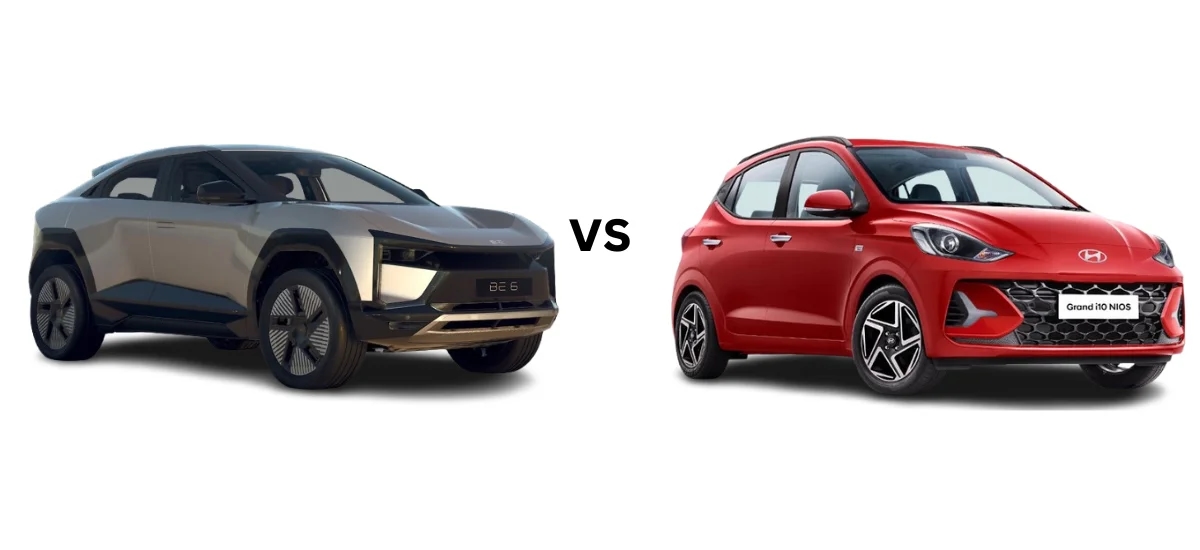


The modern automotive market is no longer defined by a single standard of value. Instead, it is shaped by contrasting priorities—premium experiences on one side and functional simplicity on the other. The Mahindra BE 6 and the Hyundai Grand i10 Nios illustrate this divide clearly. While one pushes the boundaries of what a car can offer, the other focuses on delivering exactly what is needed for everyday use.
This contrast raises an important question: do buyers need more, or just enough?
Redefining “Premium” in Modern Cars
In today’s automotive context, premium is no longer limited to luxury badges or high price points. It increasingly revolves around technology, experience, and innovation.
The Mahindra BE 6 reflects this shift. Its futuristic digital cockpit, dual 12.3-inch screens, and augmented reality heads-up display create a highly immersive driving environment. The integration of the MAIA AI system, capable of handling real-time processing and complex interactions, further enhances this experience.
In comparison, the Grand i10 Nios takes a more restrained approach. Its 8-inch touchscreen infotainment system, smartphone connectivity, and voice recognition features provide the essentials without adding unnecessary complexity.
The difference lies in intent: one aims to impress, the other to simplify.
Driving Experience: Refined vs Predictable
The BE 6 delivers a driving experience centred on refinement and performance. Its electric powertrain offers instant torque of 380 Nm, smooth acceleration, and near-silent operation. Features such as single-pedal driving, regenerative braking, and adaptive suspension systems further enhance comfort and control.
The Hyundai Grand i10 Nios, on the other hand, offers a predictable and familiar driving experience. Its 1.2L petrol engine, with 83 PS, is tuned for efficiency and ease of use. The availability of manual and AMT transmissions ensures flexibility for drivers with different preferences.
While the BE 6 emphasises refinement, the Nios prioritises ease and reliability.
Interior Experience: Immersion vs Practical Layout
Inside the BE 6, the focus is on creating a premium, immersive environment. The cabin includes:
- Ambient lighting with multiple modes
- Panoramic Infinity Roof
- 16-speaker Harman Kardon audio system with Dolby Atmos
These features transform the car into a space designed for experience, not just transportation.
The Grand i10 Nios adopts a more practical layout. It offers:
- Dual-tone interiors with ergonomic design
- Rear AC vents and adjustable seating
- Wireless charging and storage solutions
The focus here is on usability—ensuring that every feature serves a clear purpose.
Space and Dimensions: Expansion vs Efficiency
The BE 6, with its larger footprint and electric architecture, offers spacious interiors, a 455-litre boot, and an additional frunk. This allows it to function as both a family vehicle and a long-distance cruiser.
The Grand i10 Nios, with its compact dimensions (3,815 mm length), is optimised for urban environments. Its smaller size makes it easier to park, manoeuvre, and navigate through traffic.
This reflects two different philosophies: maximising space versus optimising efficiency.
Safety Approach: Advanced Intelligence vs Essential Assurance
Safety in the BE 6 is built around advanced systems. It includes:
- Level 2+ ADAS with multiple radars and sensors
- Driver monitoring systems and autonomous features
- Up to 7 airbags
These features create a comprehensive safety ecosystem that actively assists the driver.
The Grand i10 Nios focuses on foundational safety. It offers:
- 6 airbags as standard
- Electronic Stability Control (ESC) and Vehicle Stability Management (VSM)
- Rear parking camera and hill-start assist
While less complex, these systems provide dependable protection for everyday use.
Ownership Experience: Complexity vs Convenience
Premium vehicles often come with added complexity. The BE 6 requires charging infrastructure, familiarity with software, and a higher upfront investment. However, it also offers benefits such as lower running costs and reduced emissions.
The Grand i10 Nios, in contrast, is straightforward to own. It offers:
- Easy maintenance
- Wide service network
- Lower initial cost
For many buyers, this simplicity is a key advantage.
The Role of Digital Comparison
Online car-buying platforms such as ACKO Drive allow buyers to compare vehicles not just on specifications, but on how they fit into their lives before booking online.
In such comparisons:
- The BE 6 stands out for its premium features and advanced technology
- The Grand i10 Nios stands out for its practicality and ease of ownership
This helps buyers align their decisions with their priorities.
Conclusion
The Mahindra BE 6 and Hyundai Grand i10 Nios represent two distinct approaches to car design. One focuses on delivering a premium, technology-driven experience, while the other emphasises functional simplicity and everyday usability.
As the automotive market continues to evolve, these two philosophies are likely to coexist, offering buyers a choice between innovation and practicality.