







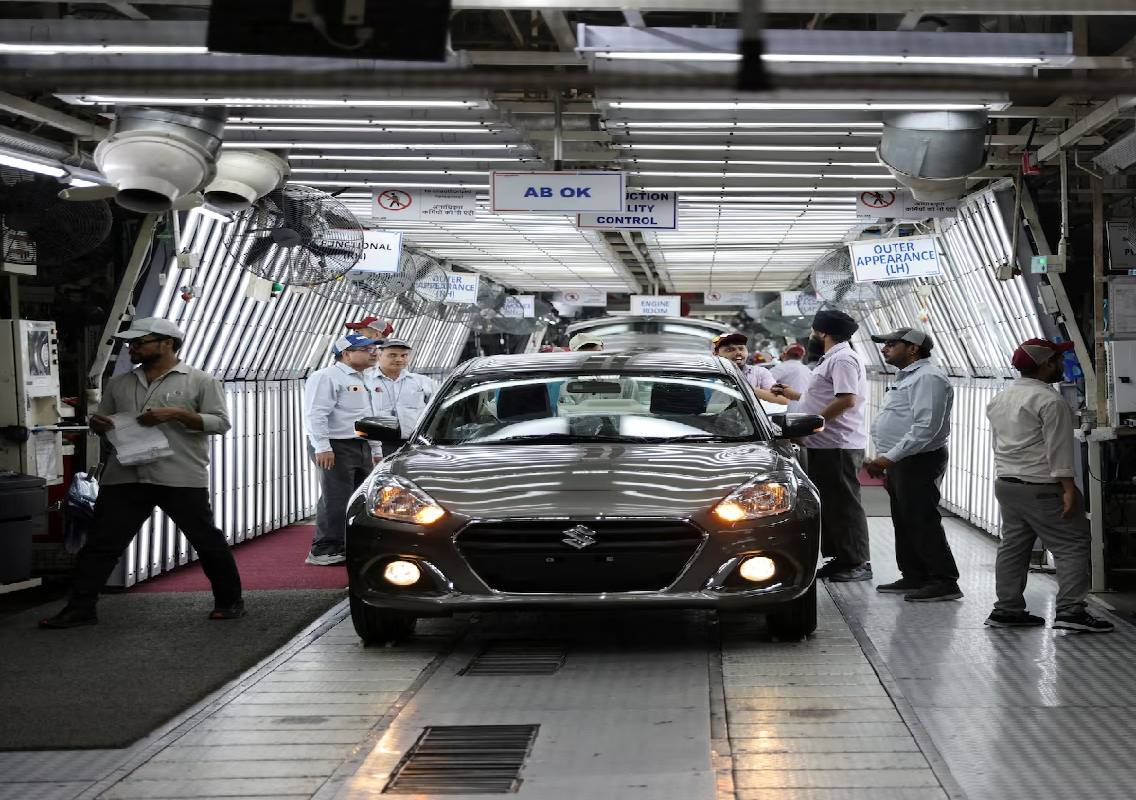


New Delhi: For decades, Maruti Suzuki dominated India’s passenger vehicle market by offering affordable, fuel-efficient and low-maintenance cars that became the first choice for millions of Indian families. However, shifting consumer preferences towards feature-rich sport utility vehicles (SUVs) are challenging the automaker’s long-standing dominance, forcing it to rethink its strategy in the world’s third-largest automobile market.
The company’s market share has declined to around 39 per cent, close to its lowest level, as rivals such as Tata Motors and Mahindra & Mahindra have capitalised on growing demand for premium features including sunroofs, larger infotainment systems, connected technology and advanced safety equipment.
From affordable hatchbacks to market leader
Maruti Suzuki built its reputation by focusing on affordability, reliability and low running costs.
For nearly four decades, hatchbacks produced by the company became synonymous with personal mobility in India, at one stage accounting for between half and four-fifths of all new passenger vehicle sales in the country. The strategy helped millions of first-time buyers own a car while establishing Maruti Suzuki as the country’s dominant automaker.
The company’s extensive dealer network, inexpensive spare parts and strong resale value further strengthened its position across urban and rural markets.
Buyers now want more features
The Indian car market has evolved significantly in recent years.
Younger consumers increasingly prefer SUVs and crossover vehicles that combine modern styling with premium features such as panoramic sunroofs, larger touchscreens, wireless connectivity, advanced driver assistance technologies and enhanced safety systems.
This shift has reduced the appeal of basic, no-frills hatchbacks that once formed the backbone of Maruti Suzuki’s success.
Industry competitors responded more quickly to these changing preferences, allowing them to gain market share among customers willing to spend more for additional comfort and technology.
Conservative approach delayed response
According to the Reuters report, Suzuki’s Japanese management initially resisted introducing several premium features because of concerns about higher costs and questions over their practical value for Indian customers.
The company was comparatively slow in adopting features such as sunroofs and other high-end equipment that had become increasingly popular among buyers.
The cautious approach reportedly led to internal discussions over how quickly the company should adapt to changing customer expectations while preserving its traditional emphasis on affordability.
Company steps up transformation
Recognising the shift in consumer demand, Maruti Suzuki has accelerated efforts to modernise its product portfolio.
The company is expanding research and development capabilities, giving greater decision-making authority to its Indian operations and introducing more premium SUVs equipped with features that appeal to younger buyers.
The strategy reflects a broader attempt to reposition the brand without abandoning its reputation for value and reliability.
Financial performance remains strong
Despite losing market share, Maruti Suzuki continues to report robust financial performance.
According to Reuters, the company generated approximately 19 billion US dollars in revenue and 1.5 billion US dollars in profit, demonstrating that it remains one of India’s strongest automobile manufacturers.
However, executives have acknowledged that the long-standing ambition of maintaining around half of India’s passenger vehicle market has become increasingly difficult as competition intensifies.
Road ahead
India’s passenger vehicle market continues to evolve rapidly as rising incomes, changing lifestyles and improving infrastructure encourage consumers to move towards larger and better-equipped vehicles.
For Maruti Suzuki, the challenge is balancing the affordability that built its success with the premium features now expected by a new generation of buyers.
The company’s ability to expand its SUV lineup, accelerate innovation and reshape customer perceptions will play a crucial role in determining whether it can regain market share while maintaining its leadership position in India’s highly competitive automobile industry.
Excerpt: Maruti Suzuki is adapting to changing consumer preferences as Indian buyers increasingly favour feature-rich SUVs over the affordable hatchbacks that built its dominance.
Tags: Maruti Suzuki SUV strategy India, Maruti Suzuki market share decline, Indian car market trends 2026, Maruti Suzuki premium vehicles, SUV demand in India
Meta title: Maruti Suzuki adapts as India’s SUV demand reshapes market
Meta description: Maruti Suzuki is revamping its strategy as Indian consumers increasingly choose feature-rich SUVs over traditional affordable hatchbacks.
Facebook hashtags:
#MarutiSuzuki #Automobile #SUV #AutoNews