







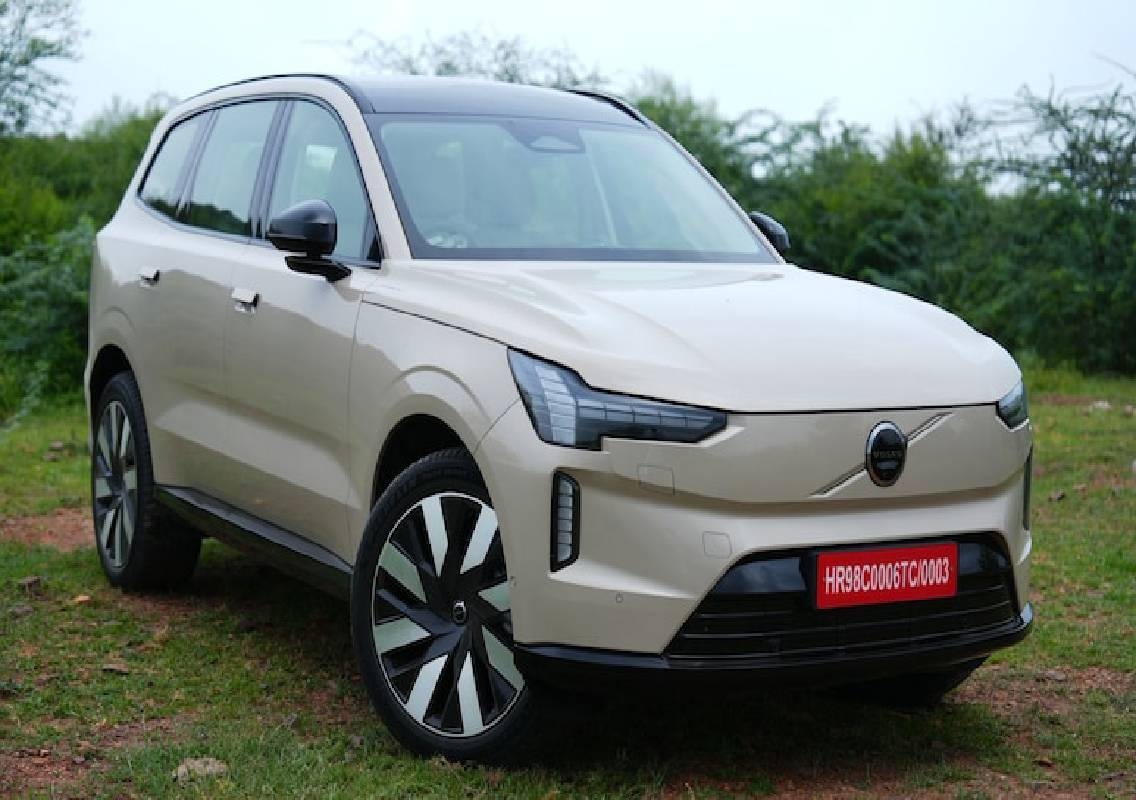


New Delhi: The Volvo EX90 marks a major shift in the Swedish carmaker’s approach to luxury electric SUVs, combining Scandinavian design, strong performance, advanced safety technology and a software-led architecture. Positioned as Volvo’s flagship electric SUV, the EX90 is set to make its India debut on October 12, 2026, alongside the ES90 electric sedan.
The EX90 is not simply an electric alternative to the Volvo XC90. It has been developed as a clean-sheet electric vehicle with a new platform and software-defined architecture. After spending time with the SUV, the first-drive experience suggests that Volvo has made a compelling technological leap, although its heavy reliance on digital controls comes with a few compromises.
Scandinavian design with a modern touch
The Volvo EX90 retains the understated styling that has become synonymous with the brand. Instead of relying on aggressive lines or excessive detailing, the SUV follows Volvo’s clean Scandinavian design philosophy.
The familiar Thor’s Hammer lighting signature has been reworked with adaptive pixel headlamp technology. Frameless exterior mirrors, a new rear-light design and aerodynamic alloy wheels give the SUV a contemporary appearance without making it look excessively styled.
At more than five metres long and with a 2,985 mm wheelbase, the EX90 has a substantial road presence. Its air suspension can increase ground clearance to as much as 250 mm when required, giving the electric SUV some additional versatility beyond urban driving.
A roof-mounted sensor module is another distinctive element. It forms part of the vehicle’s advanced safety technology and reinforces Volvo’s focus on sensor-based driver assistance.
Minimalist cabin puts technology first
The biggest change becomes evident once inside the EX90.
The cabin follows a minimalist design, but Volvo has taken the concept of digital controls considerably further. Most functions are accessed through a vertically mounted 14.5-inch touchscreen.
The touchscreen is used for several functions that traditionally have dedicated physical controls, including climate settings, mirror adjustment and other cabin functions. The system is designed to provide a clean dashboard layout, but the first-drive experience also highlights the potential drawbacks of putting so many controls behind a screen.
Some functions can be easier to operate through physical switches, particularly when driving. This is one area where the EX90’s technology-first philosophy may take some time for owners to adapt to.
The SUV also gets a 9-inch driver display, while a 25-speaker Bowers & Wilkins audio system and four-zone climate control add to its premium positioning.
Software-defined architecture
Software is at the heart of the EX90.
Volvo has designed the SUV as a software-defined vehicle, allowing several functions and systems to evolve through over-the-air updates rather than remaining fixed throughout the vehicle’s ownership period.
The approach means that the vehicle can potentially receive improvements and new functionality without requiring a conventional workshop visit for every update.
The EX90 also gets a 5G-enabled infotainment system with Google built-in, including services such as Google Maps and Google Assistant.
However, the extensive dependence on software also introduces a new consideration for luxury-car buyers.
During the first-drive experience, an attempt to unlock the vehicle using the supplied key card initially did not work despite repeated attempts. It eventually functioned, and this could have been an isolated incident, but the experience highlighted the importance of maintaining dependable physical alternatives when essential functions become heavily digitised.
Six-seat configuration for India
Unlike the XC90, the EX90 will be offered in India as a six-seater, with captain seats in the second row.
Volvo says the decision was influenced by customer feedback. The configuration provides greater space and comfort for second-row passengers and gives the cabin a more premium feel.
The third row, however, is better suited to children or shorter journeys. Adults may find the available space restrictive, particularly on longer trips.
Practicality remains one of the EX90’s strengths.
With the third row folded, boot capacity stands at 690 litres. Even with all six seats in use, the SUV retains 324 litres of luggage space. There is also a 46-litre front trunk, which can be useful for storing charging cables and smaller items.
Strong electric performance
The EX90 combines its large SUV dimensions with substantial electric performance.
For India, NDTV’s first-drive review reports a 106 kWh battery pack, producing 456 hp and 670 Nm through an all-wheel-drive system. Volvo claims a 0-100 km/h acceleration time of 5.5 seconds for this version.
Despite weighing close to 2.7 tonnes, the EX90 does not feel excessively heavy from behind the wheel.
Power delivery is smooth and progressive rather than aggressively immediate. This makes the SUV comfortable in city traffic while retaining enough performance for highway overtaking.
Four driving modes — Range, Standard, Performance and Off-road — allow the character of the vehicle to be adjusted. Drivers can also alter steering weight, suspension settings and regenerative braking according to their preferences.
Comfortable seats and reassuring handling
The seats provide good lateral support while offering enough cushioning for longer journeys.
Steering feedback is also reassuring for a large luxury electric SUV. The braking system feels progressive and inspires confidence despite the vehicle’s substantial weight.
The ride quality, however, is not as plush as some buyers might expect from a flagship luxury SUV.
Even with the suspension in its softest setting, larger potholes and broken road surfaces can transmit noticeable firmness into the cabin. The ride is not uncomfortable, but buyers expecting an exceptionally soft and cushioned experience may find the EX90 slightly firmer than anticipated.
Safety remains a key Volvo strength
Safety continues to be an important part of Volvo’s identity, and the EX90 uses an extensive range of sensors and technology to support its driver-assistance systems.
The roof-mounted sensor module is part of the SUV’s advanced safety architecture. The EX90’s technology-focused platform also allows Volvo to improve vehicle functions through software updates over its lifecycle.
The model is therefore designed around the idea that a modern luxury vehicle should not remain technologically static after purchase.
India launch and positioning
Volvo Cars India has confirmed that the EX90 will launch in India on October 12, 2026, alongside the ES90. The EX90 will sit at the top of Volvo’s electric SUV range in the country.
The India-specification SUV is expected to compete in the premium electric SUV space, where buyers increasingly expect a combination of performance, technology, luxury and long-distance usability.
The EX90’s combination of three-row practicality, all-wheel drive, strong performance and advanced software gives it a distinctive proposition.
Its six-seat layout also makes it particularly relevant for buyers who prioritise second-row comfort rather than maximum passenger capacity.
A glimpse of Volvo’s electric future
The EX90 represents a broader change in Volvo’s product strategy.
Rather than simply replacing a conventional SUV’s engine with an electric powertrain, Volvo has redesigned the vehicle around electric propulsion, connected technology and software.
That approach is evident in almost every aspect of the EX90, from its minimalist exterior and touchscreen-heavy cabin to its over-the-air update capability and advanced sensor suite.
However, the vehicle also demonstrates that technological ambition can create compromises. The extensive reliance on digital controls may not appeal to buyers who prefer conventional switches, while the ride could be softer for Indian road conditions.
Verdict
The Volvo EX90 is an ambitious flagship electric SUV that combines a restrained Scandinavian design with impressive performance, extensive technology and practical six-seat accommodation.
Its 456 hp all-wheel-drive powertrain provides strong acceleration, while the large battery, spacious cabin and multiple driving modes make it suitable for a range of driving conditions. The 690-litre boot with the third row folded further strengthens its practicality.
At the same time, Volvo’s software-first approach is both the EX90’s biggest attraction and one of its potential weaknesses. The 14.5-inch touchscreen gives the cabin a clean appearance, but putting so many functions behind a digital interface may not suit every driver.
Conclusion:
The Volvo EX90 is more than an electric successor to the XC90. It represents Volvo’s vision of a software-defined luxury SUV, combining strong performance, Scandinavian design, advanced technology and family-friendly practicality. With its India launch scheduled for October 12, the EX90 will be an important addition to Volvo’s premium EV portfolio.