







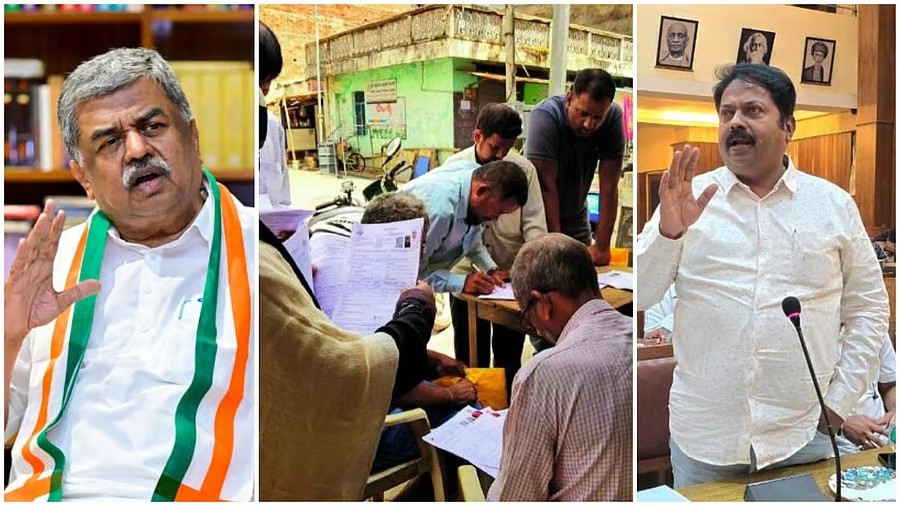


Belagavi: Belagavi South BJP MLA Abhay Patil on Friday denied Karnataka Pradesh Congress Committee (KPCC) president B K Hariprasad’s allegation that he had sought the deletion of more than 2,500 voters belonging to the minority community from the electoral rolls.
Patil said his letter to the returning officer only sought verification of objections raised by Booth Level Assistants-2 (BLA-2) against suspected voters during the Special Intensive Revision (SIR) of electoral rolls.
“I have not named any community,” Patil said while speaking to reporters in Belagavi.
The controversy follows allegations by Hariprasad that Patil had written to election authorities seeking deletion of around 2,500 names. Hariprasad had also displayed a copy of the purported letter and said the Congress would approach the Election Commission over the issue.
Patil says letter sought verification, not direct deletion
Patil said the letter referred to objections submitted by BLA-2s to Booth Level Officers (BLOs) after the publication of the draft electoral roll following the SIR exercise.
According to him, BLA-2s had identified suspected voters and submitted objections to the concerned BLOs. The BLOs were then required to verify the objections, including through door-to-door verification, before taking any action.
Patil said names were to be deleted only if verification established that the voters were fake.
He said several suspected voters had been identified across all 260 polling booths in Belagavi South. As an example, he cited a house where 50 voters were listed, saying such entries required verification.
The issue has emerged amid a broader dispute in Belagavi over alleged bulk objections to voter names during the SIR process. In one recent incident, a BLO reportedly refused to sign around 200 Form-7 applications seeking deletion of names. Belagavi Deputy Commissioner Mohammed Roshan said no names had been deleted based on those objections and that the administration would examine the matter.
‘BLA-2s did not submit objections in bulk’
Patil maintained that BLA-2s had submitted objections whenever they encountered suspected voters and had not submitted them collectively without verification.
He said the responsibility of the BLOs was to conduct field verification and establish whether the names on the electoral roll belonged to genuine voters.
“I have only asked the returning officer to verify the names based on objections submitted by BLA-2s and have not sought their direct deletion,” Patil said.
He also said he had served as an MLA for four terms and was aware of the legal procedure governing electoral rolls.
Responding to Hariprasad’s warning that legal action could be initiated against him, Patil said he was prepared to face any case.
“I shall not file any case against him and shall not stoop to such low level,” he said.
Patil rejects allegation of targeting a community
Patil rejected the allegation that his letter specifically targeted members of a particular community.
He said the letter did not mention Muslims or any other community and maintained that the focus was on verification of suspected entries.
“We do not want Rohingya, Bangladeshi or Pakistani voters in our list,” he said, while reiterating that suspected names should be verified before any deletion.
Hariprasad, however, had alleged that the names targeted for deletion belonged to minority voters and questioned the basis on which such names had been flagged. He had demanded action and said the Congress would submit a complaint to the Election Commission.
The competing claims have not been independently resolved, and the Election Commission or other competent authorities would have to establish whether any objections were improperly submitted or whether the electoral roll procedures were violated.
Patil questions SIR process in Belagavi
Patil also raised questions about the implementation of the SIR process in Belagavi.
Referring to Public Works Department Minister and district in-charge minister Satish Jarkiholi’s description of the SIR process as a model in the district, Patil pointed to what he said were names of deceased voters appearing in the draft electoral roll.
He said he had written to the returning officer in his capacity as a BLA-1 seeking verification of voters.
According to Patil, Belagavi City Corporation Commissioner and Returning Officer Kartik M did not properly understand his letter and responded that objections could not be raised in bulk.
Patil said he subsequently submitted a consolidated report based on objections received from BLA-2s.
Allegations over verification of voter forms
Patil further claimed that BLOs had submitted names of suspected fake voters for deletion after verification but that the process was subsequently stopped because of government pressure.
He also alleged that a large number of voter forms were submitted without proper verification during the final stage of the process.
These claims have not been independently established. The controversy is currently centred on the manner in which objections were submitted and verified during the SIR exercise.
The recent Belagavi dispute has already prompted calls for an inquiry. The district administration has said it would examine complaints concerning bulk objections and take action according to the rules if violations were established.
Patil to approach Election Commission
Patil said complaints against the District Election Officer, Returning Officer and Assistant Returning Officer would be submitted to the Election Commission in New Delhi on September 29 or 30.
He also accused Hariprasad of making allegations for publicity and said that, being a long-time political leader, the KPCC president should be aware of the electoral roll revision process.
Patil’s remarks came a day after Hariprasad publicly alleged that the BJP MLA had sought deletion of around 2,500 voters and released documents in support of his claim. The Congress has said it would approach the Election Commission, while Patil has maintained that his letter only sought verification of objections against suspected voters.
The dispute is now set to move to the Election Commission, where the contents of the letter, the objections submitted by BLA-2s and the verification process followed by election officials can be examined.