


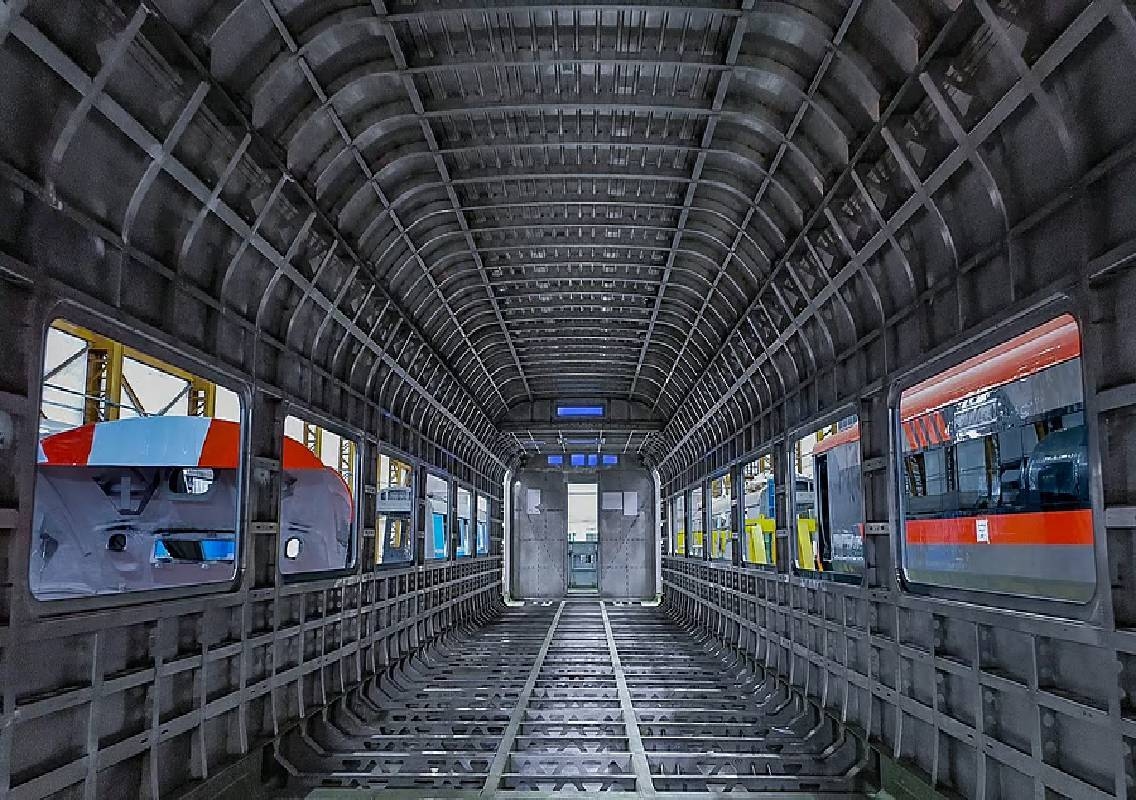


Bengaluru: Union Railway Minister Ashwini Vaishnaw on November 1 inspected the manufacturing progress of India’s first indigenously developed high-speed bullet train at Bharat Earth Movers Limited’s (BEML) manufacturing facility in Bengaluru. The train, designated B-28, is being developed for the Mumbai-Ahmedabad High-Speed Rail Corridor.
During his visit to BEML’s Aditya manufacturing facility at Tippasandra, the Minister reviewed production activities, quality-control procedures and passenger amenities. He expressed satisfaction with the progress and said the manufacturing process was advancing well, with particular attention being given to quality and international standards. Indigenous bullet train takes shape at BEML
The B-28 is being jointly developed by BEML and Integral Coach Factory (ICF), Chennai. The project marks an important step towards strengthening India’s domestic capabilities in high-speed train manufacturing.
During the inspection, Vaishnaw reviewed specialised manufacturing infrastructure, including precision-engineered jigs and fixtures used for carbody fabrication. He also observed different stages of production, including underframe fabrication, sidewall and roof assembly, final carbody integration, surface preparation and treatment.
The Minister inspected the manufacturing of side and roof modules and their integration into the final assembly. He also reviewed passenger seating arrangements and important onboard systems, including heating, ventilation and air-conditioning (HVAC), couplers and other equipment.
BEML’s facility is equipped to handle the specialised manufacturing requirements of high-speed trains, where precision, structural strength and quality control are critical.
Squeeze test checks structural strength
One of the important aspects of the inspection was the demonstration of the squeeze test, a quality-assurance procedure used to assess the structural strength and stability of the train’s carbody.
The test subjects the train structure to controlled compressive and tensile forces to examine its rigidity, strength and dimensional stability.
Vaishnaw highlighted the importance of maintaining atmospheric pressure inside the coaches when trains operate at very high speeds. He said testing was being conducted at loads of up to 1,500 kilonewtons to ensure the structure meets the required standards.
The Minister said the major components were being manufactured, integrated and tested, with quality receiving particular attention throughout the process.
Train designed for speeds of up to 280 kmph
The indigenous B-28 bullet train is being developed with a maximum test speed of 280 kmph and a proposed operational speed of approximately 249 kmph.
The eight-coach trainset will measure around 202 metres in length and accommodate approximately 557 passengers. Its configuration will include seven standard-class coaches with 3×2 seating and one executive-class coach with 2×2 seating.
The train will also have four motor cars and four trailer cars. Two trainsets can be coupled to form a 16-coach configuration to accommodate future passenger requirements.
Designed for Indian operating conditions, the train will feature an intelligent onboard control system, passenger information displays in English, Hindi and regional languages, automated announcements and emergency communication facilities.
Other passenger amenities include ergonomic seating, wide windows, LED lighting, overhead luggage racks, charging points and bio-digester toilets. A Wi-Fi-based infotainment system is also planned.
Accessibility and safety features
The B-28 train has been designed with accessibility and passenger convenience in mind. It will feature level boarding, retractable footsteps and wheelchair-friendly doors to make entry and exit easier for passengers with reduced mobility.
Dedicated seating and toilets for persons with disabilities, along with Braille-enabled signage, are also part of the design.
The train will operate using a 25 kV AC traction system and incorporate regenerative braking technology to improve energy efficiency.
Its aerodynamic design has been developed using computational fluid dynamics simulations. The design aims to reduce air resistance, turbulence, tunnel pressure waves and noise during high-speed operations, contributing to a smoother passenger experience.
First train expected to reach testing stage in 2027
According to reports, the train’s design has been completed and it has cleared an important squeeze test. The next stages include integrating interior furnishings and testing the train under different climatic conditions.
BEML has also developed a dedicated testing track at its Bengaluru facility. The train is expected to undergo initial testing there before being moved to the Surat depot for further trials on longer tracks.
Vaishnaw indicated that the first train could reach the tracks around April or May 2027. The first section of the Mumbai-Ahmedabad High-Speed Rail Corridor, between Surat and Bilimora, is targeted for completion by August 15, 2027.
Bengaluru plays a key role in India’s high-speed rail ambitions
BEML’s Bengaluru manufacturing facility is expected to play an important role in India’s efforts to develop indigenous high-speed railway technology.
The B-28 project combines domestic engineering, specialised manufacturing and modern passenger amenities. Its development is also expected to strengthen the country’s manufacturing ecosystem for future high-speed rail projects.
The inspection by the Railway Minister comes as work continues on both the train manufacturing programme and the Mumbai-Ahmedabad corridor. Once completed and tested, the indigenous trainsets will form part of India’s first bullet train service.