







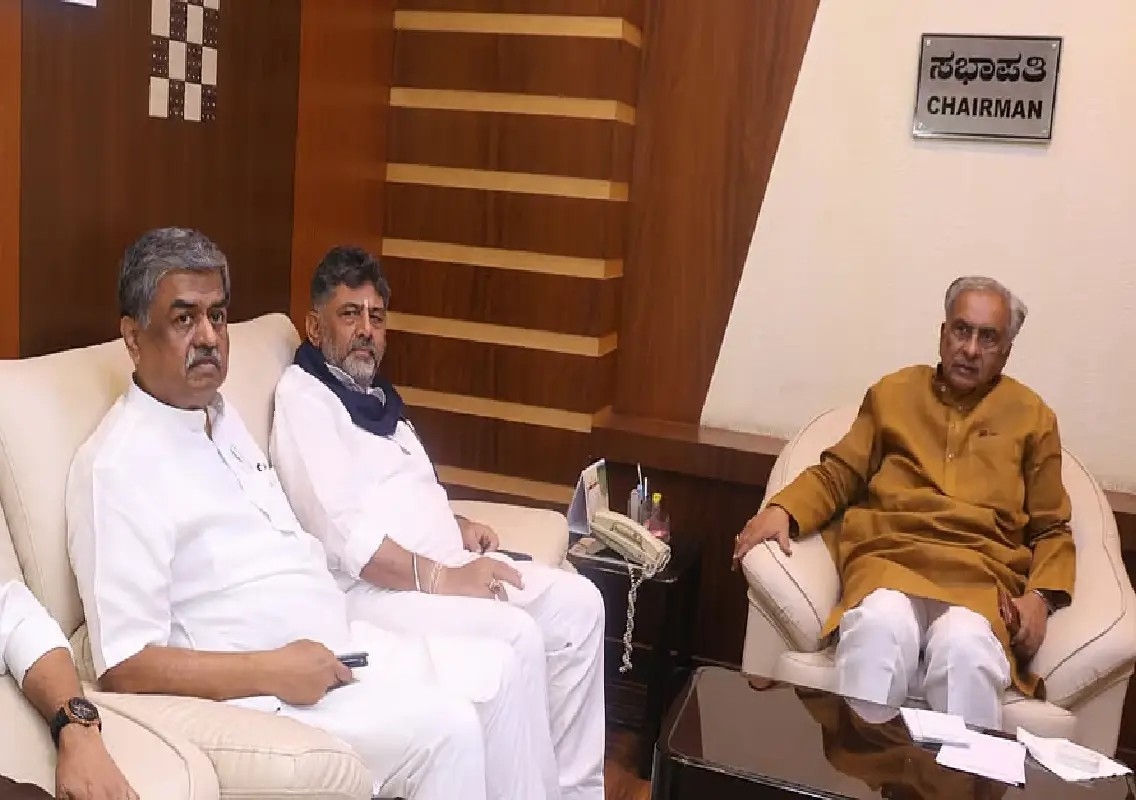


Bengaluru: Karnataka Legislative Council chairman Basavaraj Horatti resigned from his post on Friday after the ruling Congress threatened to move a no-confidence motion against him.
Horatti, a senior BJP leader, confirmed that his resignation had been accepted following a meeting with Chief Minister D K Shivakumar. He said he stepped down after being asked to do so by the ruling party, but added that he was not aware of the specific reason behind the decision.
The resignation is expected to clear the way for the Congress to take control of the chairperson’s post in the Legislative Council.
Horatti says he was asked to resign
Speaking after tendering his resignation, Horatti said he had decided to step down after being instructed to do so.
“I was asked to resign, so I tendered my resignation,” he said, while adding that he did not know why he had been asked to quit.
The development follows a political confrontation over the leadership of the Upper House. Horatti had faced the possibility of a no-confidence motion if he refused to resign.
He had already indicated on Thursday that he was prepared to step aside, paving the way for the Congress to nominate one of its legislators for the post.
CM Shivakumar held talks with Horatti
Horatti had earlier said that Chief Minister D K Shivakumar had spoken to him twice over the phone regarding his resignation.
According to Horatti, Shivakumar subsequently called him for a personal meeting on Wednesday and conveyed that the Congress high command had directed him to resign as Council chairman.
Horatti said the Chief Minister also told him that the ruling party would move a no-confidence motion if he refused to step down.
The BJP leader’s decision to resign has now avoided a direct floor test against the chairman.
Congress prepares to take charge
The resignation is significant for the Congress as the party has already selected its candidates for the top positions in the Legislative Council.
Senior Congress lawmaker Saleem Ahmed has been named as the party’s nominee for the chairperson’s post.
Former minister Umashree has been nominated for the deputy chairperson’s position.
The nominations indicate that the Congress is preparing to install its nominees in both key positions in the Upper House.
The change in leadership comes amid continuing political contestation between the ruling Congress and the Opposition BJP in Karnataka.
No-confidence motion threat
The immediate political trigger for Horatti’s resignation was the threat of a no-confidence motion.
Horatti had said on Thursday that the ruling party wanted him to resign and that he had been informed that a no-confidence motion would be moved if he refused.
His decision to quit means the Congress does not have to pursue that process against the chairman.
The resignation also brings an end to the immediate uncertainty surrounding the leadership of the Council, although the election of the new chairperson will determine the next phase of the political contest.
Horatti’s long political career
Horatti is a veteran Karnataka politician who has served in the Legislative Council for several decades.
His resignation from the chairman’s post comes despite his continued position as a senior BJP leader and member of the Upper House.
The circumstances surrounding his exit have therefore attracted attention within Karnataka’s political circles.
By stepping down rather than facing a no-confidence motion, Horatti has brought the immediate leadership dispute to a close.
However, his statement that he was not aware of the reason for being asked to resign could keep the political discussion alive.
Congress eyes Upper House leadership
With Horatti’s resignation accepted, the Congress is now positioned to seek the chairperson’s post through its nominee Saleem Ahmed.
The party has also named Umashree for the deputy chairperson’s position, signalling its intention to strengthen its control over the functioning of the Legislative Council.
The appointments will be important for the ruling party as the Council remains a key forum for legislative debate, scrutiny of government policies and Opposition interventions.
The transition is also likely to be closely watched by the BJP, which will move into the Opposition role in the Council’s leadership structure.
Political implications
The change at the top of the Legislative Council comes at a time when the Congress government and BJP have frequently clashed over political and legislative issues in Karnataka.
Horatti’s resignation demonstrates how the balance of support within the Council can influence the leadership of the Upper House.
For the Congress, securing the chairperson’s position will provide an opportunity to have its nominee preside over proceedings. For the BJP, Horatti’s departure marks the loss of an important position held by one of its senior leaders.
The next step will be the formal process for choosing the new chairperson and deputy chairperson.
For now, Horatti’s resignation has removed the immediate threat of a no-confidence motion and opened the way for the Congress to install its nominees in the Council’s top positions.