









Bengaluru: When you moved from Mumbai (then Bombay) to Bengaluru (then Bangalore) in the late 1980s, it was for a better quality of life — and for about a decade, that promise held true. The city was greener, quieter, and far easier to navigate.
In those days, the drive from Indiranagar to Chowdaiah Memorial Hall — the hub of most cultural events — took barely 20 minutes. Bengaluru had fewer events than Mumbai, but it was possible to attend all of them without battling traffic.
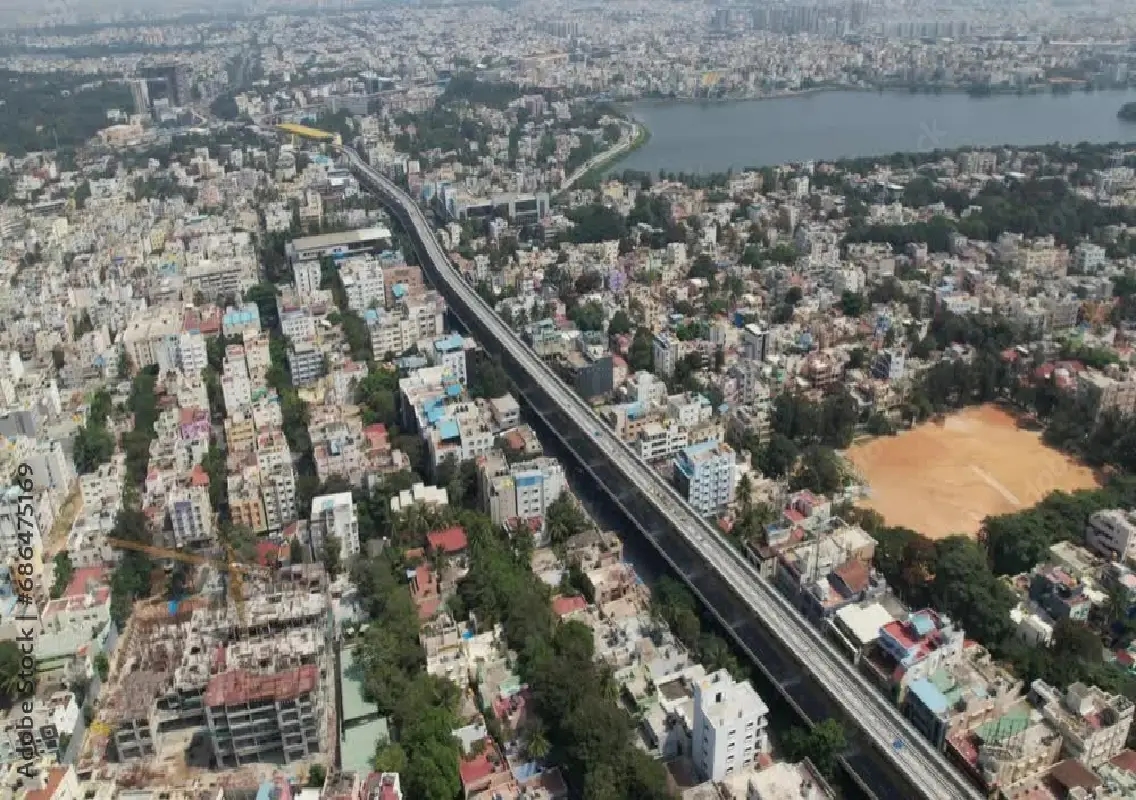
Today, the city has many more venues and far more cultural vibrancy, yet reaching any of them takes at least an hour. Convenience has been replaced by congestion, and what was once a charming, liveable city has morphed into a chaotic, sprawling urban expanse.
The cost of uncontrolled growth
Bengaluru’s population has grown exponentially — from under 40 lakh in 1988 to nearly 1.44 crore in 2025, according to the Karnataka Directorate of Economics and Statistics. It is projected to reach 1.47 crore by 2031. That means over one crore people have arrived in less than four decades — but without matching planning or infrastructure.
This unplanned growth has left the city struggling to provide even basic amenities. The question is not just how this happened, but who was responsible.
Political instability and lack of governance
Since 1988, Karnataka has had 19 chief ministers, some serving for less than a year. The state has also been under President’s Rule four times. All major political parties have governed at different points, but instability, infighting, and dissidence have often taken precedence over governance.
Successive governments have created numerous task forces of bureaucrats, industry leaders, and experts to address the city’s problems. Yet, little seems to have improved. Coordination among civic agencies remains minimal, with departments frequently undoing one another’s work.
Urban planning gone astray
The Bangalore Development Authority (BDA), once meant to ensure planned growth, has long since lost control. Its flagship Nadaprabhu Kempegowda Layout (NPKL) continues to face criticism for lack of basic amenities. Even older BDA layouts are overcrowded, with residential and commercial structures mushrooming on plots meant for single-family homes.
The state government has recently approved six new BDA layouts along Peripheral Ring Road-2, but land acquisition hurdles are expected to delay progress. Meanwhile, the private sector — particularly real estate developers and IT companies — has driven Bengaluru’s rapid, chaotic sprawl.
Much of this development has occurred on unconverted agricultural land, a practice that has persisted as governments “turned a blind eye,” as State Revenue Minister Krishna Byre Gowda acknowledged earlier this year.
From farmlands to concrete corridors
Neighbourhoods that were once rural have been transformed beyond recognition. Areas around Sarjapur Road, Hosur Road, and Kaikondrahalli are now lined with gated communities, educational institutions, sports clubs, and commercial establishments. Even abandoned quarries have become housing complexes.
Traffic jams now choke roads that were once village lanes. According to government data, Bengaluru Urban district has around 13,000 acres of illegal revenue layouts, which should have yielded at least 6,000 acres of public amenities like roads and parks — land that never materialised.
Environmental stress and vanishing lakes
The rapid urbanisation has overwhelmed civic systems. Many new developments are outside the reach of the Bangalore Water Supply and Sewerage Board (BWSSB), relying instead on borewells and private water tankers. Sewage and industrial waste frequently flow into lakes and wetlands, worsening pollution.
Despite an annual Rs 35 crore lake rejuvenation budget, maintaining Bengaluru’s lakes remains an uphill battle. Ironically, while the government has sanctioned Rs 80 crore for one high-profile lake, citizen-led initiatives like the Puttenahalli Neighbourhood Lake Improvement Trust have been forced to withdraw due to bureaucratic hurdles.
Crumbling roads and misplaced priorities
Bengaluru’s traffic jams are legendary, but they are just one symptom of a deeper malaise. Cracked roads, missing footpaths, piles of garbage, and haphazard parking plague both the old city and the new extensions.
The government’s typical response has been to announce massive white-topping projects, even though many such roads deteriorate quickly. The state recently allocated Rs 4,000 crore to white-top 500 km of roads and another Rs 2,296 crore for “development works” — efforts critics say are more cosmetic than structural.
Public transport still lagging
With over 1.2 crore private vehicles on Bengaluru’s roads and nearly 5.5 lakh new registrations every year, public transport is struggling to keep up.
The Bangalore Metropolitan Transport Corporation (BMTC) operates about 6,851 buses, carrying 40 lakh passengers daily. While 100 new buses have been promised, frequency and coverage gaps persist, especially in outlying areas.
Metro connectivity, though expanding, remains patchy. Fourteen years after the first 6.7 km line opened, the Namma Metro now spans 97 km and serves over 10 lakh commuters daily — a fraction of the city’s potential. The suburban rail project, first proposed in 1983 and formally approved in 2020, has barely advanced, with work resuming only recently after contractor disputes.
Governance in flux
The government’s latest solution is the creation of the Greater Bengaluru Authority (GBA), intended to replace the Bruhat Bengaluru Mahanagara Palike (BBMP) with five regional corporations. However, the new system has been criticised for being top-heavy and politically driven, involving ministers and MPs whose roles differ from those of elected corporators.
Crucially, Bengaluru has not had corporation elections for over five years, leaving it without an accountable local government. Experts warn that the Constitution’s 74th Amendment, which mandates empowered urban local bodies, continues to be sidelined — a root cause of the city’s civic distress.
Waiting for a turnaround
From a once-green, well-planned town to a chaotic mega-city, Bengaluru’s transformation tells a story of unchecked expansion, fragmented governance, and misplaced priorities. Yet, its citizens continue to adapt and hope.
Whether the new governance models, infrastructure projects, and policy interventions can restore some of Bengaluru’s lost liveability remains to be seen. For now, the city continues to watch, wait, and hope.