







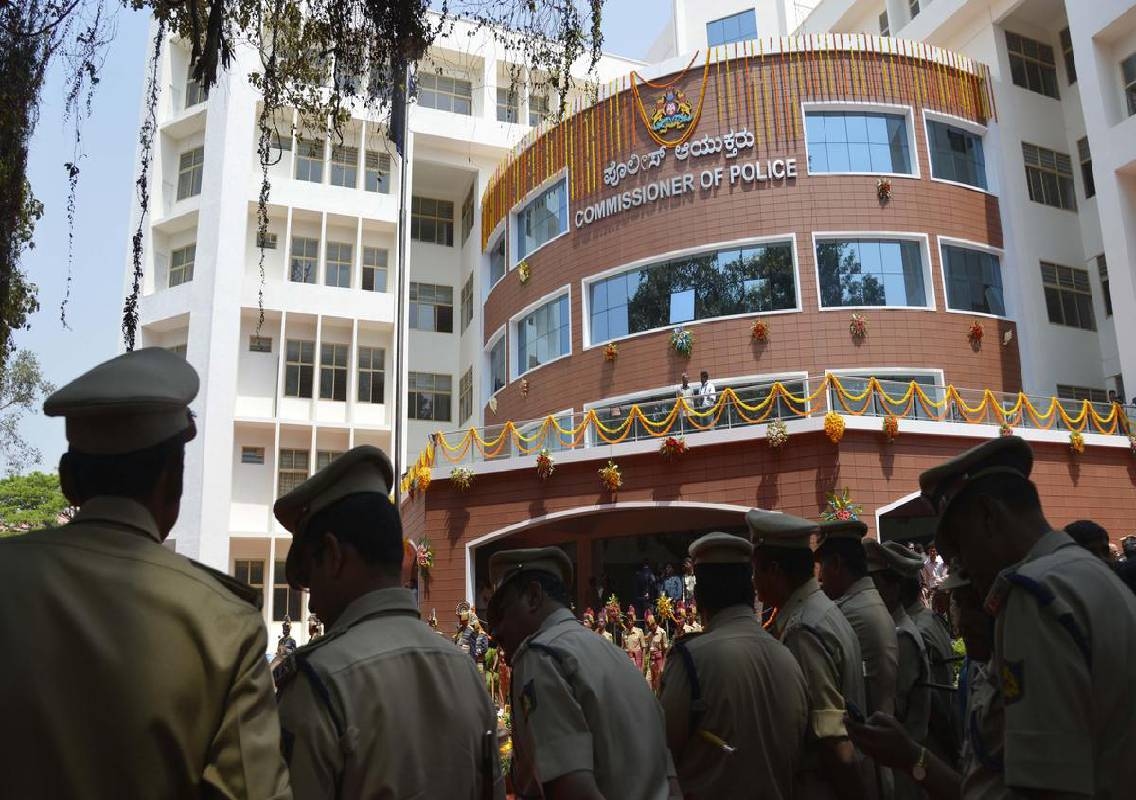


Bengaluru: The Karnataka Cabinet has approved the restructuring of Bengaluru’s police commissionerate into five separate commissionerates — Central, East, West, North and South — in a major overhaul aimed at improving law and order, crime control and traffic management in the rapidly expanding city.
The existing post of Bengaluru Police Commissioner will be upgraded to Chief Commissioner of Police (CCP), under whom the five new commissioners will function. The Cabinet has also approved 1,022 new police posts for the restructuring, while additional personnel will be redeployed from the existing force.
The decision comes after months of discussion over the proposal to divide Bengaluru’s single commissionerate. The plan broadly follows the five-corporation structure created under the Greater Bengaluru Authority (GBA).
Bengaluru police to be divided into five units
Under the approved arrangement, Bengaluru will have five police commissionerates covering Central, East, West, North and South.
Each commissionerate will be headed by a police commissioner of Inspector General of Police (IGP) or Deputy Inspector General of Police (DIG) rank. All five commissioners will report to the Chief Commissioner of Police.
The restructuring is intended to bring police administration closer to the city’s expanding population and geographical spread.
Home Minister Priyank Kharge said the move was aimed at improving response time, crime control, law and order and traffic management in Bengaluru, which has a population of around 1.56 crore.
The existing Bengaluru commissionerate currently has 11 divisions, 116 police stations and 53 traffic police stations.
1,022 new posts approved initially
The Cabinet has approved the creation of 1,022 new posts as part of the first phase of the restructuring.
The government has estimated that the complete five-commissionerate system would require around 6,550 additional personnel. Since creating the entire requirement immediately would involve a much larger financial commitment, the remaining manpower needs will be met through redeployment of personnel from the existing police force.
In addition, 276 personnel have been sanctioned for 11 existing police stations, including stations located on the outskirts of Bengaluru.
The government plans to undertake recruitment, establish new police stations and deploy personnel in phases.
Six new ACP posts for traffic management
The restructuring also includes changes at the assistant commissioner level.
Six new Assistant Commissioner of Police (ACP) posts will be created as part of the traffic management arrangements. Each ACP office will receive five new executive posts.
The existing Joint or Additional Commissioner of Police (Traffic) post will also be redesignated as Commissioner of Police (Traffic) under the new structure.
The government expects the additional administrative structure to help deal with Bengaluru’s growing traffic congestion and the increasing policing requirements associated with the expansion of the city.
New Chief Commissioner will supervise five commissioners
One of the most significant features of the proposal is the creation of the Chief Commissioner of Police post.
The existing Bengaluru Police Commissioner will be upgraded to the CCP position and will supervise the five regional commissioners.
This differs from the current structure, where a single city police commissioner heads the Bengaluru commissionerate and reports through the existing state police hierarchy.
The five regional commissioners will handle their respective jurisdictions, while the CCP is expected to provide overall coordination.
A new City Armed Reserve unit will also be created for the East commissionerate by redeploying personnel from existing CAR units.
Former police officers raise concerns
While the need to decentralise policing in a city as large as Bengaluru has received support from some retired police officers, the proposed command structure has also attracted criticism.
Retired DGP and IGP S.T. Ramesh supported dividing Bengaluru into smaller commissionerates but questioned the need for a Chief Commissioner above the five commissioners.
He argued that Bengaluru could be divided into smaller commissionerates for more effective policing without creating a separate “super” commissioner or DGP-level post to coordinate them.
Ramesh also said that Bengaluru’s police structure need not necessarily mirror the civic structure of the Greater Bengaluru Authority because the functions of the police and civic administration are fundamentally different.
Another former DGP suggests two commissionerates
Retired DGP D.V. Guruprasad expressed a different view, questioning the need for five commissionerates altogether.
He suggested that Bengaluru could instead have two police commissionerates — Central Bengaluru and Outer Bengaluru.
According to him, having too many commissionerates could create challenges involving jurisdiction and coordination. At the same time, he acknowledged that smaller units could improve supervision from a policing perspective.
The differing views underline the debate over whether the proposed five-unit model will simplify policing or create additional layers of administration.
Proposal follows Greater Bengaluru Authority model
The police restructuring is closely linked to the reorganisation of Bengaluru’s civic administration.
The Greater Bengaluru Authority replaced the earlier BBMP structure with five city corporations. The police proposal seeks to broadly align police jurisdictions with this new civic arrangement.
The government has argued that better alignment between civic and police boundaries could improve coordination, particularly when dealing with traffic, law and order and other issues requiring cooperation between multiple government agencies.
The proposal had originally been prepared by Bengaluru Police Commissioner Seemant Kumar Singh and envisaged five regional commissionerates under a Chief Commissioner of Police.
Earlier proposal required over 6,600 posts
The original restructuring proposal was considerably larger than the first phase now approved by the Cabinet.
The August proposal envisaged 6,633 new posts and an estimated expenditure of about Rs 765 crore.
The proposed manpower distribution was different across the five commissionerates, reflecting differences in population, geographical size and policing requirements. East Bengaluru was projected to require the largest number of additional personnel.
The Cabinet’s current decision to approve 1,022 new posts, combined with redeployment of existing personnel, represents a phased approach to implementing the restructuring.
Bengaluru’s growing policing challenges
The move comes against the backdrop of Bengaluru’s rapid expansion.
The city’s policing jurisdiction has grown considerably from the area covered when the Bengaluru commissionerate was established in 1963. The proposal cited the city’s expanding population, rising crime and cybercrime, traffic congestion and the concentration of IT hubs, government offices, courts and other major public institutions as reasons for restructuring.
A single commissionerate covering such a large metropolitan area can place considerable administrative demands on senior officers.
The government believes that dividing the city into smaller units will allow senior police officers to focus more closely on local law and order, crime prevention and traffic management.
Implementation will take place in phases
The Cabinet approval does not mean that all five commissionerates will immediately become fully operational with the complete proposed manpower strength.
The government has sanctioned the first batch of new posts and plans to supplement them through redeployment.
Recruitment processes, the creation or reorganisation of police stations and phased deployment of personnel will follow.
The restructuring will therefore require coordination within the police department as jurisdictions, administrative responsibilities and staffing patterns are reorganised.
The effectiveness of the new system will ultimately depend on how clearly responsibilities are divided between the five commissioners and the Chief Commissioner.
Conclusion
The Karnataka Cabinet has approved the division of Bengaluru’s police commissionerate into five units — Central, East, West, North and South — under a Chief Commissioner of Police.
The Cabinet has approved 1,022 new posts in the first phase, with additional manpower to be provided through redeployment. Six new ACP posts will also be created to strengthen traffic management.
While the government expects the restructuring to improve policing, response times and coordination, former police officers have raised questions about whether five commissionerates and a Chief Commissioner will create an unnecessarily complex command structure. The system will now be implemented in phases.