







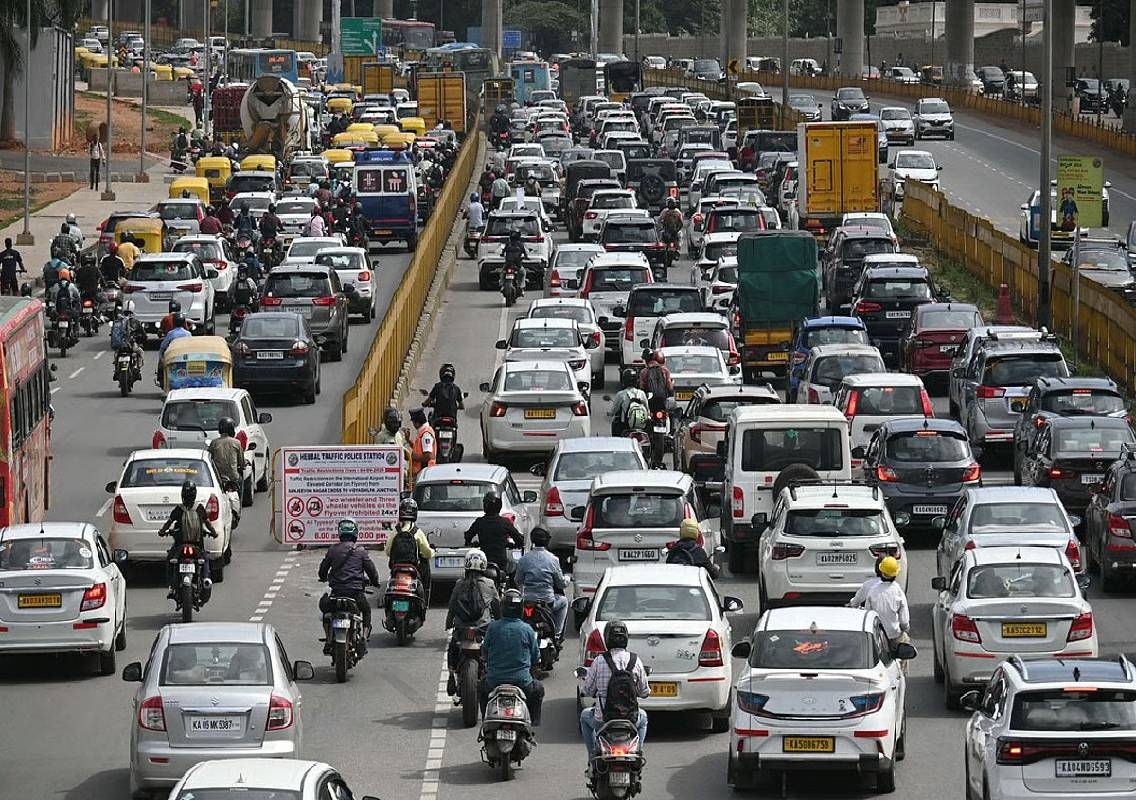


Bengaluru: Honking on Bengaluru’s roads appears to have become more of a habit than a response to immediate safety concerns, according to a survey conducted by citizen volunteer group Beautiful Bharat.
The survey, conducted as part of the organisation’s ‘Let’s Hear the Birds Chirp Again’ campaign around World Deaf Day, found that only around 30% of respondents associated honking with alerting others to danger or pointing out incorrect driving. More than half linked the behaviour to habit, impatience, frustration and aggressive driving.
The findings have renewed attention on noise pollution in Bengaluru, where frequent honking has become a familiar feature of daily traffic.
97% call excessive honking a major problem
The survey covered 259 respondents from different age groups in Bengaluru.
An overwhelming 97% of those surveyed said excessive honking was a very big problem in the city. A similar proportion also believed commuters had considerable scope to reduce the frequency with which they use their horns.
The campaign was intended to draw attention to the growing levels of traffic noise and its potential impact on people’s health and quality of life.
Odette Katrak, founder of Beautiful Bharat and an Environment and Sustainability Changemaker, said the organisation had first highlighted the issue in 2016. She observed that the soundscape of Bengaluru had changed considerably over the years, with vehicle horns increasingly replacing quieter urban sounds.
Habit and impatience drive much of the honking
One of the key findings of the survey was the reason people use their horns.
Only about three in 10 respondents said honking was primarily connected with safety alerts or highlighting dangerous or incorrect driving.
More than half associated it with habitual behaviour, including automatically honking at traffic signals, impatience while waiting in traffic, frustration and aggressive driving.
This suggests that a substantial amount of honking may not necessarily be linked to an immediate road-safety requirement.
Bengaluru’s heavy traffic and frequent congestion can create situations where motorists spend considerable periods waiting at junctions. The survey indicates that such conditions can also contribute to impatient or reflexive use of vehicle horns.
Many respondents see horns as safety devices
The survey also highlighted a contradiction in motorists’ attitudes towards honking.
While many respondents acknowledged that excessive use of horns was a problem, 68% said they believed they could drive safely if their vehicle’s horn stopped working because they considered it an important safety device for vehicle occupants.
This indicates that motorists continue to view the horn as an important part of road safety even as concerns grow over excessive and unnecessary use.
A vehicle horn can serve a legitimate purpose by warning another road user about an immediate hazard. The survey, however, focuses on situations where the horn is used repeatedly or without a specific safety reason.
Awareness of health impact remains limited
The survey found that awareness about the possible health effects of prolonged exposure to traffic noise was relatively low.
More than half of respondents said they were not aware of a direct connection between exposure to high levels of honking and medical or mental health concerns.
The survey organisers used the findings to highlight concerns about hearing health and noise exposure.
Katrak said the survey was intended to draw attention to the possibility of hearing damage associated with excessive exposure to loud vehicle horns. The report also cited the organisation’s concern that people in India experience hearing loss earlier than people in quieter countries.
However, the survey itself is based on respondents’ perceptions and awareness and does not establish a medical cause-and-effect relationship for Bengaluru’s population.
92% see impact on community well-being
The survey also asked respondents about the broader impact of excessive honking.
Around 92% said they believed excessive honking could negatively affect the well-being of a community.
Noise from vehicles can affect not only drivers but also pedestrians, roadside workers, residents, shopkeepers and people living near busy junctions.
The issue can become particularly noticeable in densely populated parts of Bengaluru, where traffic congestion, commercial activity and residential areas frequently exist alongside one another.
The survey’s findings therefore point towards noise pollution as a wider urban issue rather than one limited to motorists.
Education and traffic management suggested
Respondents were also asked what could be done to reduce unnecessary honking.
Most suggestions centred on greater public education and awareness, along with improved traffic management.
The survey report suggested that better coordination between traffic police and hospitals could also help increase awareness about the health effects associated with prolonged exposure to high levels of traffic noise.
Such measures could focus on helping motorists distinguish between necessary safety-related honking and habitual use of horns.
Traffic management can also play a role because congestion and delays are among the conditions that contribute to frustration and impatient driving.
Bengaluru’s traffic noise remains a concern
The survey comes amid continuing discussions about traffic-related issues in Bengaluru.
The city’s roads see heavy vehicle movement throughout the day, with motorists frequently navigating congested junctions, construction zones and crowded corridors.
Recent traffic-related incidents have also raised questions about how technology and enforcement systems are being used on the city’s roads. The New Indian Express recently reported a case in which an AI-powered traffic camera allegedly mistook a guitar carried by a scooter rider for a pillion passenger and issued a helmet-related challan.
While that incident concerns automated enforcement rather than noise pollution, it reflects the wider range of traffic-related challenges facing Bengaluru.
For the honking issue, the survey’s organisers are calling for behavioural change rather than simply greater enforcement.
Conclusion
A survey of 259 Bengaluru residents has found that excessive honking is widely perceived as a major urban problem, with 97% of respondents describing it as a very big concern.
Only around 30% associated honking mainly with safety alerts or incorrect driving, while more than half linked it to habits, impatience, frustration and aggressive driving. The survey also found that 92% believed excessive honking could affect community well-being.
Beautiful Bharat has called for greater awareness and better traffic management to reduce unnecessary honking. The findings offer a snapshot of public perceptions, while wider research and medical evidence would be needed to establish the precise health impact of traffic noise on Bengaluru’s population.