







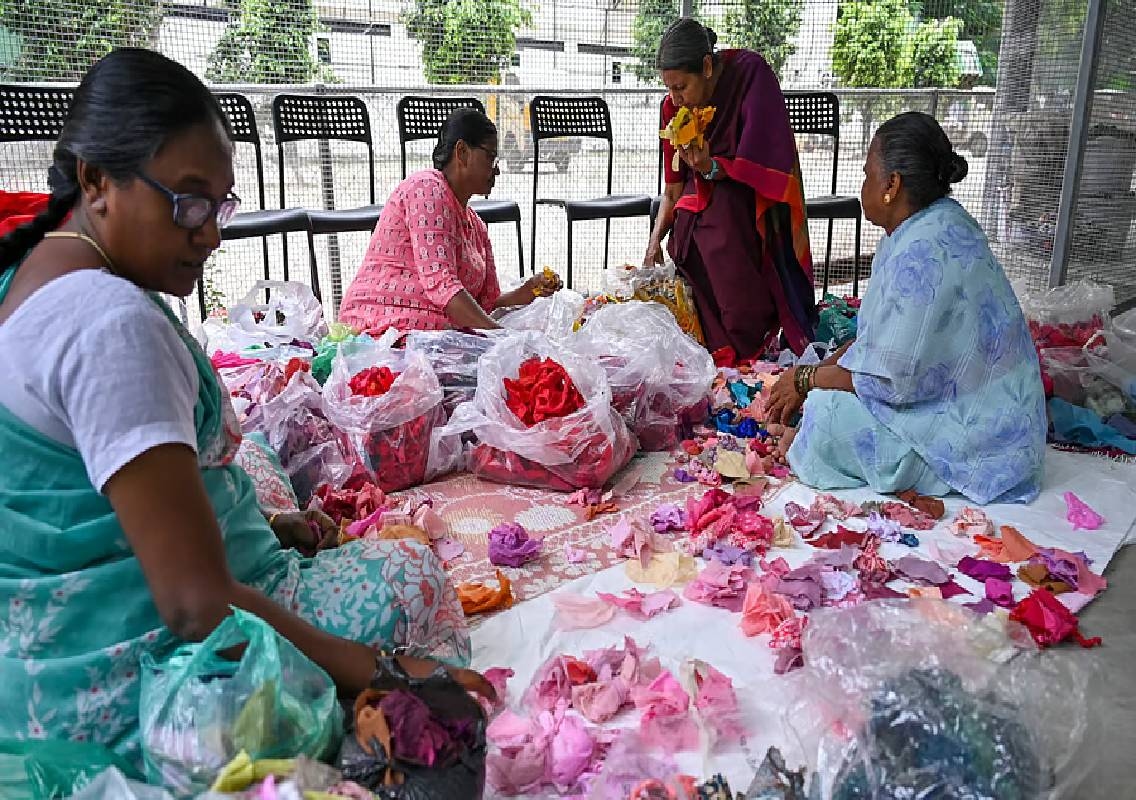


Bengaluru: A textile recovery facility in Bengaluru is giving discarded clothes a second life by sorting, repairing, reselling, recycling and upcycling garments that might otherwise end up in landfills. The initiative is creating a circular system for textile waste while also generating livelihood opportunities for waste-picker communities.
The Textile Recovery Facility (TRF) at Hirandahalli was established in August 2024 under the Saamuhika Shakti initiative, with support from the Circular Apparel Innovation Factory (CAIF), an Intellecap initiative, and Hasiru Dala. The facility was started by Indumathi, a waste picker who became a waste entrepreneur, and has since developed into a hub for textile recovery and circular-economy activities.
From discarded clothes to usable material
Textile waste collected across Bengaluru is brought to the facility through Dry Waste Collection Centres (DWCCs), institutions, individuals and community collection drives.
Instead of treating all discarded clothing as waste, workers at the facility examine each item and sort it according to its type, quality, colour and condition. This determines what happens to the material next.
Clothes that remain in good condition can be directed towards resale. Garments requiring minor repairs are refurbished, while textiles unsuitable for direct reuse can be channelled towards recycling, upcycling or other applications.
This sorting process is important because textile waste contains materials with different levels of recovery potential. Separating them at the facility allows more material to be retained within the value chain instead of being sent directly to landfill.
Technology helps identify textile fibres
The facility has also introduced technology to improve the accuracy of textile sorting.
It uses a textile identification device known as Matoha, which helps workers identify fibre blends and material composition. Knowing the composition of a discarded garment can help determine the most appropriate recovery route and improve the chances of matching materials with suitable buyers or processors.
The approach reflects a broader shift in waste management, where discarded materials are increasingly being viewed as potential resources rather than simply refuse.
Repair and reuse come before recycling
One of the important features of the Bengaluru facility is its focus on reuse before recycling.
A dedicated refurbishment unit allows workers to repair and restore garments that can still be worn. Clothes in suitable condition are also made available through Navajeevana, a thrift store operating within the facility.
The garments can be sold directly to customers or through pop-up thrift events organised in different parts of Bengaluru. This gives usable clothing another opportunity to enter the market instead of becoming waste.
The model also demonstrates that textile recovery does not necessarily begin with breaking down the material. Extending the life of an existing garment through repair and resale can be another pathway for reducing waste.
Thousands of kilograms of textiles recovered
The initiative has expanded its collection network through a hub-and-spoke model, with the Textile Recovery Facility functioning as the hub and 16 Dry Waste Collection Centres serving as collection points.
According to information published by Saamuhika Shakti, the wider Closing the Loop on Textile Waste programme had diverted around 5.76 lakh kg of textile waste from landfills by September 2025. The network collected more than 30 metric tonnes of textile waste in January 2025 and crossed 51 metric tonnes in a single month in April 2025.
The collection system has also expanded beyond conventional waste channels, with textiles being sourced from educational institutions, housing societies, hostels, community drives and other organisations.
Lower-quality textiles also find new uses
Not every discarded garment can be repaired or sold.
Textiles that have limited resale potential can still be directed towards other applications. The facility has developed market linkages for materials such as polyester and blended textiles, which can be used for industrial applications.
According to Saamuhika Shakti, bulk sales of recovered polyester and blended textiles have included materials being sent to buyers in Coimbatore and Tiruppur for applications such as filler and building materials.
Other recovered textiles can be converted into products such as industrial wipes, depending on their quality and material characteristics.
This approach helps ensure that different categories of discarded textiles have different recovery pathways.
Women from waste-picker families gain opportunities
The textile recovery model also has a livelihood component.
Through a collaboration with the Sambhav Foundation, the facility has explored a Skills-as-a-Service model in which post-consumer textile waste is supplied to trained women from waste-picker families.
The women use tailoring and related skills to transform discarded textiles into finished products based on orders from upcyclers.
The model links textile recovery with skill development and income generation, while giving women from waste-picker communities opportunities to participate in different parts of the circular textile economy.
Waste pickers at the centre of the model
A key feature of the Bengaluru initiative is its emphasis on involving waste-picker communities rather than treating them only as collectors of discarded materials.
Indumathi’s journey from waste picker to waste entrepreneur is central to the model. The facility provides infrastructure, sorting systems and market connections that allow waste-picker communities to participate in a more organised recovery process.
The facility has also worked with free-roaming waste pickers and supported them in collecting textile waste from their communities.
According to Saamuhika Shakti, one waste picker, Anitha, mobilised her community and collected more than 2.3 metric tonnes of textile waste after engaging with the facility.
Bengaluru’s textile waste challenge
The initiative comes against the backdrop of growing concern over textile waste and the environmental impact of discarded clothing.
Clothing and other textiles can take considerable time to break down when disposed of in landfills. Synthetic fibres can also persist in the environment, while the production of new garments requires raw materials, energy and water.
Recovering textiles for reuse, recycling or other applications can reduce the amount of material going to landfill and extend the useful life of resources already in circulation.
However, establishing a sustainable textile-recovery system requires reliable collection, accurate sorting, processing capacity and markets for recovered materials.
The Bengaluru facility is attempting to address these different stages through a single recovery ecosystem.
Building a circular textile economy
The facility’s approach is based on the principle of keeping materials in use for as long as possible.
Higher-quality clothing can enter resale and thrift channels. Garments requiring repair can be refurbished. Materials unsuitable for reuse can be recycled, upcycled or supplied for industrial applications.
This diversification is also important from a business perspective. The facility has explored multiple revenue streams rather than depending entirely on one market for recovered textiles.
The model therefore combines environmental objectives with livelihood generation and market-based recovery.
Citizens can play a role
The success of textile recovery ultimately depends on how discarded clothing is handled at the household level.
Residents can contribute by separating unwanted clothes and other textiles from general waste and directing them towards appropriate collection systems.
The Saamuhika Shakti initiative has encouraged citizens to use its network of 16 DWCCs or the Textile Recovery Facility in Hirandahalli for textile waste disposal. Collection drives have also been organised in collaboration with institutions and community organisations.
Separating textiles at source makes subsequent sorting and recovery easier and reduces the likelihood of reusable material being contaminated by wet or mixed waste.
Conclusion
Bengaluru’s Textile Recovery Facility at Hirandahalli is demonstrating how discarded clothing can be diverted from landfills and channelled into reuse, repair, resale, recycling and upcycling. Supported by organisations including CAIF and Hasiru Dala, the facility also places waste-picker communities at the centre of its circular textile model.
With a network of 16 DWCCs, specialised textile sorting, refurbishment, thrift sales and market linkages for recovered materials, the initiative is creating an alternative pathway for clothing that would otherwise be treated as waste. Its focus on livelihoods alongside environmental recovery also highlights how Bengaluru can build a more inclusive circular economy around discarded textiles.