









Bengaluru: A social media post by a Bengaluru resident comparing the city’s nightlife with Ahmedabad has sparked a lively online debate about public spaces, safety and the changing urban culture of India’s technology capital.
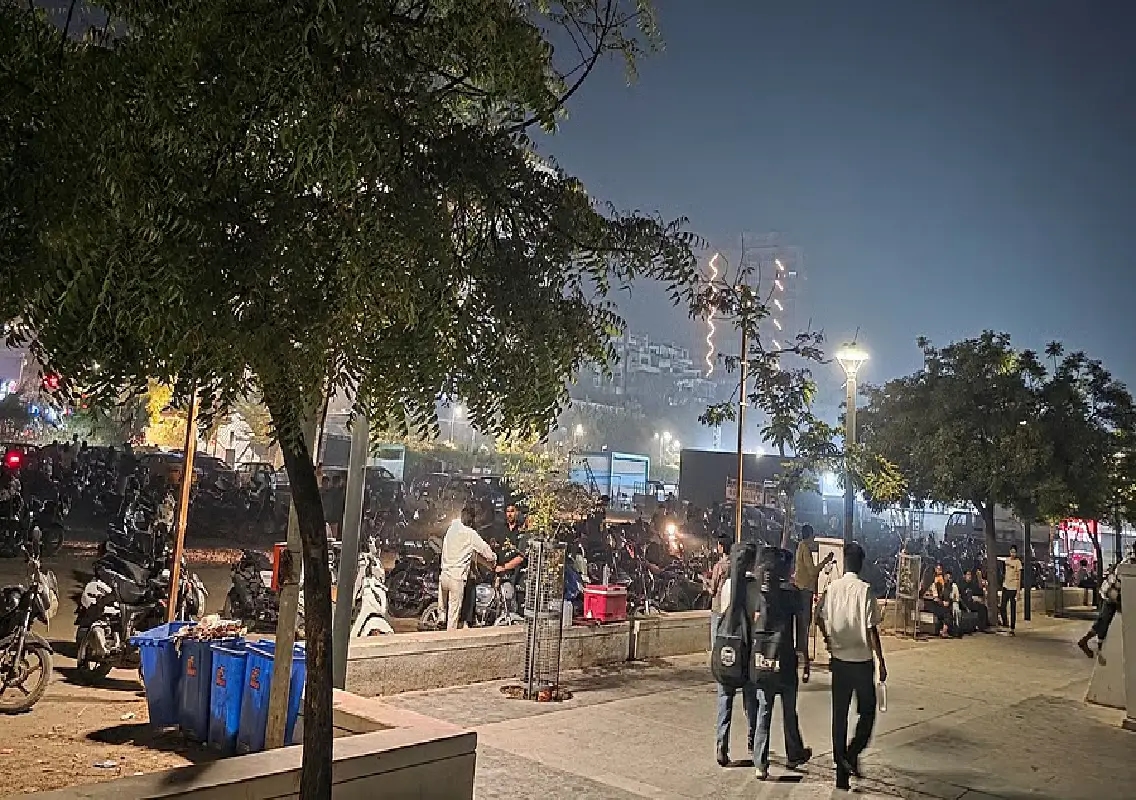
The discussion began when Kartik Kannan shared photographs on X (formerly Twitter) showing a lively plaza in Ahmedabad at around 1 am, where people could be seen walking, socialising and enjoying the late-night atmosphere.
Praising the city’s vibrant ambience, Kannan wrote that Ahmedabad was “buzzing for 1 AM with a very festive feel”. However, he also expressed disappointment that Bengaluru lacks a similar central space where people can gather and spend time comfortably late at night.
“I wish we had a place in Bangalore where we could walk out at midnight around a central place without police breathing down your neck,” he wrote in the post.
Online conversation on nightlife and public spaces
Kannan’s post quickly gained traction on social media and triggered a wide-ranging discussion among users about urban design, nightlife culture and safety in Indian cities.
Several users praised Ahmedabad for its safe and relaxed environment. Many commented that the city offers a family-friendly nightlife atmosphere where people can spend time outdoors even late at night.
One user wrote that they had visited Ahmedabad multiple times and found it to be a safe and calm city where families and individuals could enjoy public spaces without disturbances.
Another user noted that the city appears lively throughout the night with numerous places open for food and social gatherings even after midnight.
Some social media users also suggested that Ahmedabad’s prohibition on alcohol may have contributed to a safer and more controlled nightlife environment.
Bengaluru residents defend the city
While many users appreciated Ahmedabad’s nightlife, several others defended Bengaluru, arguing that the city still has vibrant areas where people gather late into the night.
Some users pointed to popular locations such as Church Street, which remains a well-known hub for nightlife, restaurants and late-night hangouts.
“Come to Church Street,” one user responded, suggesting that the area still offers a lively environment for people seeking late-night social spaces.
Others said that Bengaluru continues to have active nightlife districts despite increased regulations and policing in recent years.
Nostalgia for Bengaluru’s earlier nightlife
The conversation also sparked nostalgia among long-time residents who recalled the city’s nightlife during earlier decades.
Some users pointed out that Brigade Road once served as a central late-night destination where people could walk, dine and socialise well past midnight.
“Brigade Road used to be that place, buzzing with life at 1 AM. Not quite sure how it is now,” one user commented.
Others observed that rapid urbanisation, increasing traffic and stricter law enforcement measures have gradually changed the character of the city’s nightlife over time.
Debate reflects larger urban planning questions
Urban planners and civic observers note that the discussion reflects a broader issue faced by many growing Indian cities — the need for well-designed public spaces where people can gather safely at all hours.
Public plazas, pedestrian-friendly zones and late-night activity hubs are increasingly seen as important elements of modern urban life.
Such spaces can promote social interaction, tourism, local business activity and a sense of community while ensuring safety through good planning and infrastructure.
Growing interest in people-friendly urban spaces
The online debate has highlighted a growing interest among city residents in creating inclusive and accessible public spaces.
Many participants in the discussion emphasised the importance of designing cities where people can comfortably walk, relax and socialise even during late hours.
While opinions differed on whether Bengaluru already offers such spaces, the conversation underscored the desire among many residents for more pedestrian-friendly areas that encourage community interaction.
As cities continue to expand and evolve, discussions like these reflect changing expectations about urban life and the role of public spaces in shaping a city’s identity and culture.