







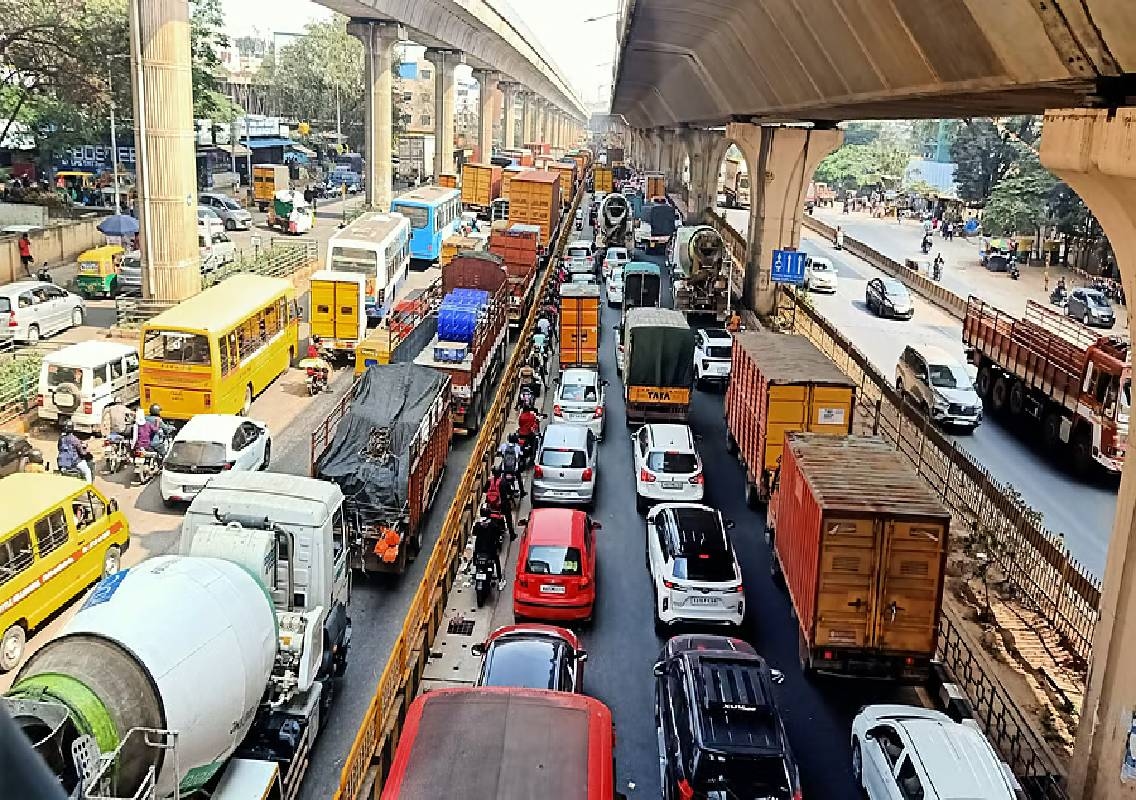


Bengaluru: Residents and traffic authorities have stepped in to address the persistent traffic bottleneck around Nallurhalli in east Bengaluru, where damaged roads, growing vehicle movement and ongoing infrastructure work have contributed to difficult commuting conditions.
The Nallurhalli-Whitefield area has been under increasing traffic pressure as residential communities, offices, schools and commercial establishments have expanded around the eastern technology corridor. Citizens have repeatedly raised concerns about road conditions and congestion, while authorities have been attempting short-term measures alongside larger infrastructure projects.
The latest community-led intervention reflects growing frustration among residents who say that waiting for major infrastructure projects to be completed is not enough to address immediate problems on roads used every day by thousands of commuters.
Residents join efforts to improve traffic movement
Community participation has emerged as an important part of efforts to tackle local traffic problems in the Nallurhalli area.
Residents have previously highlighted potholes, damaged road surfaces, inadequate footpaths, drainage problems and bottlenecks as major obstacles to smooth movement. Similar civic concerns have been raised repeatedly across Whitefield and surrounding neighbourhoods as traffic volumes have increased.
Recent reports from the area have also highlighted how poor road conditions can worsen congestion. Traffic police and residents had earlier worked together on temporary repairs along stretches affected by severe congestion in east Bengaluru. The immediate objective was to make damaged portions more usable and prevent vehicles from becoming stuck at critical points.
The approach is significant because even relatively small obstructions can create long queues on roads with limited carriageway space. A stalled vehicle, pothole or damaged stretch can quickly reduce the effective road width and affect traffic over a much larger area.
Nallurhalli faces long-standing infrastructure pressure
The traffic problems around Nallurhalli are not new. The locality has been identified for years as an area requiring improvements to roads and junctions.
Bengaluru’s Revised Master Plan has identified Nallurhalli Main Road and Borewell Road among roads requiring widening or upgrading. It has also identified several junctions in the Whitefield planning district for improvements, including Nallurhalli Junction and the intersection of Nallurhalli Main Road with other connecting roads.
The planning documents also recognise the pressure created by the concentration of residential development and employment centres in the area. The Whitefield planning district includes major technology and industrial employment zones, while its road network serves both local traffic and vehicles travelling towards other parts of Bengaluru.
This combination has placed substantial pressure on roads that were originally designed for much lower traffic volumes.
Poor roads add to congestion
Road conditions have become a major concern for commuters using the Nallurhalli-Whitefield corridor.
Earlier reports from the area have documented potholes, open manholes, poor patchwork and damaged internal roads. Residents have said that these conditions have made some stretches difficult to navigate, particularly for two-wheelers.
A 2025 report noted that residents of several Whitefield apartment complexes had complained about the deteriorating Pattandur Agrahara Road and problems with underground drainage. Residents said that repeated roadwork had failed to provide a lasting solution, while leaking underground drainage continued to damage road surfaces.
Such problems can have a direct impact on traffic. Vehicles slow down to negotiate potholes and damaged sections, reducing road capacity during already busy periods.
Traffic problems also affect pedestrians
The challenges around Nallurhalli are not restricted to motorists.
The area around Nallurhalli Metro station has previously faced pedestrian-safety concerns because of changes to the road layout and construction activity. In 2024, commuters were reported to be crossing busy stretches of road to access the station after part of the carriageway was closed for work.
The situation highlights the importance of designing traffic solutions for pedestrians as well as vehicles.
With the Nallurhalli Metro station serving residents and employees in the surrounding technology corridor, pedestrian movement needs to be coordinated with traffic management, road construction and public transport access.
Community action comes as east Bengaluru expands
The Nallurhalli bottleneck is part of a wider infrastructure challenge facing east Bengaluru.
Areas around Whitefield, Varthur, Gunjur, Mahadevapura and Sarjapur have experienced rapid residential and commercial development. Apartment complexes and technology offices have increased the number of daily trips, while several road and drainage projects have struggled to keep pace.
Traffic congestion has also become more visible in neighbouring corridors. Recent problems on the Gunjur-Varthur stretch, for instance, led to severe delays for school buses and prompted traffic police and residents to identify damaged portions requiring immediate attention.
The wider problem is therefore not simply a question of traffic enforcement. Road capacity, drainage, junction design, pedestrian infrastructure and construction coordination all influence how effectively traffic can move.
Need for immediate and permanent solutions
Community-led repair and traffic-management measures can provide immediate relief, but residents are likely to continue seeking permanent improvements.
The Greater Bengaluru Development administration has recently directed officials to adopt both short-term and long-term approaches to infrastructure problems in eastern Bengaluru. During a review of the Sarjapur Road-Dommasandra-Gunjur-Varthur-Balagere corridor, officials were instructed to address potholes, waterlogging and traffic bottlenecks immediately while simultaneously working on permanent solutions.
Officials have also been asked to examine road widening, land requirements, drainage connections, electricity poles and junction modifications. The emphasis is on coordinating different infrastructure works so that road projects are not repeatedly disrupted by other civic works.
Such coordination will be important for Nallurhalli as well, where roads serve several residential and commercial developments while also carrying traffic towards Whitefield and major employment centres.
Community participation puts pressure on authorities
The involvement of residents also demonstrates how civic groups have increasingly become active in highlighting Bengaluru’s infrastructure problems.
Citizen groups in Whitefield have previously used public campaigns, videos and demonstrations to draw attention to damaged roads, drainage problems, traffic congestion and inadequate pedestrian facilities.
In one earlier campaign, residents highlighted the poor condition of roads connecting Siddapura and Nallurhalli and called for road widening, repairs, footpaths and better drainage. The complaints reflected concerns that had accumulated as traffic volumes increased over several years.
The latest intervention indicates that residents are increasingly willing to participate in immediate solutions while continuing to demand accountability from civic agencies.
Nallurhalli needs coordinated infrastructure planning
The long-term solution to the Nallurhalli bottleneck will require more than patching damaged road surfaces.
Road improvements need to be accompanied by effective drainage, pedestrian facilities, junction redesign, traffic enforcement and coordination with Metro and other infrastructure projects.
The area’s continued development also means that future road capacity needs to be considered while approving or expanding residential and commercial developments.
For commuters, however, the immediate priority remains simple: roads that are usable, predictable traffic movement and safer access for pedestrians.
Conclusion
The community’s involvement in addressing the Nallurhalli traffic bottleneck highlights the growing role of residents in responding to Bengaluru’s infrastructure challenges. While temporary repairs and traffic-management measures can ease immediate congestion, the area needs sustained investment in roads, drainage, junctions and pedestrian infrastructure.
As east Bengaluru continues to expand as a residential and technology hub, coordinated planning and timely execution of civic works will be essential to prevent local bottlenecks from becoming larger traffic problems.