


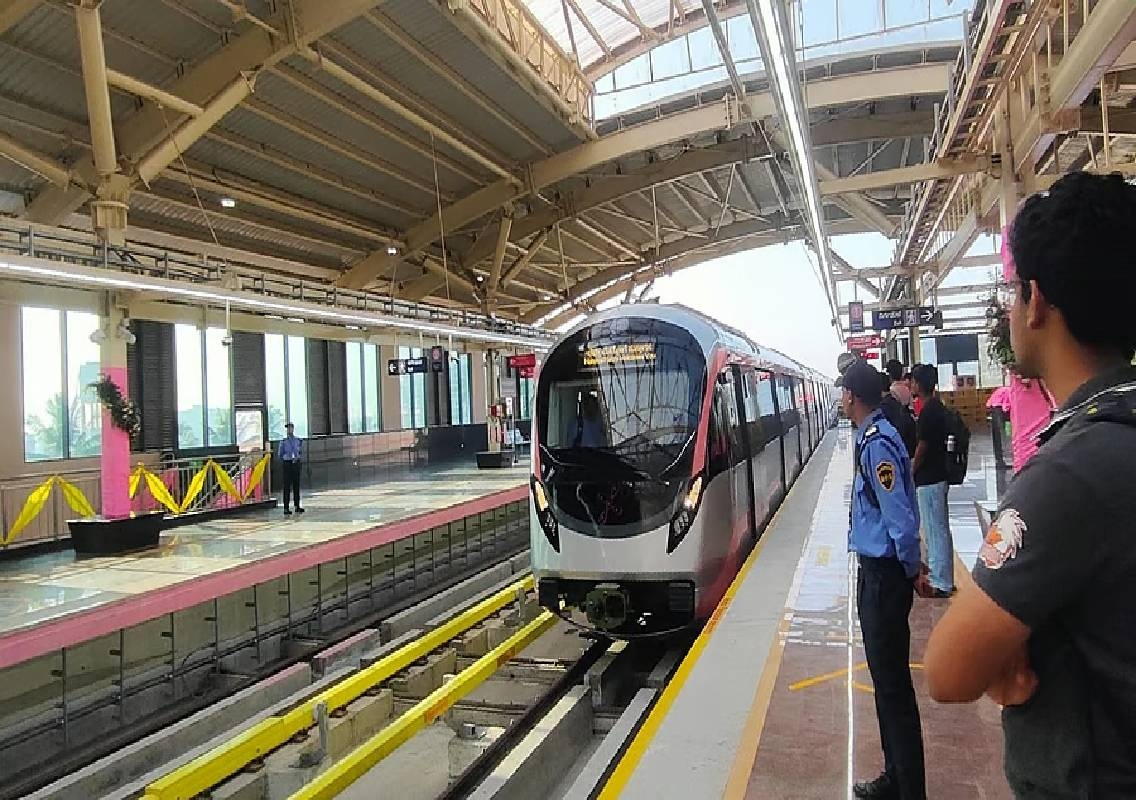


Bengaluru: The newly opened elevated section of Namma Metro’s Pink Line attracted 33,409 commuters on its first day of commercial operations on Saturday, November 14, signalling strong initial interest in the new connectivity across South Bengaluru.
The 7.5-km elevated stretch, connecting Kalena Agrahara to Suddagunte Palya (S.G. Palya), began passenger services at 6 am, a day after Prime Minister Narendra Modi inaugurated the corridor. The section has six stations and provides improved access to residential neighbourhoods, educational institutions, hospitals and commercial centres along Bannerghatta Road.
The new service is expected to offer commuters an alternative to road travel in areas that frequently experience heavy traffic.
Jayadeva Hospital station records highest footfall
Among the six stations, Jayadeva Hospital recorded the highest passenger activity, with 21,642 commuters reported up to 7 pm on the first day.
The station is an important interchange point connecting the Pink Line with the Yellow Line, which serves the Electronic City corridor. The interchange is expected to make the new stretch more useful to commuters travelling between South Bengaluru and employment and residential hubs in other parts of the city.
Passenger movement figures showed that 4,346 commuters travelled towards Kalena Agrahara, while 4,263 travelled towards R.V. Road. In comparison, 1,065 passengers travelled towards Bommasandra and 1,596 towards Suddagunte Palya.
The numbers indicate that the new corridor is already supporting movement between different parts of the Metro network, although its full impact will become clearer as regular weekday commuting resumes.
Weekday ridership to determine long-term demand
A Bengaluru Metro Rail Corporation Limited (BMRCL) official described the initial ridership as encouraging but said the actual impact of the new service would be clearer after the weekend.
The official noted that the Jayadeva interchange had recorded an increase in passenger movement and that the ridership pattern was expected to become more stable towards the end of November.
With offices, colleges and other institutions returning to their regular weekday schedules, Metro authorities will be able to assess how many commuters use the Pink Line for daily travel rather than occasional journeys.
The first-day figures provide an early indication of public interest, but sustained ridership will depend on factors such as train frequency, convenient interchange facilities and last-mile connectivity.
Commuters welcome reduced travel time
Several commuters welcomed the launch, saying the new service had reduced travel time on routes that were previously affected by traffic congestion.
Residents of areas such as Hulimavu and Gottigere are expected to benefit from easier access to the wider Metro network. Some commuters also highlighted the convenience of reaching hospitals, educational institutions and commercial establishments along the corridor.
A resident of Hulimavu told The New Indian Express that a journey to his shop in Madiwala, which earlier took around 35 to 40 minutes by road, could now be completed in approximately 10 to 15 minutes by Metro, excluding first- and last-mile travel.
Another commuter said a journey that previously took nearly an hour had been reduced to around 10 minutes on the Metro, although the time required to reach and leave stations remained an additional consideration.
However, not all passengers reported significant time savings. Some pointed out that walking distances and the time needed to reach stations could affect the overall convenience of the service.
Full Pink Line corridor still under construction
The newly operational elevated stretch is only part of the planned 21.26-km Pink Line corridor, which will connect Kalena Agrahara in South Bengaluru with Nagawara in the north.
The complete corridor will have 18 stations, including six elevated and 12 underground stations. The underground section between the Tavarekere area and Nagawara is targeted for completion in 2027.
Once the entire route becomes operational, the Pink Line is expected to provide a major north-south connection across Bengaluru, linking residential areas with commercial centres and other Metro corridors.
The first phase of operations has already given commuters in South Bengaluru access to the Yellow Line through Jayadeva Hospital station. Further connectivity with the Purple Line is expected once the underground section and its interchange facilities become operational.
The 33,409 passengers recorded on the first day mark an encouraging beginning for the new corridor. However, the coming weeks, particularly weekday travel patterns, will provide a clearer picture of its role in Bengaluru’s public transport network.