







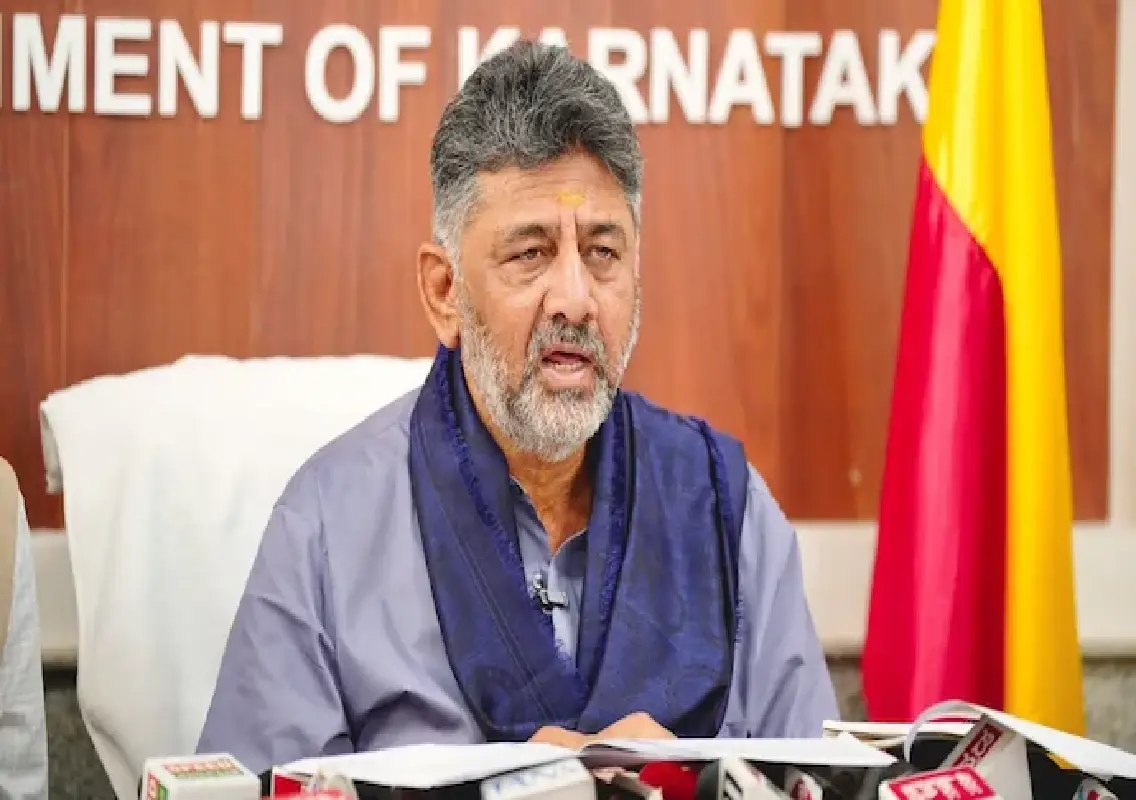


Bengaluru: Deputy Chief Minister DK Shivakumar has announced that the Karnataka government will formulate a new policy to ban street vendors from main and sub-main roads in Bengaluru, aiming to improve pedestrian movement and better regulate urban spaces.
Policy decision after key meeting
The announcement was made following a Greater Bengaluru Authority (GBA) executive committee meeting and budget discussions held at Vidhana Soudha. The meeting was attended by MLAs from areas under the GBA jurisdiction, Leader of Opposition R Ashok, and officials from key departments including police, BESCOM, BMRCL, BWSSB, and BDA.
Shivakumar stated that all five city corporations have prepared separate budgets and that MLAs had requested ward-wise allocation of funds. Amid these discussions, the issue of footpath encroachment emerged as a major concern.
Focus on pedestrian movement
Highlighting the challenges faced by citizens, Shivakumar said that pedestrians are struggling to walk due to encroachments by street vendors on footpaths and roads.
To address this, the government has decided to introduce a structured policy that will restrict vending activities on major roads. “Vendors will not be allowed on main and sub-main roads. Specific roads must be identified for vending,” he said.
He added that there was unanimous agreement among MLAs on the need for such a policy to ensure better urban mobility and reduce congestion.
Designated vending zones proposed
Under the proposed framework, designated spaces will be created where street vendors can carry out their business legally. This is aimed at balancing livelihood concerns with the need for organised urban planning.
Officials indicated that identifying suitable vending zones will be a key part of the policy, ensuring that vendors are relocated rather than removed without alternatives.
Action against violations
The Deputy Chief Minister also warned of strict enforcement measures. Vendors who leave their carts parked on roads overnight will face action, including seizure of their carts by authorities.
“If vendors trade during the day and leave carts on the roadside at night, officials will seize them,” he said, signalling a stricter approach towards maintaining road discipline.
Registration and regulation of vendors
According to Shivakumar, around 60,000 street vendors have already registered with authorities. Of these, approximately 30,000 have applied for vending carts, and tenders have been floated to facilitate their distribution.
He emphasised that only vendors possessing valid identity cards will be allowed to operate. Those without proper identification will not be permitted to conduct business on roadsides.
Crackdown on illegal flex banners
In addition to regulating street vendors, the government has announced stringent penalties to curb the proliferation of unauthorised flex banners in the city.
Shivakumar stated that despite repeated warnings, illegal banners continue to be erected, often by individuals across political affiliations. To address this, fines ranging from ₹50,000 to ₹1 lakh per banner will be imposed on violators.
Authorities have identified designated locations for advertisements, and prior permission will be mandatory. Police and municipal bodies have been tasked with enforcing these rules strictly.
Measures for traffic and parking issues
Addressing broader urban management concerns, the Deputy Chief Minister also announced steps to tackle long-standing parking issues.
Old and abandoned vehicles parked on roads for extended periods will be towed and shifted to designated dumping sites. Locations such as Bellahalli, Bidaganhalli, Biddanahalli, and Sondekoppa have already been identified for this purpose, with additional sites to be added.
To strengthen enforcement, two towing vehicles have been provided to each corporation, and vehicles parked in no-parking zones will be removed.
Other civic matters discussed
Shivakumar also touched upon the management of public parks, stating that decisions regarding opening and closing hours should be taken in consultation with local MLAs to ensure community needs are addressed.
Responding to demands from MLAs seeking ₹5–10 crore grants per ward, he remarked that such requests would be considered carefully, indicating budgetary constraints.
Conclusion
The proposed policy to restrict street vendors from main roads marks a significant step towards improving Bengaluru’s urban infrastructure and pedestrian safety. While the move is expected to ease congestion and streamline city spaces, its success will depend on effective implementation and the creation of viable alternatives for vendors. Balancing urban order with livelihood concerns will remain a key challenge for the authorities in the coming months.