







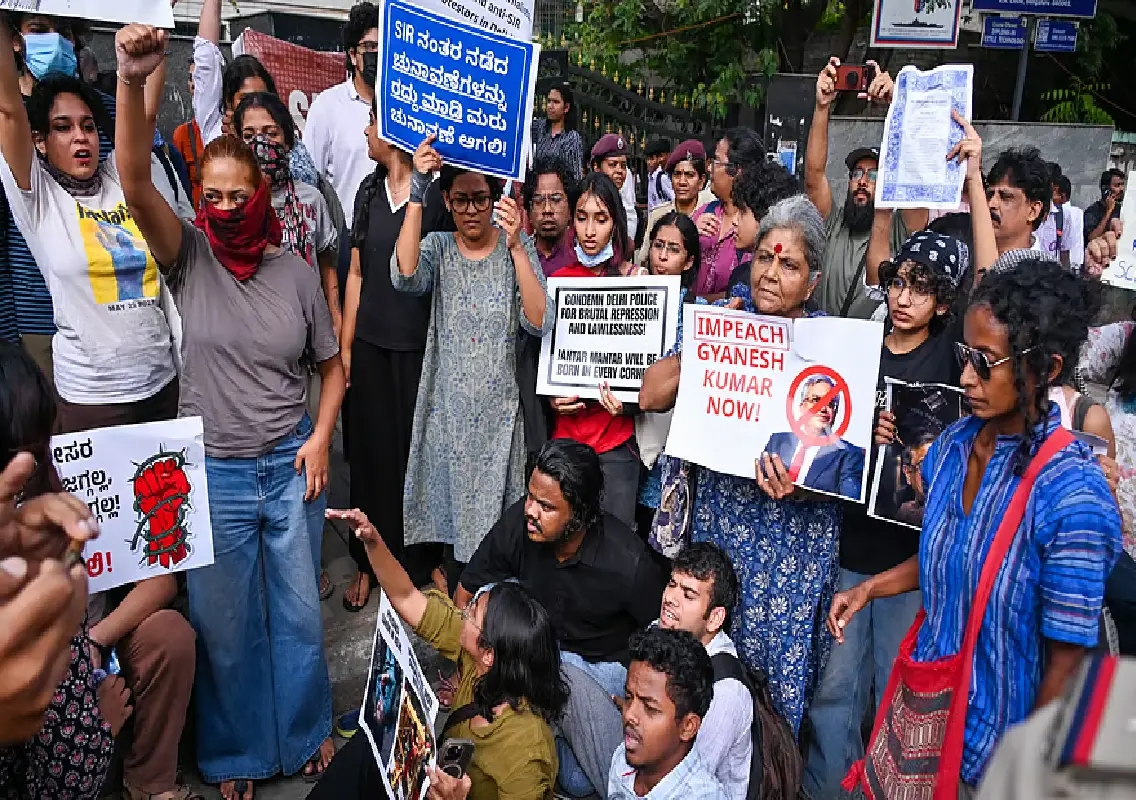


Bengaluru: Tension prevailed near KR Circle on Monday after Bengaluru City Police detained several activists and protesters who attempted to march towards the area, demanding the immediate resignation of Chief Election Commissioner Gyanesh Kumar over alleged irregularities in the ongoing Special Intensive Revision (SIR) of electoral rolls.
Hundreds of protesters, primarily youths representing various civil society organisations, including ‘My Vote, My Right’, gathered to meet the Chief Electoral Officer and raise concerns over what they described as widespread anomalies and arbitrary deletions of voters during the revision exercise.
The demonstrators carried placards and raised slogans against the Election Commission of India (ECI), demanding that the SIR exercise be scrapped and reforms introduced in the process of appointing election commissioners. The protest also condemned the police action against demonstrators in Delhi who have been seeking the withdrawal of the exercise and the resignation of Gyanesh Kumar.
Protesters raise concerns over voter deletions
The gathering in Bengaluru was organised amid growing criticism from sections of civil society over the conduct of the SIR exercise. The protesters alleged that the revision process had resulted in irregularities and arbitrary deletions from electoral rolls, raising concerns about the protection of voting rights.
Participants included lawyers, students, activists, academics and other concerned citizens. They sought an opportunity to meet the Chief Electoral Officer and present their objections to the ongoing exercise.
The protesters also expressed solidarity with activists, lawyers, journalists and young people who had reportedly faced police action during demonstrations in Delhi against the Chief Election Commissioner.
According to the organisers, the Bengaluru gathering was intended to be a peaceful march towards the Chief Electoral Officer’s office. However, the situation became tense after police personnel intervened and began detaining participants.
The demonstrators demanded the immediate scrapping of the SIR exercise and called for structural reforms in the appointment of election commissioners. Their slogans focused on electoral transparency, democratic accountability and the protection of citizens’ voting rights.
Organisers allege police prevented peaceful march
One of the organisers alleged that the police intervened before the protesters could formally begin their march.
“Concerned citizens, including lawyers, students, activists and academics, gathered to begin a peaceful march to the Chief Electoral Officer’s office. However, before a single placard was held up, the police confiscated the placards and began detaining people,” the organiser said.
The organiser further alleged that the police moved in to clear the area physically and take participants into preventive custody, triggering confusion and chaos at the protest site.
Several demonstrators were detained as police personnel attempted to disperse the gathering. The protesters maintained that they had assembled to exercise their democratic right to express dissent over the electoral revision process.
A woman activist, who was being led away by police personnel, told Deccan Herald that the demonstrators were peacefully exercising their constitutional rights.
“We are peacefully exercising our constitutional right to protest against the theft of democracy,” she said before being taken into a police vehicle.
The protesters’ allegations centred on the manner in which the police handled the gathering and their demand that concerns over the SIR exercise be addressed through appropriate channels.
Journalists allegedly manhandled during detentions
The incident also raised concerns about the treatment of journalists covering the demonstration.
According to the report, two photojournalists and three reporters working for prominent newspapers were allegedly manhandled by four police personnel while carrying out their professional duties.
The alleged confrontation occurred as the police moved to disperse the gathering and detain protesters. The incident added to the tension at the site, with questions being raised about the treatment of media personnel reporting on public demonstrations.
Journalists play a crucial role in documenting protests and informing the public about developments on the ground. Allegations of physical intimidation or obstruction of reporters during such events can raise concerns about press freedom and the ability of media organisations to report independently.
The Bengaluru City Police subsequently acknowledged that friction had occurred between media reporters and police staff, while maintaining that the interaction was unintentional and took place under strained circumstances.
Bengaluru police issue clarification
In a statement issued following the incident, Bengaluru City Police defended their actions, saying they had acted with restraint and sensitivity.
The police said a crowd had assembled suddenly near KR Circle without permission or prior intimation. According to the department, the gathering was contrary to Karnataka High Court directions requiring protests to be held at a designated location.
The police said participants were initially requested to relocate to Freedom Park, which is designated for protests in Bengaluru. However, as the demonstrators allegedly did not comply with the request, the police took them into preventive custody in accordance with the law.
The department added that those detained were subsequently released.
Addressing the reported confrontation with journalists, the police acknowledged the incident involving media reporters and police personnel.
“We would like to clarify that it was completely unintentional and it happened in the straining circumstances,” the police statement said.
The clarification sought to explain the police response while acknowledging the friction between officers and members of the media during the operation.
SIR exercise remains at the centre of controversy
The protest in Bengaluru reflects wider concerns among sections of civil society over the Special Intensive Revision of electoral rolls and its implications for voters.
The SIR process is intended to undertake a detailed revision of electoral rolls. However, critics have raised concerns about the possibility of eligible voters being excluded and have called for greater transparency and safeguards to prevent wrongful deletions.
The protesters’ demands extended beyond the immediate conduct of the revision exercise. They also sought structural reforms in the appointment of election commissioners, arguing for greater accountability in the functioning of institutions responsible for conducting elections.
The Election Commission of India has a central role in maintaining electoral rolls and overseeing elections. Allegations concerning voter deletions and the conduct of revision exercises therefore remain sensitive issues, particularly when they involve questions about citizens’ ability to exercise their franchise.
The Bengaluru demonstration ended with the detention and subsequent release of protesters, while the police defended their actions on the grounds of compliance with restrictions on protest locations.
The incident has brought attention to the competing concerns surrounding public demonstrations, police enforcement of court directions and the right of citizens to raise objections to electoral processes. The allegations made by protesters and journalists, along with the police clarification, underline the need for transparency and clear communication when authorities handle demonstrations involving matters of democratic accountability.