


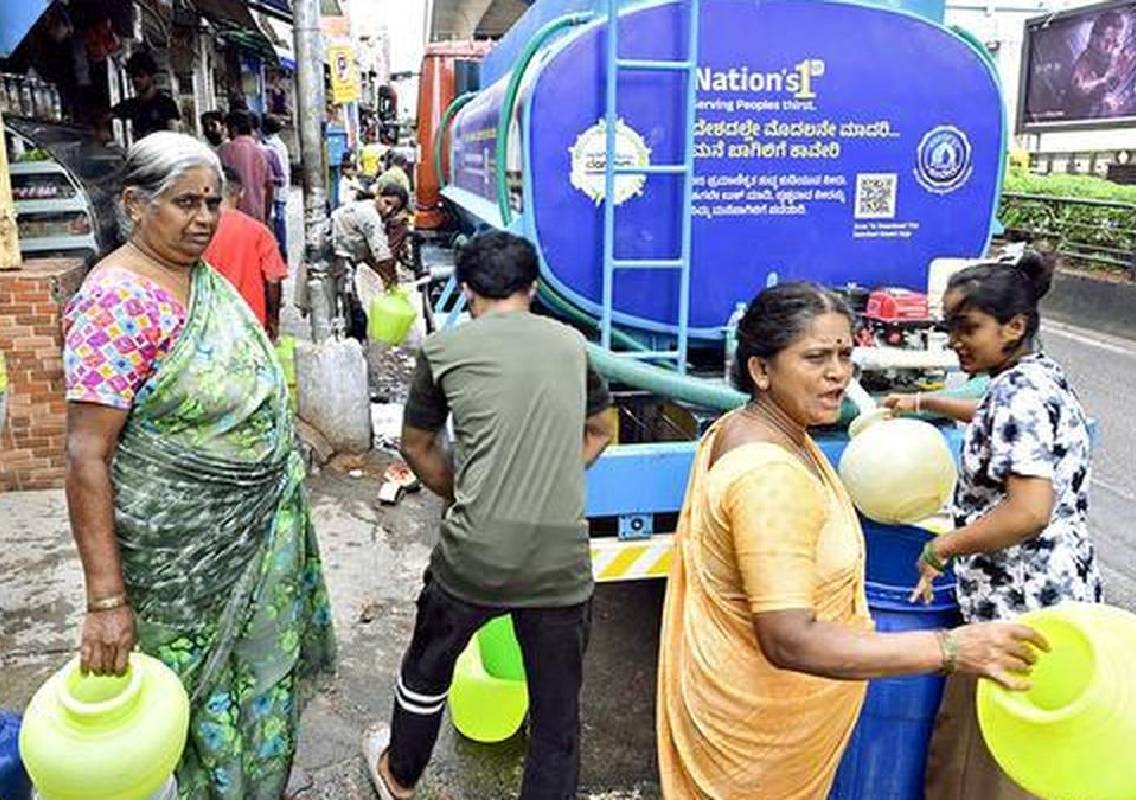


Bengaluru: An audit has highlighted the financial strain faced by low-income families in Bengaluru, with some households reportedly spending around ₹3,000 every month to meet their drinking water needs. The findings point to the challenges faced by vulnerable communities in accessing affordable and reliable drinking water.
Water Satyagraha Survey Predicts 600 MLD Supply Shortfall
The preliminary findings of a household survey conducted by the Water Satyagraha campaign indicate that economically weaker families, particularly those living in slum areas, are spending a significant portion of their income on drinking water purchased from private tankers.
According to Syed Ahmed Hussain, convenor of the campaign and Karnataka Pradesh Congress Committee (KPCC) vice-president, poor families spend approximately ₹3,000 every month on drinking water. This amount is higher than the ₹2,000 monthly assistance provided to women under the Karnataka government’s Gruha Lakshmi scheme.
The campaign has also predicted a shortfall of more than 600 million litres per day (MLD) in Bengaluru’s water supply. Its volunteers have been conducting household surveys across different localities to assess the city’s drinking water situation and the financial burden on residents.
Hussain pointed out that the Bangalore Water Supply and Sewerage Board (BWSSB) does not have the authority to regulate prices charged by private water tanker operators. This leaves families dependent on private suppliers vulnerable to high water costs, particularly in areas where regular piped supply is inadequate.
Bengaluru’s Water Demand Exceeds Cauvery Supply
The preliminary audit findings estimate that Bengaluru receives around 1,470 MLD of Cauvery water, while the city’s daily demand exceeds 2,100 MLD.
This gap between supply and demand has increased dependence on alternative water sources, including private tankers and groundwater. Residents in several peripheral areas reportedly face difficulties accessing regular piped water, making private suppliers an important source for their daily requirements.
The survey also found that some middle-class households spend as much as ₹54,000 annually on drinking water alone, highlighting the financial impact of the city’s water supply challenges across different income groups.
Hussain further stated that Bengaluru extracts groundwater at nearly twice the rate at which it is naturally replenished. Every taluk in Bengaluru Urban district has reportedly been categorised as over-exploited in terms of groundwater extraction.
Nearly 772 MLD of Sewage Remains Untreated
The preliminary findings have also raised concerns about the city’s sewage management system.
According to the figures shared by the campaign, Bengaluru generates approximately 2,120 MLD of sewage every day. Of this, around 1,348 MLD is treated, leaving nearly 772 MLD untreated.
The campaign has also highlighted the loss of piped water through leakage, theft and unbilled consumption. Hussain stated that nearly 27% of the city’s piped water is lost through these channels, while approximately 400 million litres of water are lost every day.
He expressed concern that drinking water pipelines and sewage lines often run alongside each other. Leaking joints could create the risk of sewage entering drinking water pipelines and affecting water quality.
Hussain also questioned the availability of public information on water quality. According to him, BWSSB tests between 80 and 150 water samples daily but does not publish ward-wise information on contamination and pipeline leakages.
Water Crisis Concerns Extend Across Karnataka
The campaign has raised concerns about the wider water situation in Karnataka, particularly following a reported 43% deficit in the south-west monsoon.
Hussain stated that 226 of Karnataka’s 240 taluks had been declared drought-hit this year. He also referred to deaths linked to contaminated drinking water in Raichur, Chitradurga and Mysuru districts.
The situation has brought renewed attention to the need for reliable drinking water infrastructure, effective sewage treatment and better groundwater management.
Access to safe drinking water is also recognised as an important legal and human rights issue. Referring to the Supreme Court’s 1991 judgment in Subhash Kumar v. State of Bihar, Hussain highlighted that the right to life under Article 21 includes the right to pollution-free water and air. The United Nations has also recognised access to safe drinking water and sanitation as a human right.
Water Satyagraha Aims to Survey Three Lakh Households
The Water Satyagraha campaign plans to expand its household survey across Bengaluru, with volunteers aiming to cover three lakh households by March 2027.
Once completed, the findings will be compiled into a comprehensive report and submitted to the Karnataka government. The campaign intends to use the survey to highlight the challenges faced by residents and draw attention to gaps in the city’s water supply and management systems.
Hussain said the campaign also carries historical significance as it coincides with the centenary of the Mahad Satyagraha, led by Dr B.R. Ambedkar on March 20, 1927. The movement asserted the right of Dalits to draw drinking water from a public tank in Mahad, Maharashtra.
The preliminary audit has brought several interconnected concerns into focus, including the financial burden of private water purchases, groundwater over-extraction, sewage treatment gaps and the need for greater transparency in water quality monitoring.
As Bengaluru prepares for the coming summer months, the findings underline the importance of ensuring affordable, safe and dependable drinking water for all sections of the population.