


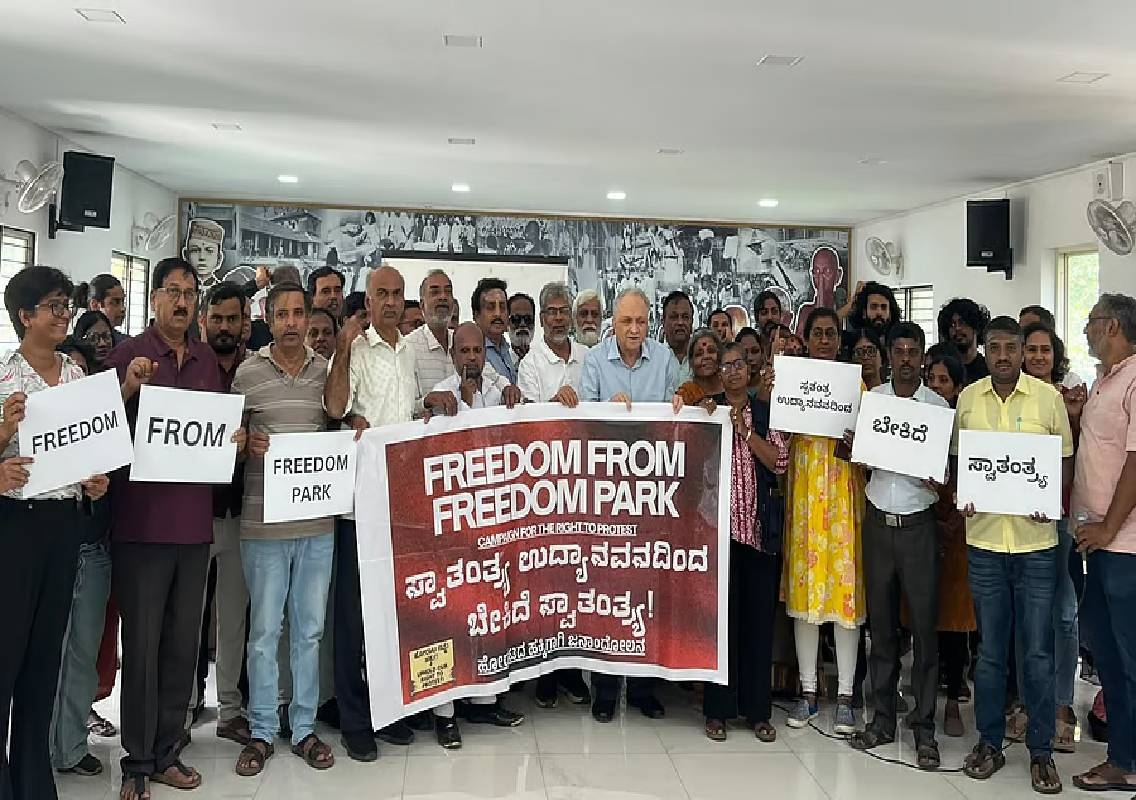


BENGALURU: The Campaign for the Right to Protest has given the Karnataka government until November 26, Constitution Day, to revoke the order restricting demonstrations in Bengaluru primarily to Freedom Park. The campaign has warned that it will launch a city-wide mass civil disobedience movement on November 28 if the government fails to act.
The decision was taken at a roundtable meeting held at Gandhi Bhavan on October 26, attended by around 100 representatives of civil society organisations, trade unions, student groups, women’s organisations and civil liberties movements.
The campaign, also known as Horatada Hakkigagi Janandolana, is seeking the withdrawal of the Licensing and Regulation of Protests, Demonstrations and Protest Marches (Bengaluru City) Order, 2021. It has also demanded that police cases registered against people for protesting outside Freedom Park be quashed.
Activists seek restoration of public protest spaces
Participants argued that restricting demonstrations to a single designated venue limits citizens’ ability to bring grievances directly to the authorities concerned. They said protests outside government departments, police stations and other public institutions can help make specific issues more visible and allow affected communities to seek accountability.
Historian and writer Ramachandra Guha was among those who questioned the continued restrictions. He called for the restoration of public spaces such as Town Hall, Maurya Circle and Mysore Bank Circle for peaceful demonstrations.
Advocate and activist Vinay Sreenivasa said the government should withdraw the order and reconsider the restrictions imposed on public gatherings.
The campaign has also argued that the restrictions introduced under the previous BJP government continue under the Congress-led administration, despite public statements supporting the right to peaceful protest.
Legal basis of Freedom Park restrictions debated
The current dispute centres on the 2021 licensing order and the legal proceedings that followed.
In March 2022, the Karnataka High Court issued an interim direction restricting protests, processions and similar activities in Bengaluru to Freedom Park, citing traffic congestion and inconvenience to the public. In August 2022, the court disposed of the case and directed the authorities to ensure compliance with the applicable licensing order.
The campaign’s representatives argue that the final order does not prevent the State government from reviewing or amending the licensing framework through the appropriate legal process. They have challenged the interpretation that the court permanently bars demonstrations at every other location in the city.
The licensing order identifies Freedom Park as the designated venue and provides for the police commissioner to designate another suitable location, depending on the circumstances.
The debate therefore involves both the interpretation of the court’s directions and the scope of the government’s and police commissioner’s powers under the existing rules.
Workers and marginalised groups raise concerns
At the roundtable, representatives of trade unions and community organisations described the practical difficulties they face when demonstrations cannot be held near the institutions connected to their grievances.
KV Bhat of the Joint Confederation of Trade Unions spoke about the difficulties in organising May Day rallies. Sujatha of Sadhana Mahila Sangha said protests outside police stations had helped sex workers raise concerns over alleged harassment and unlawful detention.
Other participants, including representatives of street vendors and women’s organisations, argued that restrictions on public demonstrations make it harder for workers and vulnerable communities to draw attention to issues such as wages, housing, water access and safety.
The speakers also raised concerns about police action against protesters who attempted to demonstrate outside Freedom Park. Allegations of excessive force and inconsistent enforcement were raised during the meeting; these remain claims made by participants and should be distinguished from independently established findings.
Recent protests add to the debate
The campaign’s renewed push follows recent demonstrations against the Special Intensive Revision (SIR) of electoral rolls and police action against protesters attempting to march towards the Chief Electoral Officer’s office.
Civil society representatives have questioned why peaceful gatherings outside Freedom Park have faced police intervention while other public processions have been permitted. They have called for transparent and consistent rules governing demonstrations and marches across the city.
Karnataka Home Minister Priyank Kharge had said earlier in October that the government would examine the existing restrictions and consider whether protest venues could be decentralised. He also stressed the need to balance the right to protest with public safety and the rights of commuters.
Campaign plans further action if government does not respond
The campaign has resolved to approach the Home Minister and Bengaluru City Police Commissioner with its demands. It also plans to form a central committee to coordinate future activities and broaden participation.
November 26 has been set as the deadline for the government to revoke the restrictions. If the order remains in force, organisers say they will begin a mass civil disobedience movement across Bengaluru on November 28.
The proposed action is intended to intensify pressure on the government to review the rules governing public demonstrations.
The dispute highlights the challenge of balancing peaceful assembly and freedom of expression with traffic management, public convenience and safety. The campaign is seeking wider access to public spaces for demonstrations, while the government must consider the legal framework and competing public interests before deciding whether to amend the existing restrictions.