


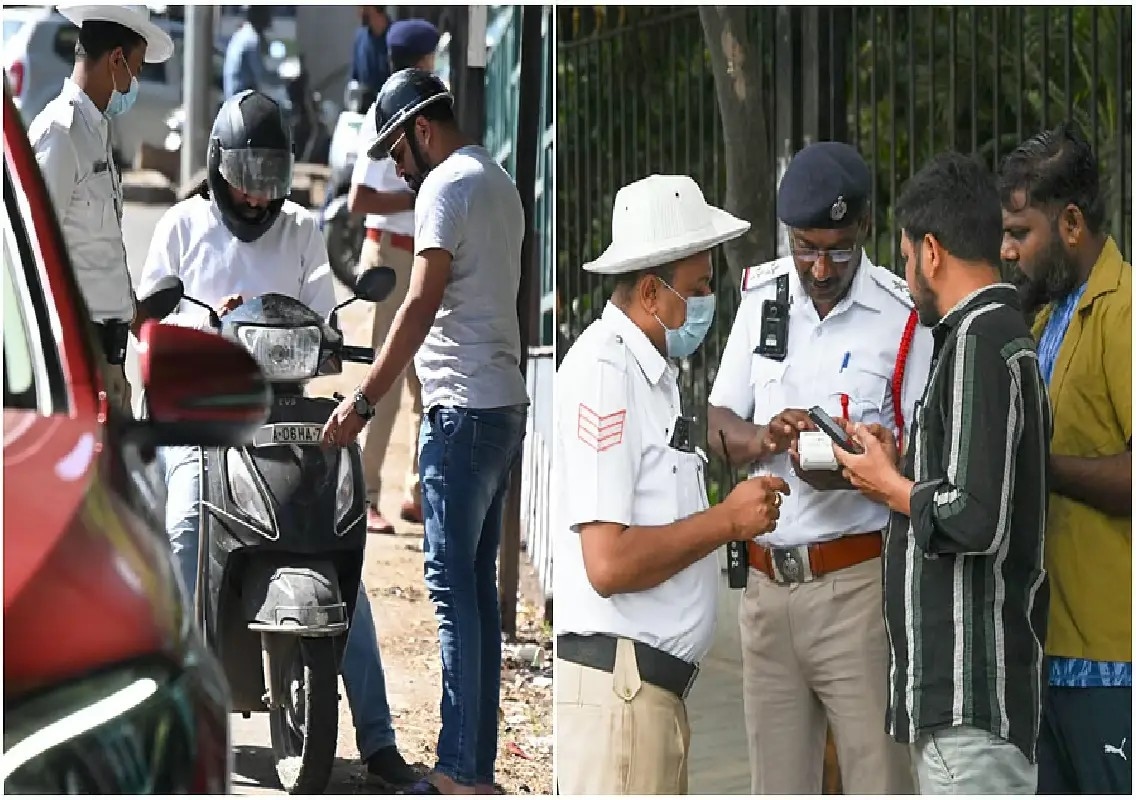


Bengaluru: Bengaluru has witnessed a sharp rise in five major traffic offences, with more than 24.5 lakh cases recorded in the first eight months of 2026. The figure has already surpassed the annual number of cases registered for these offences in each of the previous five years.
The offences include wrong parking, signal jumping, ‘No Entry’ violations, footpath riding and reckless driving. Data exclusively accessed by Deccan Herald (DH) shows that the five offences together accounted for nearly 1.28 crore traffic violations in Bengaluru over the past six years.
Traffic violations surge in 2026
The number of cases fluctuated between 19.30 lakh in 2021 and 21.09 lakh in 2025. However, the trend changed sharply in 2026, with 24.54 lakh cases recorded in just the first eight months.
Wrong parking emerged as the most common violation, accounting for 48.56% of the total cases over the six-year period. It contributed 62.58 lakh cases.
Signal jumping was the second most common offence, with 46.34 lakh cases, representing 35.95% of the total. ‘No Entry’ violations accounted for 18.78 lakh cases, or 14.57%.
Together, wrong parking, signal jumping and ‘No Entry’ violations constituted more than 99% of all five categories recorded during the period.
Footpath riding accounted for 88,328 cases, or 0.69%, while reckless driving made up 40,362 cases, or 0.31%.
Wrong parking remains biggest concern
Wrong parking accounted for 10.99 lakh cases during the first eight months of 2026. An additional 1.16 lakh cases involved vehicles being parked on footpaths.
Director General and Inspector General of Police (DG&IGP) and Head of Police Force for Karnataka, Dr M A Saleem, said the increase reflected both improved enforcement capabilities and widespread indiscipline among motorists.
Saleem pointed out that illegal parking does more than inconvenience other road users. Vehicles parked improperly reduce the effective capacity of roads and create congestion bottlenecks.
He said fines alone would not resolve the issue and called for a combination of measures, including clearly marked parking spaces, sustained towing operations, camera-based enforcement and physical patrols.
Action against repeat offenders and coordination with civic authorities to establish scientifically planned parking and loading zones would also be necessary, he said.
Signal jumping poses immediate safety risk
Signal jumping was another major contributor to Bengaluru’s traffic violations.
Saleem stressed that enforcement against the offence needs to remain stringent because motorists jumping signals face an immediate risk of collisions.
AI-enabled automatic number plate recognition (ANPR) systems and violation-detection cameras have already been deployed at major junctions under the Intelligent Traffic Management System (ITMS).
However, Saleem said technology alone would not be sufficient. Engineering improvements at junctions are equally important to encourage compliance.
These measures include clearly marked stop lines, proper pedestrian crossing phases, improved signal visibility and correction of confusing signal phasing.
Need for action against habitual offenders
Saleem also highlighted the need for stronger measures against deliberate violations such as wrong-side driving and footpath riding.
He suggested measures including a penalty-point system, suspension of driving licences, vehicle blacklisting and higher penalties for habitual offenders.
He also raised concerns regarding low-speed electric two-wheelers, cautioning that regulatory exemptions should not result in an enforcement vacuum.
Dangerous manoeuvres involving such vehicles should attract strict action, while safety norms and accountability of fleet operators employing commercial delivery riders should be strengthened, he said.
AI cameras have limitations
A senior traffic police officer told DH that AI-based cameras cannot reliably detect one-way violations or wrong parking across all lanes and locations.
Manual enforcement, meanwhile, cannot provide continuous monitoring across the city.
The officer said the consistently high number of violations had prompted policymakers to consider steeper financial penalties and licence-related action.
The challenge is therefore not merely to increase the number of challans but to ensure that enforcement results in safer and more disciplined road use.
Licence points system among proposals
Recently, Home Minister Priyank Kharge held discussions with Transport Minister Byrathi Suresh on a comprehensive roadmap to improve road discipline.
Among the proposals discussed was a points-based system under which repeated traffic violations could eventually lead to suspension of driving licences.
Other proposals include enhanced penalties for offences that cause congestion or threaten public safety, with fines potentially increasing to as much as Rs 5,000.
The proposed measures also include stricter regulation of unregistered electric bikes, stronger action against habitual offenders through vehicle detention and blacklisting, and mandatory orientation and safety training before a suspended or revoked driving licence is restored.
Community service has also been proposed as an alternative or supplementary punishment for traffic offenders.
Commuters seek better infrastructure
While stronger enforcement has received attention, commuters have stressed that road infrastructure must improve alongside penalties and surveillance.
Commuter Naveen Gowda said authorities should focus on reducing violations rather than treating traffic enforcement primarily as a source of revenue.
He also pointed to unsafe movements by two-wheelers, including sudden lane changes and vehicles moving unpredictably between four-wheelers. He called for dedicated lanes for two-wheelers and autorickshaws to improve road safety.
Another commuter, Ananya R, said strict fines and camera-based enforcement would be effective only if the city’s road infrastructure supported safer driving.
She pointed to the shortage of parking spaces and confusing signals as factors that can contribute to illegal parking and risky manoeuvres. She also called for improvements to pothole-ridden and frequently flooded roads before heavier penalties are imposed.
Enforcement and infrastructure must go together
The sharp rise in traffic violations has highlighted the scale of Bengaluru’s road-discipline challenge. While enhanced surveillance and enforcement have helped authorities record more violations, the figures also point to persistent behavioural and infrastructure-related problems.
A combination of technology, stronger action against repeat offenders, better junction design, adequate parking facilities and improved roads may be necessary to bring down violations.
As proposals for higher fines and a licence points system are considered, commuters and traffic experts are also seeking infrastructure changes that make compliance easier.
For Bengaluru, the challenge will be to ensure that tougher enforcement translates into fewer violations, smoother traffic movement and safer roads rather than simply a higher number of cases and penalties.