







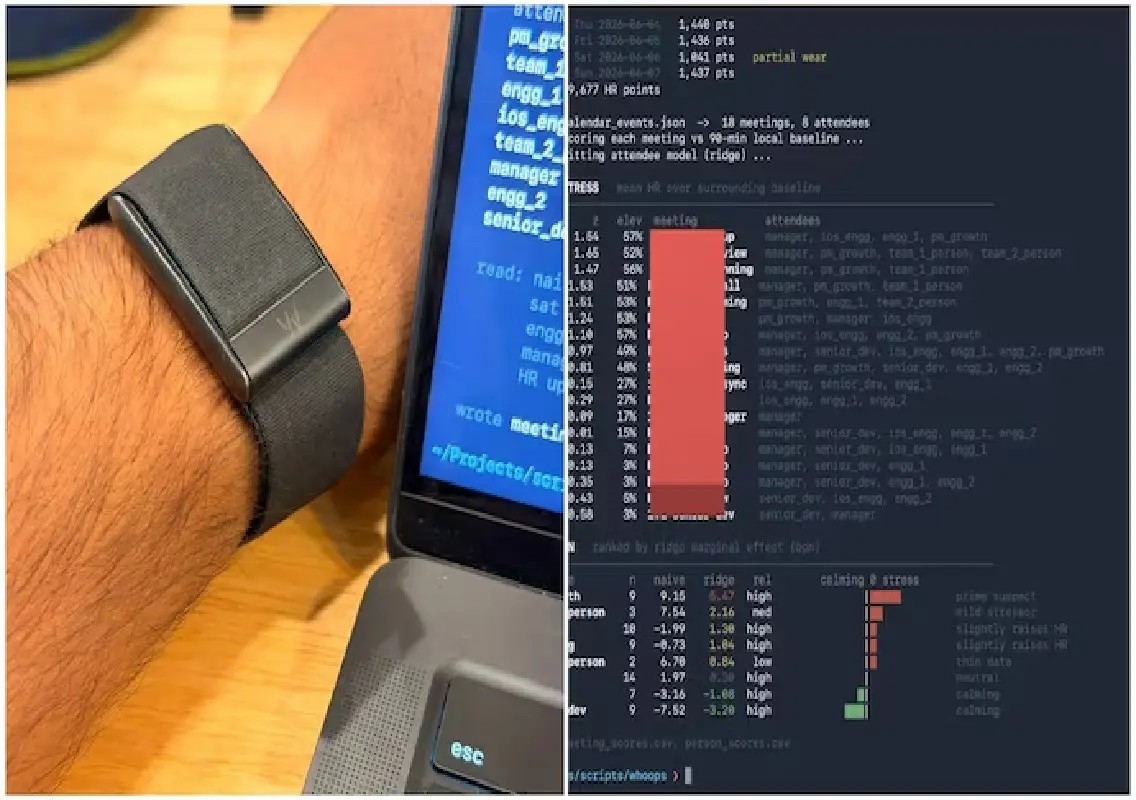


Bengaluru: A software engineer from Bengaluru has gone viral on social media after revealing that he created a tool that identifies which coworkers cause him the most stress during meetings by analysing heart-rate data from his fitness tracker and matching it with entries on his work calendar.
The project, developed by Bengaluru-based engineer Pankaj, has attracted widespread attention online for its unusual combination of workplace analytics and wearable technology. While shared in a humorous tone, the experiment has also sparked conversations about the growing use of personal health data beyond fitness and wellness tracking.
Fitness tracker data linked to work calendar
Pankaj shared details of the project on X, explaining that he connected data from his Whoop fitness tracker with his work calendar to determine which meetings triggered the strongest physiological responses.
According to him, the project began after he reverse-engineered the wearable device’s data stream to access minute-by-minute heart-rate information. He then compared those readings with scheduled calendar events and meeting attendees to identify potential correlations between elevated heart rates and specific interactions.
The engineer said the analysis allowed him to determine which meetings consistently produced noticeable spikes in his heart rate.
A humorous ‘stress leaderboard’
After combining the heart-rate data with meeting schedules, Pankaj created what he jokingly described as a “leaderboard” ranking coworkers according to the stress levels their meetings appeared to generate.
In his social media post, he remarked that he now had a ranking system and found himself thinking about it regularly.
The post included photographs of his fitness tracker as well as screenshots showing portions of the code used for the project and what appeared to be a blurred list of meeting participants associated with heart-rate fluctuations.
The unique experiment quickly gained traction online, with many users sharing the post across social media platforms.
Social media reacts with humour and curiosity
The project generated a mix of amusement, curiosity and scepticism among internet users.
Several users joked that such a system could become a workplace analytics product, while others humorously suggested that human resources departments might one day use similar tools to measure employee stress levels.
Some commenters also speculated that managers and team leaders might not appreciate seeing themselves ranked on a stress leaderboard.
The light-hearted nature of the project contributed to its viral appeal, with many office workers relating to the idea of stressful workplace meetings.
Questions raised over accuracy
While many found the project entertaining, some users questioned whether heart-rate data alone could accurately identify stressful coworkers or meetings.
Commenters pointed out that various factors can influence heart rate, including physical activity, caffeine intake, emotional state, lack of sleep, climbing stairs, meal timing and other daily activities unrelated to workplace interactions.
Experts generally note that heart-rate spikes may indicate physiological arousal but do not necessarily reveal the precise cause without additional context.
As a result, some users argued that the data should be viewed as an interesting indicator rather than definitive evidence of workplace stress.
Wearable technology finds new uses
The viral post has also highlighted the increasing popularity of wearable devices and the creative ways users are analysing their personal health information.
Modern fitness trackers can monitor metrics such as heart rate, sleep patterns, activity levels and recovery scores, generating large amounts of personal data that enthusiasts often use for custom projects and experiments.
Although Pankaj’s stress-ranking system was clearly intended as a humorous side project, it demonstrates how wearable technology can be combined with other digital tools to uncover patterns in everyday life.
For now, the Bengaluru engineer’s coworker stress leaderboard remains a light-hearted internet sensation, but it has undoubtedly prompted many professionals to wonder what their own workplace data might reveal.