







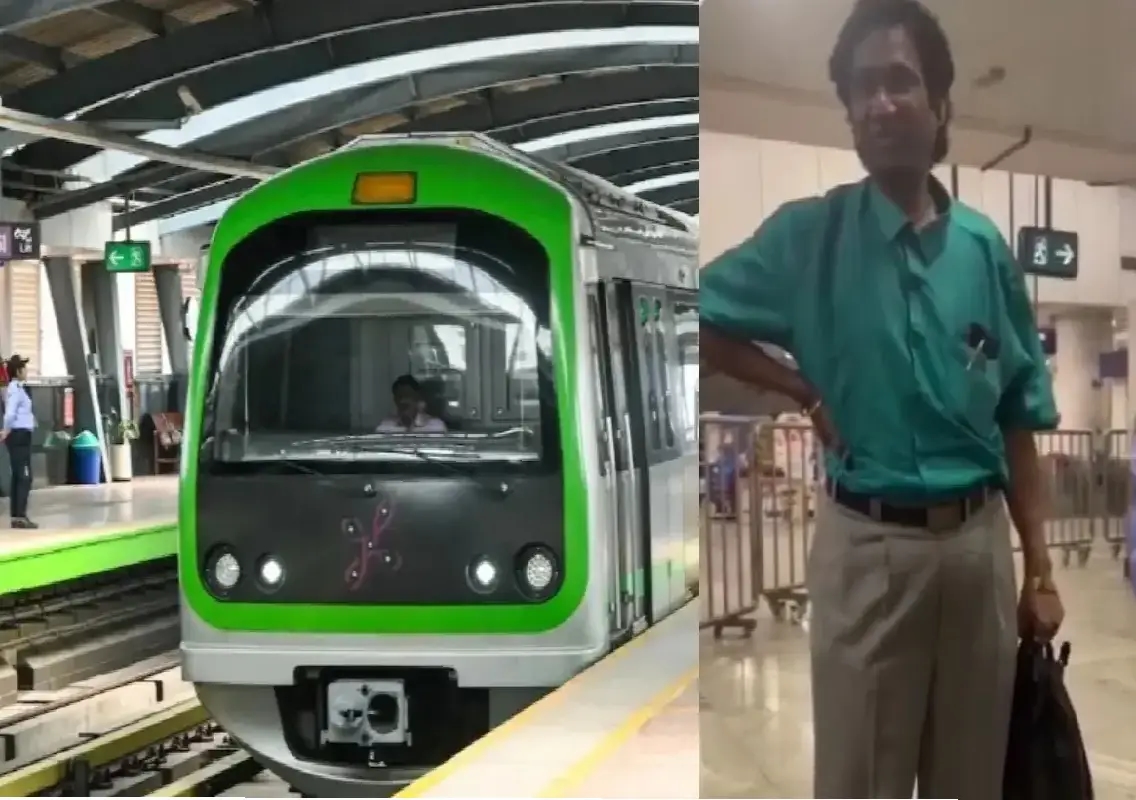


Bengaluru: A woman commuter in Bengaluru has alleged that she was subjected to obscene behaviour and inappropriate touching by a fellow passenger during a metro journey, triggering fresh concerns over women’s safety in public transport systems. The incident reportedly took place on Tuesday while the woman was travelling from Vidhana Soudha Metro Station, one of the busiest stations in the city.
Based on her complaint, the police have registered a non-cognisable report (NCR) against the accused. The woman later shared a video statement narrating her ordeal, which has since circulated widely on social media, drawing public attention to the issue.
Incident during peak-hour travel
According to the victim, she was travelling on the metro and was initially comfortable, standing or seated among other commuters and occupied with her phone. She said the situation changed when a passenger seated next to her got down at the next station and another man took the vacant seat beside her.
“The moment he sat, I felt crushed in between the people because he really sat close to me. I felt extremely uncomfortable,” the woman said in her video statement. Believing that the man might have needed space due to the crowd, she initially adjusted her position to create distance.
However, she soon realised that the discomfort was not accidental.
Allegations of deliberate inappropriate contact
The woman alleged that the accused began pressing his hand against her body. At first, she assumed it might have been unintentional due to crowding inside the metro coach. In an attempt to avoid contact, she moved further away, which reportedly caused inconvenience to another woman seated on her other side.
Despite her efforts to create distance, the accused allegedly continued his behaviour. The woman stated that the man deliberately placed his leg against hers, touching her repeatedly.
“Then this dude put his leg onto my leg, keeping it closer and touching my leg,” she said. At this point, she confronted him and asked him to move his leg, which he did temporarily.
Realisation and confrontation
The victim said that after a brief pause, the accused again placed his hand against her body. “At that moment, I realised that this was not a mistake. This was intentional,” she said, adding that the realisation left her shocked, angry, and momentarily frozen.
When her destination station arrived, the woman decided to act. She stood up, confronted the man, and slapped him inside the metro coach, demanding that he get up from his seat.
“Luckily, he was also getting down at the same station,” she said. After exiting the train, she slapped him again on the platform. According to her account, the man appeared to be crying but was also smiling, which she found disturbing.
Accused detained by security
The woman immediately alerted metro security personnel at the station. Acting on her complaint, the security staff detained the accused and handed him over to the police. He was taken to Upparpet police station for questioning.
The victim alleged that during the confrontation, the accused spoke in Kannada, which she did not fully understand, and apologised intermittently while also saying other things. She claimed that he did not clearly explain himself and appeared aware of his wrongdoing.
Police response and NCR registration
Police officials confirmed that a non-cognisable report had been registered in connection with the incident. According to them, the accused was questioned, counselled, and warned about his behaviour before being released.
Officials stated that since the complaint did not immediately result in the registration of a cognisable offence, an NCR was filed, which allows the police to maintain a record of the complaint and take preventive action.
Public outrage and safety concerns
The incident has sparked widespread discussion on social media, with many users expressing concern over the safety of women commuters on Bengaluru’s metro network, which is otherwise considered one of the safer modes of transport in the city.
Activists and women’s rights groups have called for stricter action, better surveillance inside metro coaches, and increased sensitivity training for security and police personnel. Several users pointed out that counselling alone may not act as a sufficient deterrent against repeat offenders.
Conclusion
The alleged molestation incident once again highlights the vulnerabilities faced by women in crowded public spaces, even in regulated transport systems like the metro. While swift intervention by security personnel helped prevent further harm, the case has renewed calls for stronger legal action, quicker complaint redressal, and greater awareness among commuters to ensure safer travel for women in Bengaluru.