







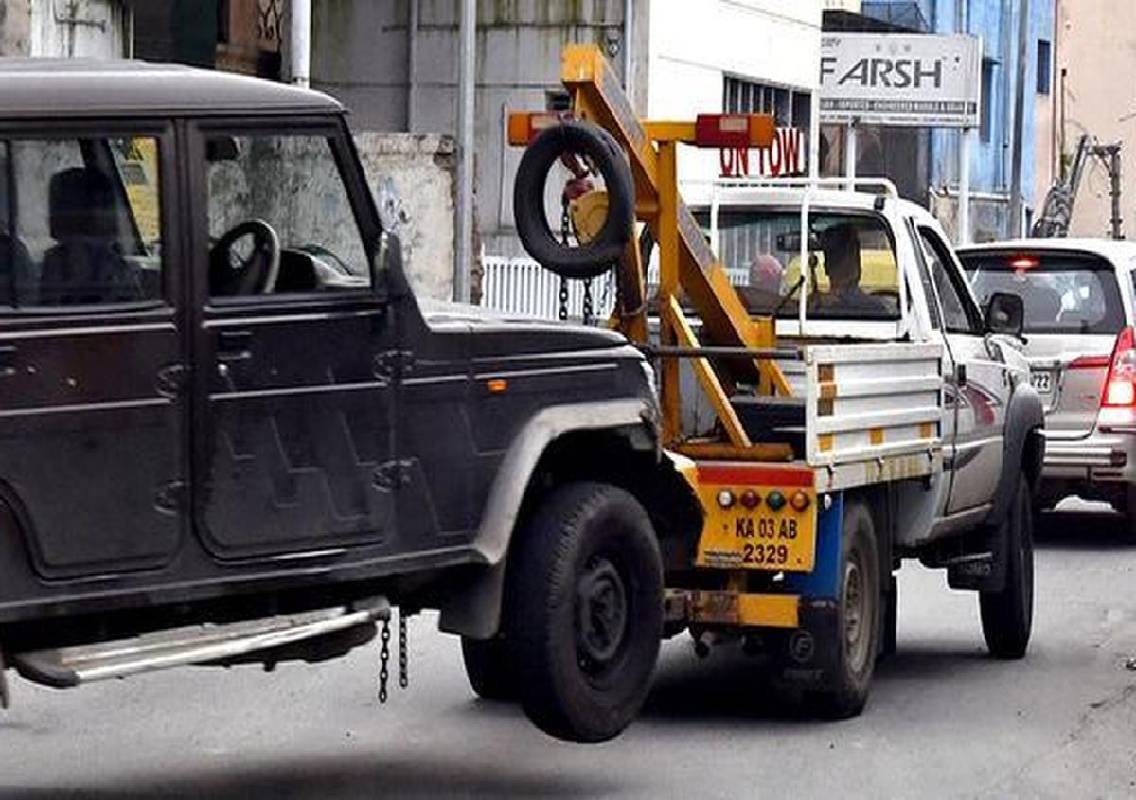


Bengaluru: Bengaluru Traffic Police have booked a record 10.99 lakh cases for wrong parking in the first eight months of 2026, almost matching the 11.16 lakh cases registered during the whole of 2025. Despite the intensified enforcement, traffic officials acknowledge that haphazard parking continues to affect roads and contribute to congestion across the city.
The latest figures accessed by The Hindu show that the number of wrong-parking cases recorded between January and August this year is the highest for the corresponding period in the last decade. The enforcement drive has included towing, paid parking initiatives and dedicated traffic beats, but these measures have so far had limited impact on parking behaviour.
Wrong parking cases reach record levels
Bengaluru Traffic Police recorded 10.99 lakh wrong-parking cases up to August 2026, putting the city on course to surpass last year’s record.
For comparison, BTP registered 11.16 lakh wrong-parking cases during the entire year in 2025. The corresponding annual figures were 9.73 lakh in 2024, around 10 lakh each in 2022 and 2023, and 7.26 lakh in 2021.
The sharp increase in cases does not necessarily mean parking violations have suddenly become more common. Traffic officials have pointed out that the rise also reflects greater enforcement and the growing number of vehicles in Bengaluru.
With vehicle ownership continuing to increase, the pressure on limited road space has become a persistent urban challenge.
Footpath parking also reaches record high
The problem extends beyond roadsides and designated no-parking areas.
BTP has registered 1.16 lakh cases of vehicles being parked on footpaths up to August 2026, according to the data cited by The Hindu. This is also a record for the first eight months of a year, with no year in the previous five years recording more than 90,000 such cases during the same period.
Vehicles parked on footpaths can force pedestrians to move onto the carriageway, particularly on roads where pavements are narrow or poorly maintained. This can create additional risks for pedestrians and further reduce the effective space available for moving traffic.
The issue has consequently become part of the wider debate over road safety and Bengaluru’s limited public space.
Why parking violations continue despite enforcement
Traffic police officials have pointed to the relatively low penalty for haphazard parking as one of the reasons enforcement has not produced the desired deterrent effect.
A senior traffic police officer cited by The Hindu said the fine for haphazard parking in Bengaluru is ₹500, and suggested that the first violation should attract a penalty of more than ₹1,000, with higher slabs for repeat offences.
Officials have also raised concerns about repeated concession schemes for pending traffic fines.
According to a New Indian Express report, Karnataka has announced several 50% concession schemes for pending traffic fines in recent years. Between 2019 and April 2026, more than 7.46 crore traffic violations were booked through the e-challan system across the State, while more than five crore cases remained unpaid, according to the data cited by the newspaper.
Traffic officials have argued that repeated discounts can encourage some motorists to delay payment in anticipation of another concession.
Parking adds to Bengaluru’s congestion problem
Wrong parking is not only a parking-management issue. Traffic officials have identified it as a contributor to congestion at the local level.
When vehicles occupy a portion of a carriageway, traffic has less usable road space. On already narrow or busy roads, parked vehicles can create bottlenecks and force moving vehicles into fewer lanes.
The effect can spread to larger arterial roads when traffic from smaller roads gets delayed.
Bengaluru’s broader parking challenge has also been recognised by the Karnataka government. Draft parking rules published earlier this month proposed paid parking, stricter no-parking restrictions and better-managed parking facilities as part of efforts to address congestion and protect public road space.
Paid parking and stricter rules proposed
The proposed Greater Bengaluru Authority parking rules are based on the Bengaluru Parking Policy approved by the Karnataka government in 2021.
The draft framework envisages scientifically managed paid parking, restrictions on parking along congested roads and measures to encourage private parking facilities. It also proposed tax incentives for vacant sites that are converted into parking spaces.
The government has highlighted Bengaluru’s large vehicle population and limited road density as major factors behind the parking crisis.
The draft rules also noted that parked vehicles can occupy a substantial share of a road’s carrying capacity, reducing traffic movement and increasing travel time.
The proposed measures indicate that authorities are looking at parking as a citywide mobility issue rather than merely an enforcement problem.
Police step up action against footpath parking
Bengaluru authorities have also taken action to reclaim footpaths occupied by seized vehicles.
Under the Safe Footpath Campaign, police recently relocated more than 11,000 seized vehicles from footpaths to designated locations on the city’s outskirts. The initiative was aimed at clearing pedestrian pathways and restoring public space for walking.
The move comes alongside continued enforcement against vehicles parked on footpaths.
However, the record number of cases suggests that enforcement alone has not eliminated the problem. Authorities are therefore also considering changes in parking management, pricing and penalties.
Calls for higher penalties
The debate over parking penalties is part of a wider discussion about whether existing fines are sufficient to discourage repeat violations.
Greater Bengaluru Development Minister Krishna Byre Gowda had previously raised concerns about penalties for driving on footpaths and written to the Transport Minister seeking an increase, according to the report on the latest wrong-parking figures.
Traffic officials have similarly argued that higher penalties, particularly for repeat violations, could provide a stronger deterrent.
At the same time, enforcement needs to be accompanied by adequate parking alternatives. Without sufficient legal parking spaces, simply increasing penalties may not address the underlying demand for parking in densely developed neighbourhoods.
Bengaluru faces a wider parking challenge
The latest figures highlight the scale of Bengaluru’s parking problem. Nearly 11 lakh wrong-parking cases have already been booked this year, while more than one lakh footpath parking cases have also been recorded.
The figures show increased enforcement, but they also indicate that illegal and haphazard parking remains widespread.
The proposed parking rules, paid parking systems, relocation of seized vehicles and possible changes to penalties are part of a broader attempt to address the issue.
For Bengaluru, the challenge will be to combine enforcement with adequate parking infrastructure and better management of public road space. Until that happens, the city is likely to continue facing the contradiction of record numbers of parking violations being booked while roadside and footpath parking remains a daily problem.