







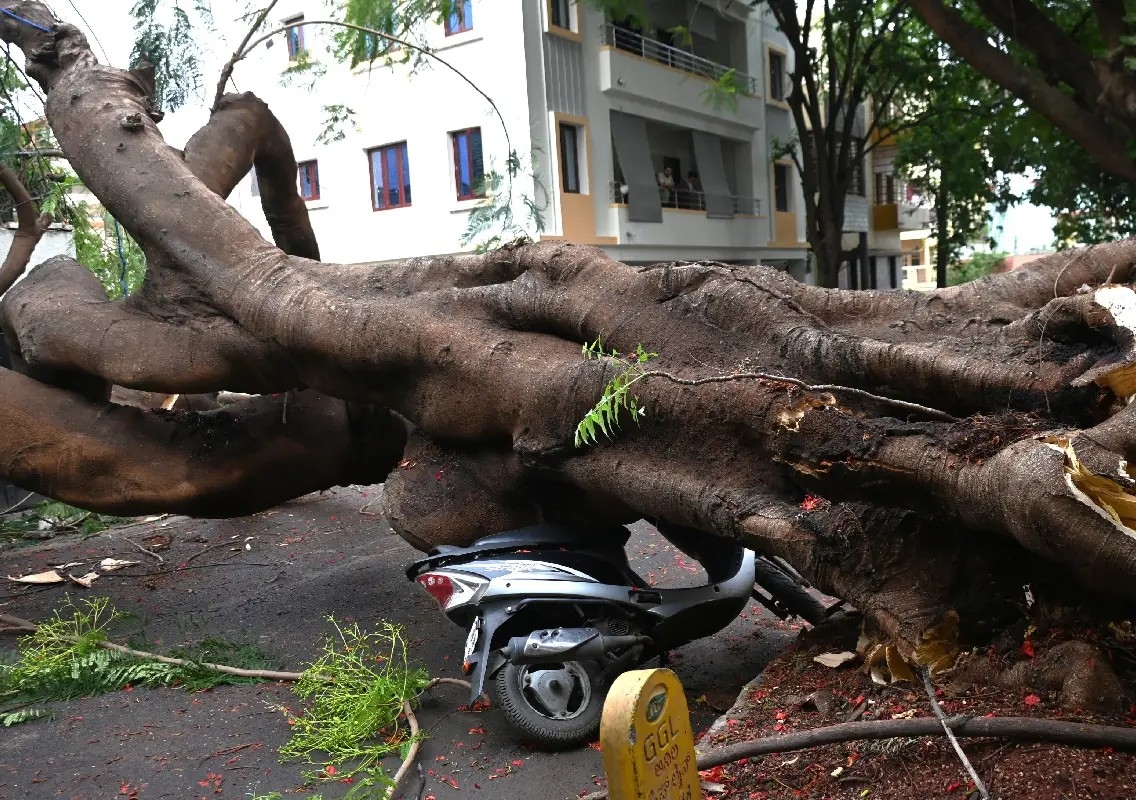


Bengaluru’s iconic exotic trees, known for colouring the city’s roads with vibrant blooms, are now emerging as a growing safety concern due to ageing, weak root systems, and unscientific urban development practices.
According to data from the Greater Bengaluru Authority, over 66 per cent of trees that collapsed during the April 29 thunderstorm belonged to just four exotic species — Copperpod, African Tulip, Gulmohar, and Nile Tulip.
Hundreds of trees collapsed during storm
Between April 29 and May 1, the Forest Cell of the Greater Bengaluru Authority recorded 516 fallen trees from 20 species across the city. Of these, 343 trees were from the four exotic ornamental varieties.
Officials said many of these trees were planted nearly 30 years ago and have now crossed or approached their natural lifespan.
Experts call for scientific assessment
GBA Deputy Conservator of Forests Sudarshan G K said the city urgently requires scientific evaluation of ageing trees and gradual replacement with stronger native species that can better withstand extreme weather events.
Experts also warned that unscientific pruning, road widening, drain works, and footpath construction often damage root systems, weakening trees over time.
Study highlights health concerns
A study conducted by the Institute of Wood Science and Technology found that nearly half the street trees surveyed in Malleshwaram were unhealthy, with exotic species forming the majority.
Scientists recommended using non-invasive technologies such as sonic tomography and Resistograph testing to assess tree health.
Native species seen as safer option
Researchers suggested replacing ageing exotic trees with native varieties such as neem, honge, jamun, mahua, and arjuna, which are considered more resilient during heavy rain and storms.
Experts also stressed that selecting the right species for specific urban spaces is critical for public safety and long-term ecological balance.