







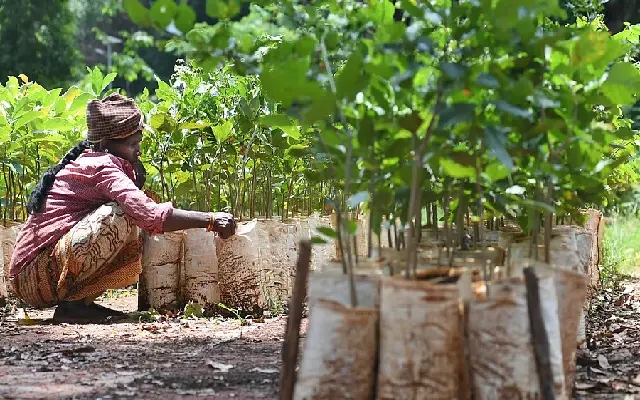


Bengaluru – As June arrives, Bengalureans, concerned about the city’s fading green charm, step forward to plant saplings in open spaces and neighborhoods. The Bruhat Bengaluru Mahanagara Palike (BBMP) sets aside funds annually to promote greenery, and this year, plans to plant 1 lakh saplings citywide, said Deputy Conservator of Forests, B.L.G. Swamy.
Four new Miyawaki forests are being developed in Kudlu (Bommanahalli), Singapura (Yelahanka), Ambedkar Park (Dasarahalli), and Sadashivanagar. Additionally, 20,000 saplings will be planted as compensatory afforestation for trees felled by agencies like BWSSB and BMRCL.
To improve survival rates, BBMP intends to remove cement around plants and replace it with water-permeable pavers. Metal tree guards obstructing growth will also be taken out through a new tender. However, activists like Vijay Nishanth have flagged a lack of transparency and public updates in BBMP’s green drives.
Swamy stated that citizens can request limited saplings, while bulk requests from communities are managed by BBMP, which also monitors sapling health. Planting costs, including five-year maintenance, come to ₹3,100 per sapling. However, activists argue that the impact doesn’t justify the expenses.
BBMP uses a geo-tagging system and the Hasiru Rakshaka app to monitor planted saplings, but citizens report that the app is non-functional or inaccessible. Likewise, the Mapathon site used to flag planting locations often fails to work.
Concerns also persist over poor timing, weak contract enforcement, and lack of variety in species. Despite efforts, green cover continues to shrink while accountability remains elusive.