







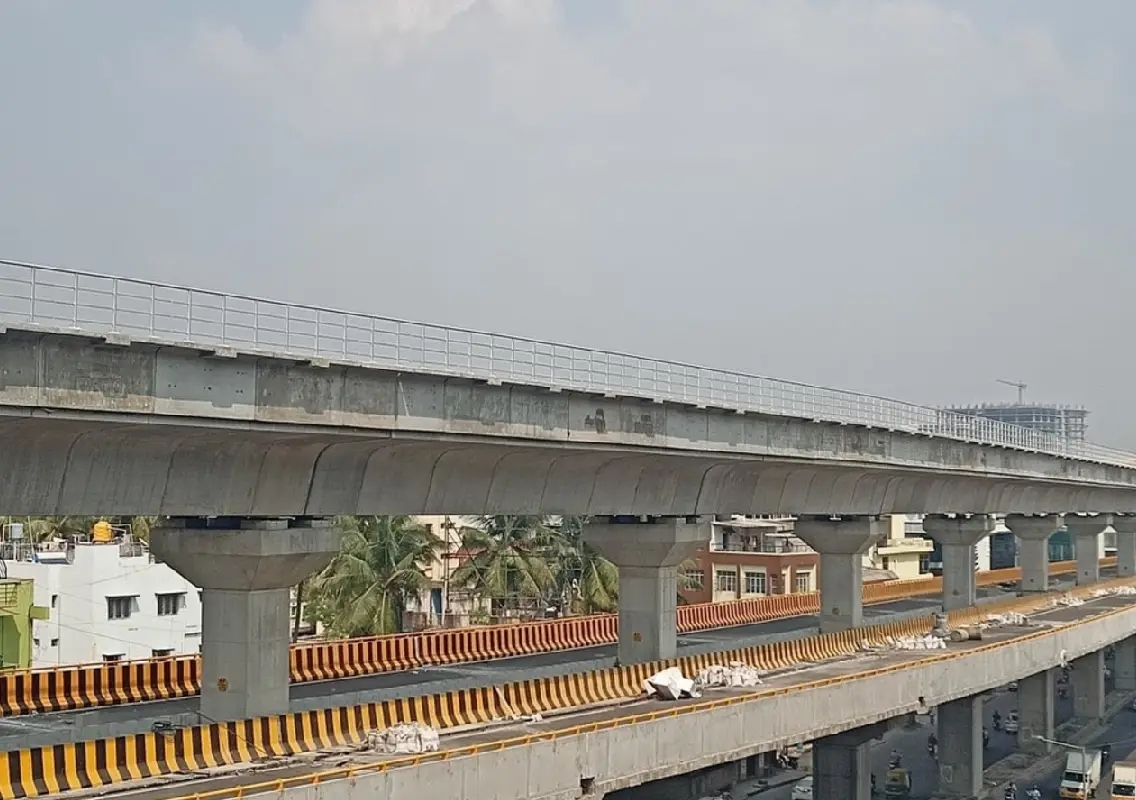


The upcoming Phase 3 of Namma Metro will include the city’s longest double-decker viaduct, equipped with five entry and exit ramps and nine traffic loops, according to senior officials familiar with the project. The ambitious structure is expected to significantly ease congestion along some of Bengaluru’s busiest stretches while integrating elevated metro and road transport on a single corridor.
The Bangalore Metro Rail Corporation Limited (BMRCL) will construct a 37.121-km double-deck viaduct, covering both corridors of the 44.65-km Phase 3 network. The project involves placing the road flyover on the lower deck and the metro line on the upper deck, similar to the Ragigudda–Silk Board Junction double-decker built under Phase 2A and 2B.
Two major corridors planned under Phase 3
Phase 3 comprises two corridors:
• Corridor 1: JP Nagar 4th Phase to Kempapura, covering the western stretch of the Outer Ring Road.
• Corridor 2: Hosahalli to Kadabagere along Magadi Road.
Corridor 1 will house the longest double-decker in the city, spanning 28.486 km from Delmia Circle to Hebbal. This section will replace the existing flyover at Delmia Circle, where a 631-metre entry/exit ramp will be constructed as the starting point. The ending point at Hebbal will see the flyover diverging towards the airport, while the metro continues on the elevated alignment towards Kempapura, the terminal station.
Corridor 2 will include an 8.635-km double-decker between KHB Colony and Kadabagere. Entry/exit ramps for this corridor are planned at KHB Colony, Sunkadakatte, and Kadabagere, with ramps on either side of the Sunkadakatte depot to streamline the viaduct height and accommodate the depot entry line within the available land.
Nine loops across two corridors
To support local vehicular connectivity, the double-decker will include several loops:
Corridor 1 loops (5.565 km total):
- Sarakki Junction (Kanakapura Road)
- NICE Road
- Mysuru Road
- Vinayaka Layout
- Sumanahalli Junction (Magadi Road)
- Goraguntepalya (Tumakuru Road)
- Hebbal (towards Kempegowda International Airport)
Corridor 2 loops (3.19 km total):
- Sumanahalli Junction
- NICE Road
Except at Delmia Circle, the double-decker will either run alongside or above existing flyovers, including those at Hosakerehalli, Mysuru Road, Nagarabhavi, and Sumanahalli, allowing seamless integration with current infrastructure.
Project cost and funding structure
The double-decker viaduct is estimated to cost ₹9,692.33 crore, fully funded by the Karnataka government. The state will contribute 50%, while the Greater Bengaluru Authority (GBA) will fund 10%, and the remainder will be sourced through loans.
The DPR estimates a Financial Internal Rate of Return (FIRR) of 16.5%, supported by combined metro ridership revenue and toll collections from the elevated road. While the government has confirmed that tolling will be introduced, specific charges have not been finalised. Civil works under Phase 3 have been delayed owing to the complexity of incorporating the double-decker structure, though authorities aim for its completion by 2030. The broader Phase 3 corridor has a tentative deadline of May 2031.
BMRCL has finalised the Detailed Design Consultancy (DDC) report for the entire project and will soon invite tenders. A single contractor will execute both the metro viaduct and the flyover, ensuring synchronised work across structures.
Six interchange stations to boost network connectivity
Phase 3 will also improve Bengaluru’s inter-corridor connectivity through six interchange stations, linking new lines with existing metro corridors. These include:
- JP Nagar 4th Phase (Pink Line)
- JP Nagar (Green Line)
- Mysuru Road (Purple Line)
- Sumanahalli Cross (Corridor 1 and Corridor 2)
- Goraguntepalya (Green Line)
- Kempapura (Blue Line)
These interchanges are expected to ease transfers, reduce travel time, and enhance last-mile connectivity in the expanding metro network.
Conclusion
The double-decker viaduct planned under Phase 3 represents one of Bengaluru’s most complex urban transport projects to date. With integrated metro and elevated road systems, multiple loops, and strategic interchange stations, the project aims to future-proof mobility in the western and northwestern parts of the city. While delays have occurred, officials maintain that once completed, the structure will significantly decongest major corridors and improve travel efficiency for lakhs of commuters