







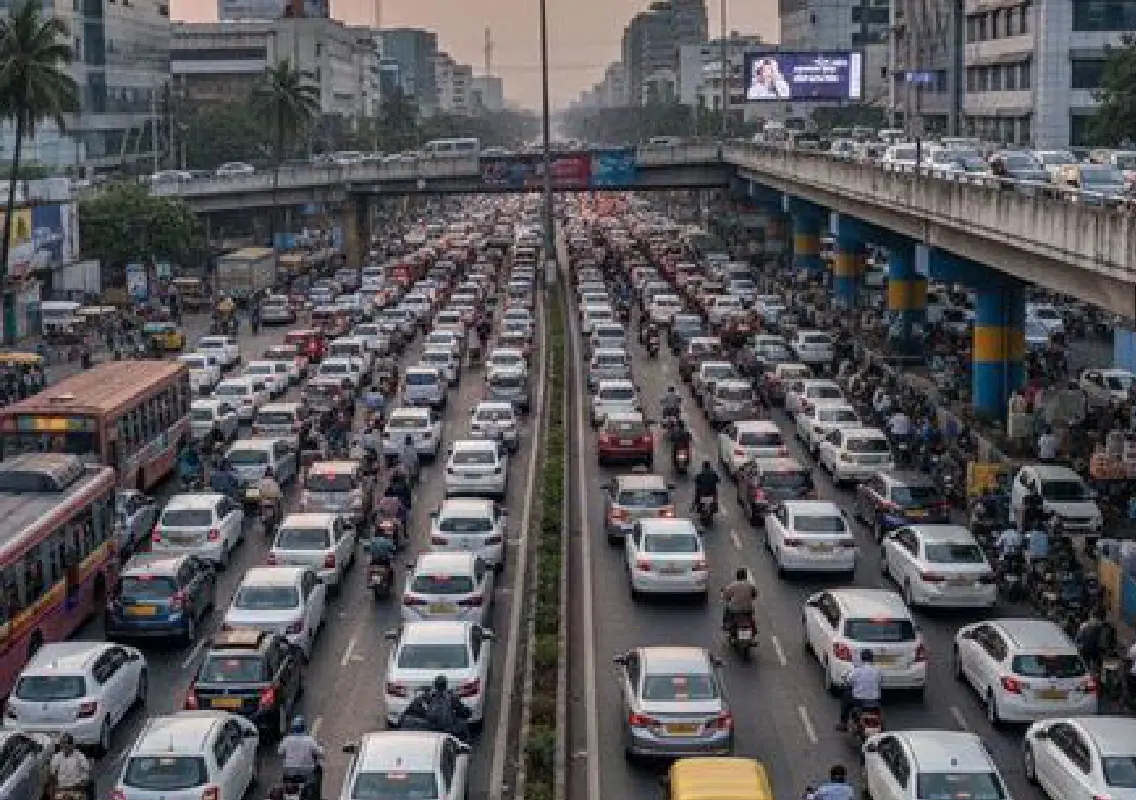


Bengaluru’s traffic crisis has deepened as the city crossed 1.2 crore registered vehicles as of March 31, 2026, highlighting a widening gap between rapid vehicle growth and limited road infrastructure.
With just 14,063 km of road network, the city now has nearly 900 vehicles per kilometre—almost double that of Delhi, which has around 480 vehicles per km despite having a significantly larger road network.
Rapid rise in vehicle registrations
In FY 2025–26 alone, Bengaluru added 7.9 lakh new vehicles, averaging about 2,100 registrations daily. This marks a sharp increase from the previous year’s 7.2 lakh additions, indicating that the growth rate is accelerating.
Two-wheelers continue to dominate, accounting for 5.2 lakh of the new additions, followed by 1.5 lakh cars. The city’s total fleet now includes 86 lakh two-wheelers, 24.8 lakh cars, along with autos and taxis.
Limited alternatives driving two-wheeler boom
The surge in two-wheelers reflects the realities of daily commuting. Public transport systems have not expanded at the same pace as demand. The Namma Metro currently operates around 96 km of lines, while the Bangalore Metropolitan Transport Corporation fleet has remained largely unchanged at about 7,000 buses.
For many residents, two-wheelers remain the most practical and time-efficient mode of transport in a congested city.
Road infrastructure struggling to keep up
While the number of vehicles has nearly doubled over the past decade—from 64.4 lakh in 2015 to over 1.2 crore in 2026—the expansion of road infrastructure has not kept pace.
This imbalance is evident in declining travel speeds, with average peak-hour speeds on major corridors ranging between 11 and 15 kmph. On key stretches such as Outer Ring Road, commute times during peak hours are often two to three times longer than off-peak durations.
Future plans and growing concerns
According to estimates, commuters lose nearly 168 hours annually due to traffic congestion. The Karnataka government has allocated funds for new road development and upgrades, while metro expansion aims to reach 175 km by 2027, with further additions planned.
However, experts caution that unless infrastructure growth accelerates significantly, the current ratio of vehicles to road length may continue to worsen, intensifying congestion and impacting quality of life in the city.