







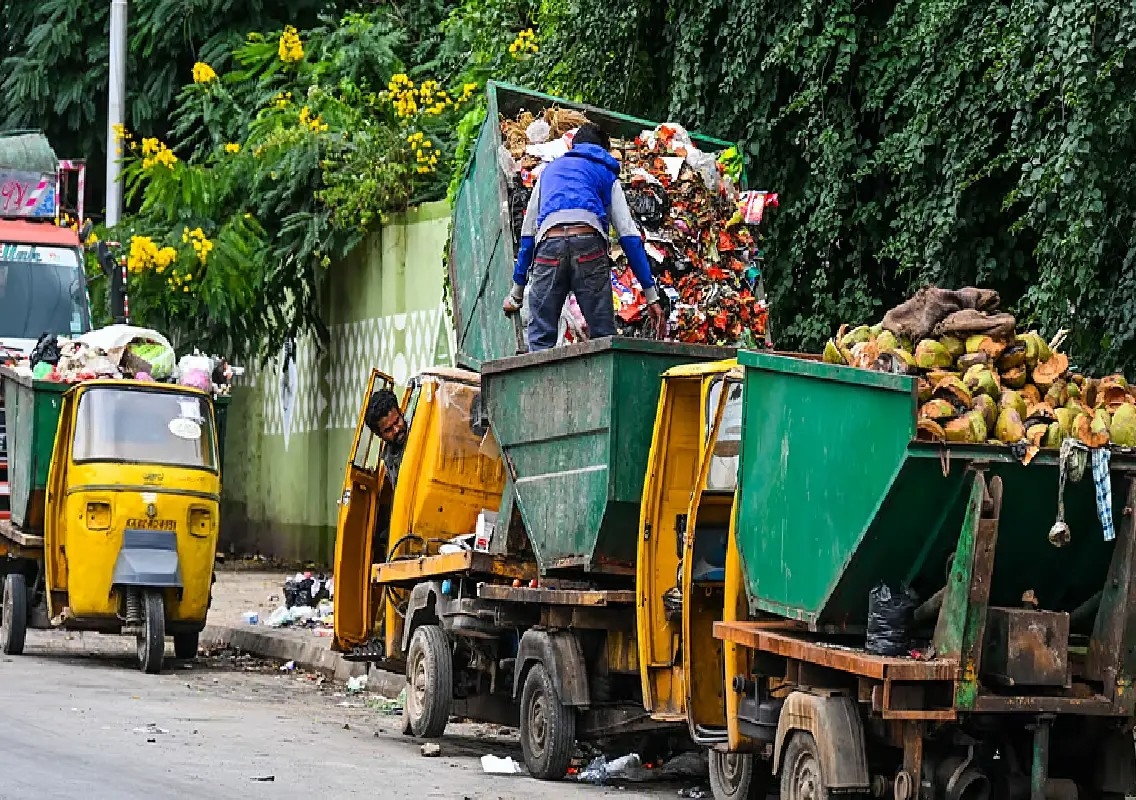


Bengaluru: Despite being one of India’s early pioneers in decentralised waste management and source segregation, Bengaluru is witnessing a slowdown in household waste segregation, with compliance stagnating at around 54 per cent. The plateau comes even as the city generates nearly 5,000 tonnes of municipal solid waste every day and the Centre’s Solid Waste Management Rules, 2026 introduce stricter norms aimed at improving segregation and scientific waste processing.
The new rules, which are to be implemented within 18 months from April, require waste to be segregated into four categories at the source—wet, dry, sanitary and special care waste. Civic authorities and waste management experts say stronger public participation and improved infrastructure will be critical to meeting the new compliance standards.
New rules tighten waste management norms
The Solid Waste Management Rules, 2026, seek to strengthen scientific waste management across urban areas by making segregation at source mandatory.
Under the revised framework, households and commercial establishments are required to separate waste into four streams before handing it over for collection. The rules also discourage landfill disposal and encourage recycling, composting and decentralised processing.
While several established neighbourhoods in Bengaluru have adopted source segregation, compliance remains inconsistent in many peripheral layouts and densely populated areas where awareness and enforcement continue to be limited.
In some localities, auto-tippers refuse to collect mixed waste, but officials acknowledge that the practice has not become universal across the city.
Bengaluru once led the way
Bengaluru began promoting scientific waste management long before segregation became a nationwide requirement.
In the early 2000s, following the notification of the first national Solid Waste Management Rules, the city launched the Swachh Bengaluru initiative under the Bangalore Agenda Task Force (BATF), which had been constituted during the tenure of then Chief Minister S. M. Krishna.
The initiative replaced large roadside cement garbage bins with door-to-door waste collection and encouraged residents to segregate waste at source.
Neighbourhood composting units, dry waste collection centres and decentralised waste processing facilities were established in areas such as Jayanagar, Koramangala, Malleswaram and Indiranagar, making Bengaluru a national model for community-driven waste management.
Citizen participation played key role
Kalpana Kar, a founding member of BATF, recalled that community volunteers known as Suchi Mithras played an important role in promoting segregation and improving local participation.
She said the volunteers created awareness among residents, monitored waste collection by auto-tippers and coordinated with civic authorities to improve waste management practices.
According to her, the programme evolved gradually despite limited technological resources at the time.
Kar noted that today’s digital tools and social media platforms could significantly improve awareness campaigns if supported by sustained collaboration between civic agencies and citizens.
Infrastructure and awareness remain challenges
Waste management experts believe Bengaluru’s segregation drive lost momentum as the city expanded its waste processing infrastructure.
The city currently operates seven wet waste processing plants with a combined treatment capacity of 1,550 tonnes per day.
As larger quantities of wet waste began reaching these facilities, the urgency to improve segregation reportedly diminished, while mixed waste continued to be transported to landfills.
Officials say increasing segregation levels remains essential to improving recycling efficiency and reducing dependence on landfill sites.
Officials call for shared responsibility
Bengaluru Solid Waste Management Ltd (BSWML) Chief Executive Officer Karee Gowda said stakeholder consultations are being conducted to improve segregation and strengthen public participation.
He observed that many residents assume their responsibility ends once waste is handed over for collection, whereas improper segregation creates significant downstream challenges for processing agencies.
He noted that waste management requires continuous effort because garbage is generated every day, unlike infrastructure projects such as road repairs that are completed periodically.
Experts seek long-term reforms
Solid waste management expert V. Ramprasad said waste processing should be treated as a specialised industry rather than solely a civic responsibility.
He suggested that the government establish waste processing facilities in Karnataka Industrial Areas Development Board (KIADB) industrial zones and allocate land specifically for scientific waste processing projects.
According to him, involving multiple agencies and encouraging private participation would strengthen Bengaluru’s waste management ecosystem.
Kalpana Kar also stressed the need to revive the collaborative model that once made Bengaluru a leader in waste management, emphasising that technology, citizen participation and accountability must work together to improve segregation levels.
City faces crucial transition
With the implementation deadline for the Solid Waste Management Rules, 2026 approaching, Bengaluru faces the challenge of bridging the gap between policy and practice.
Experts believe improving awareness, strengthening enforcement, expanding scientific processing facilities and encouraging active citizen participation will be essential for increasing segregation beyond the current 54 per cent.
As one of India’s fastest-growing metropolitan cities, Bengaluru’s success in implementing the new rules could play an important role in shaping sustainable urban waste management practices across the country.