







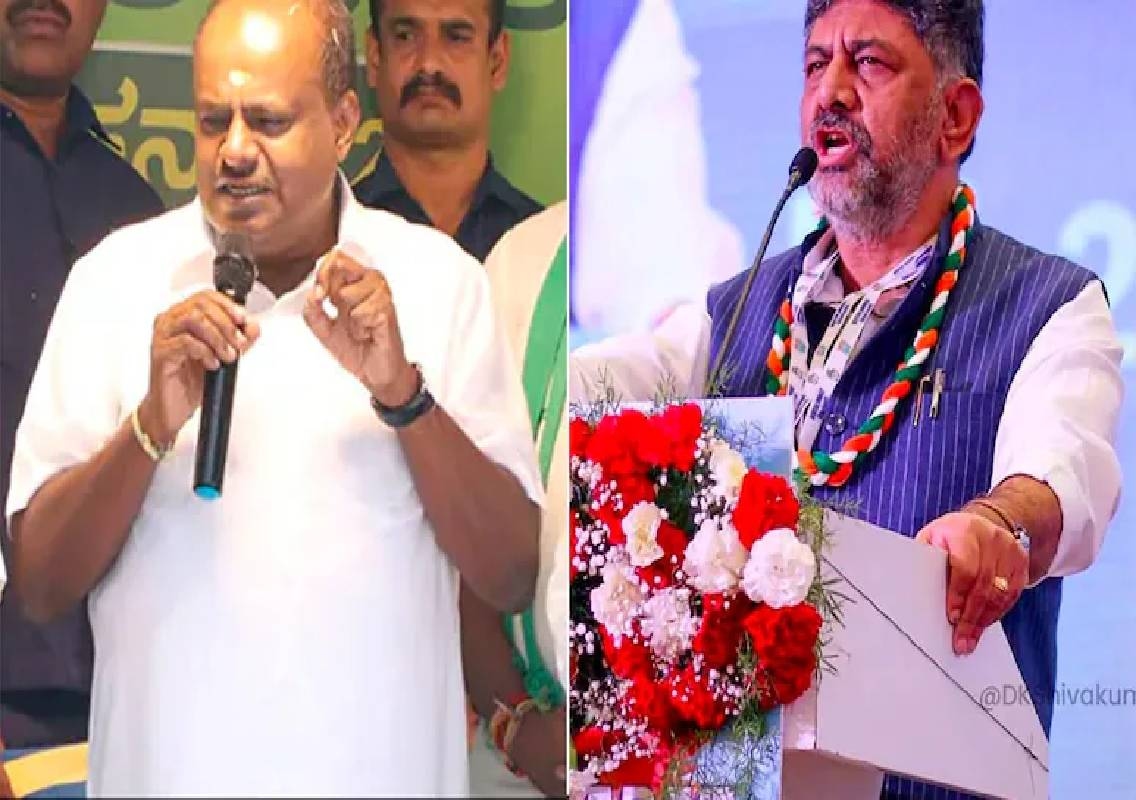


Bengaluru: A fresh political confrontation has erupted in Karnataka over the proposed Bidadi Township project, with Deputy Chief Minister DK Shivakumar and Union Minister HD Kumaraswamy engaging in a war of words over land acquisition, farmer compensation and development priorities.
The controversy centres on the acquisition of agricultural land in Bidadi, located on the outskirts of Bengaluru, for a large-scale township project. While the state government argues that the project is essential for urban and industrial growth, critics have raised concerns about the impact on fertile farmland and the long-term interests of farmers.
Shivakumar accuses Kumaraswamy of changing stance
Speaking after a Cabinet meeting at Vidhana Soudha, Shivakumar questioned Kumaraswamy’s opposition to the project and alleged that the former chief minister was attempting to mislead farmers.
According to Shivakumar, the Bidadi Township project was originally conceived during Kumaraswamy’s tenure and was later continued by successive governments, including those led by the Bharatiya Janata Party.
“The farmers of Bidadi are good people, but they are being misled. Isn’t Kumaraswamy the architect of this project? He himself has admitted it,” Shivakumar said.
The Deputy Chief Minister maintained that the Congress government was not introducing a new proposal but merely advancing a project that had already been initiated and approved by previous administrations.
Government highlights enhanced compensation package
Shivakumar emphasised that the current government had improved the compensation package for affected landowners.
He noted that while earlier proposals reportedly offered farmers 40 per cent of the developed land, the present government had increased the share to 50 per cent.
The Deputy Chief Minister also announced that the process of disbursing compensation had begun, with affected landowners set to receive Rs 2.5 crore per acre.
According to him, the revised package demonstrates the government’s commitment to balancing development needs with the interests of farmers.
“We have assured farmers that they will receive 50 per cent of the developed land. The process of compensation distribution commenced on Friday,” he said.
State says majority of landowners support project
The government has claimed that a substantial majority of landowners have voluntarily agreed to participate in the project.
Shivakumar stated that nearly 80 per cent of landowners had consented to part with their land and that the administration would proceed strictly within the framework of the law.
He also rejected demands from some groups seeking de-notification of the acquired land, arguing that infrastructure and industrial growth require the availability of land for planned development.
According to the state government, the township is expected to contribute to economic growth and generate employment opportunities in the region.
Kumaraswamy defends opposition
Responding to Shivakumar’s remarks, Kumaraswamy insisted that his position on the project has remained consistent.
The Union minister stated that when the issue was discussed in the Karnataka Legislative Assembly during his tenure as chief minister, he had clearly opposed the acquisition of fertile agricultural land for township development.
“My position as Chief Minister is on record. I had clearly stated that not even an inch of fertile agricultural land would be acquired for the project,” Kumaraswamy said.
He argued that while township development may be necessary, it should not come at the expense of productive farmland that supports the livelihoods of local communities.
Debate over long-term value of farmland
A key point of disagreement between the two leaders concerns the economic benefits of compensation versus retaining agricultural land.
Kumaraswamy questioned whether one-time compensation payments could match the long-term appreciation of land values.
According to him, agricultural land in and around Bengaluru has the potential to increase significantly in value over the coming decades.
He argued that even if compensation money were invested, the returns would be far lower than the potential value of retaining ownership of the land.
The Union minister claimed that landowners could potentially see their property value rise substantially over a 20-year period, making preservation of farmland a more beneficial option in the long run.
Political significance of the dispute
The Bidadi Township controversy has emerged as a significant political issue in Karnataka, particularly in regions where land acquisition remains a sensitive topic.
Supporters of the project view it as an important step towards planned urbanisation and industrial expansion around Bengaluru. Opponents, however, argue that development should not compromise fertile agricultural land and farmer livelihoods.
The dispute has also highlighted broader questions about balancing infrastructure growth with environmental sustainability and agricultural preservation.
Conclusion
The debate over the Bidadi Township project continues to divide Karnataka’s political leadership, with the state government defending the acquisition process and opposition leaders questioning its impact on farmers. As compensation payments begin and legal procedures move forward, the issue is likely to remain a major talking point in the state’s political landscape. The final outcome could have significant implications for future land acquisition and development projects across Karnataka.