


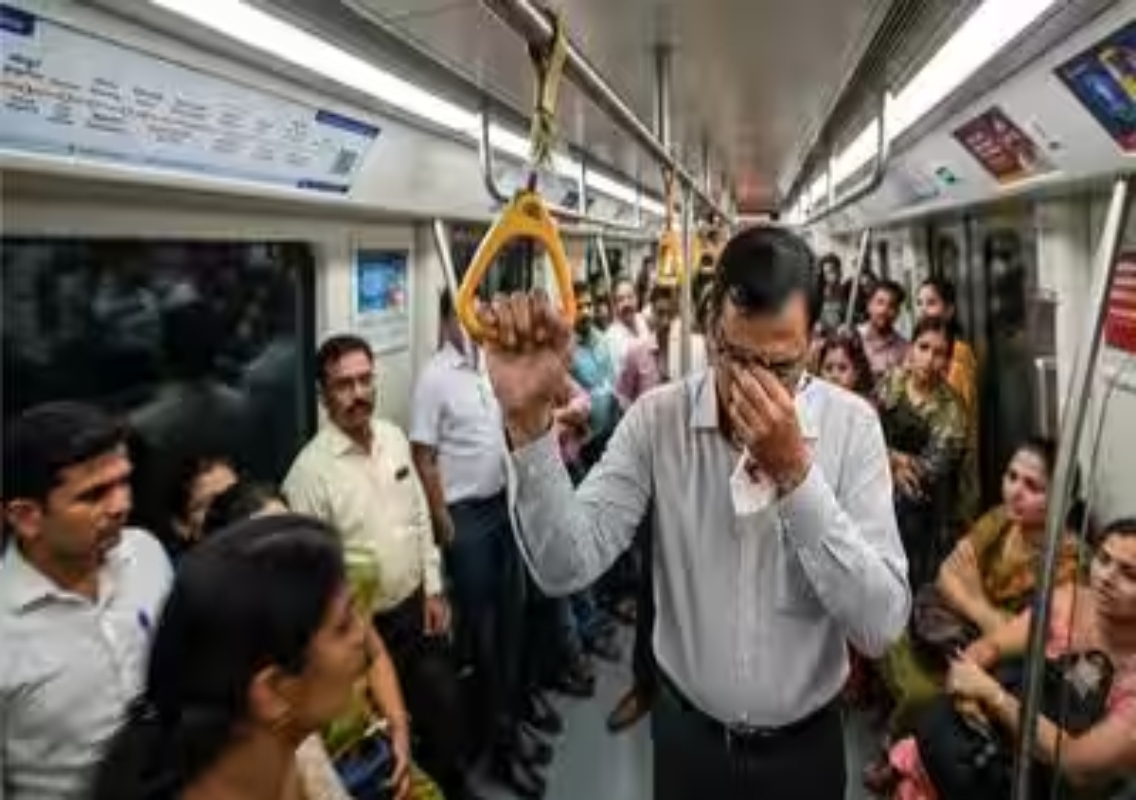


Bengaluru: A consumer commission in Bengaluru has directed Bangalore Metro Rail Corporation Ltd (BMRCL) to pay Rs 5,000 to a passenger who suffered a nose injury after a grab handle snapped inside a crowded Metro train. The incident also damaged his spectacles, valued at Rs 3,000.
The passenger, identified as MG Nagaraju, was travelling on a Metro train from Rajajinagar to KR Market on January 18, 2025, when the incident occurred. The 49-year-old was standing because all the seats were occupied and was holding a grab handle for support.
As the train approached KR Market station, the handle reportedly snapped and struck him on the nose, causing bleeding. His spectacles were also damaged in the incident.
The consumer commission held BMRCL responsible for deficiency in service and directed it to pay Rs 5,000. The amount comprises Rs 3,000 towards the damaged spectacles and Rs 2,000 as compensation and litigation costs.
Passenger alleged that his complaint was initially dismissed
Following the incident, Nagaraju approached the station controller and reported what had happened. He alleged that his complaint was initially not accepted and that he was allowed to register it only after repeated requests.
He also contacted BMRCL’s complaints cell four days later. According to his complaint, he was informed that the corporation had not received any record of his earlier complaint.
BMRCL subsequently denied responsibility for medical compensation in an email dated January 24, 2025. Nagaraju then approached the consumer commission on February 10, seeking Rs 1 lakh in compensation, reimbursement of medical expenses and the cost of his damaged spectacles.
The dispute centred on whether the passenger had used the grab handle normally or had placed excessive weight on equipment that was not designed to support a person’s full body weight.
BMRCL claimed passenger misused the grab handle
In its defence, BMRCL argued that the grab handle assembly was designed to provide light support and was not intended to bear the entire body weight of a passenger.
The corporation stated that the assembly included the handle, Kevlar rope, spring and ceiling attachment. It claimed that CCTV footage showed Nagaraju holding the handle with both hands and putting his entire body weight on it, causing the rope to tear.
BMRCL also maintained that Metro equipment was subject to daily and weekly inspections. It said the handle had been replaced at 11.05 am on the day of the incident.
The corporation disputed the passenger’s claim regarding the spectacles as well, pointing out that the purchase bill submitted by him dated back to 2015. It also questioned the applicability of consumer protection law, arguing that it was a public utility corporation jointly owned by the Karnataka and Union governments.
Commission questions absence of CCTV footage
The consumer commission did not accept BMRCL’s argument about passenger misuse. Although the corporation repeatedly referred to CCTV footage to support its claim, it failed to produce the recording before the commission.
The commission also considered a photograph submitted by Nagaraju. It reportedly showed him holding the grab handle in a normal manner, without any indication that he was misusing the equipment.
The commission observed that BMRCL had not communicated any restriction on the use of the grab handles through signboards, announcements or passenger guidelines.
It noted that passengers travelling in crowded Metro coaches could not be expected to know the technical limitations of support equipment if the operator had not clearly informed them about those restrictions.
The absence of the CCTV footage cited by BMRCL also weakened its defence that the passenger had caused the handle to break through improper use.
Metro operator comes under consumer protection law
The commission also rejected BMRCL’s argument that it should not be covered by consumer protection provisions because it was a government-owned public utility corporation.
It held that a Metro operator collecting fares from passengers provides a service and is therefore covered by the Consumer Protection Act, 2019.
The commission’s bench comprised president Syed Anser Kaleem and members Sharavathi SM and Jyothi N.
After considering the circumstances of the incident and the arguments presented by both sides, the commission held BMRCL liable for deficiency in service and ordered the Rs 5,000 payment to Nagaraju.
Passenger safety and maintenance under focus
The case has brought attention to the importance of maintaining passenger-support equipment inside Metro coaches, particularly during peak hours when many commuters have to stand.
Grab handles are commonly used by standing passengers to maintain balance while trains accelerate, slow down or move through stations. Their condition and reliability are therefore important aspects of passenger safety.
The commission’s observations also underline the importance of clearly communicating any restrictions on the use of equipment inside public transport vehicles. If a particular fitting is intended only for limited support, passengers need to be informed through appropriate instructions.
For BMRCL, the order highlights the need to ensure that equipment inspections, maintenance records and passenger grievance procedures are supported by proper documentation.
The Rs 5,000 direction brings the consumer dispute to a decision at the commission level. The case also illustrates how evidence, including CCTV recordings and photographs, can become important when responsibility for an incident inside public transport is contested.