







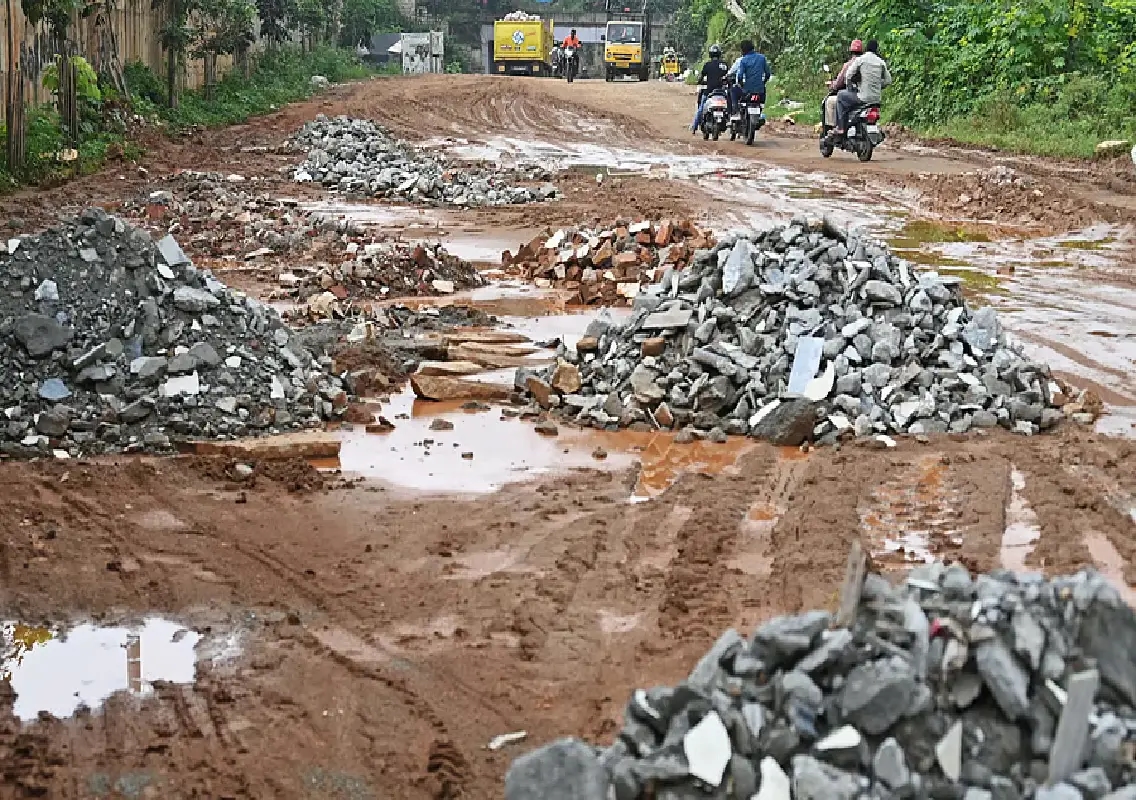


Bengaluru: The Bangalore Solid Waste Management Ltd (BSWML) has awarded a ₹1,714-crore contract to a private firm for the collection, transportation and processing of construction and demolition (C&D) waste, a move that has sparked concerns among experts over monopoly, transparency and long-term accountability in debris management across the city.
Under the contract, Chaitra Civil Ventures LLP will handle 2,250 tonnes of C&D waste per day for a concession period of 15 years, operating under a design-build-finance-operate-transfer (DBFOT) model. The Urban Development Department (UDD) issued orders appointing the concessionaire on December 29, 2025.
Single-operator model for entire waste chain
The project adopts a single-operator model, placing the entire chain of operations — collection, transportation and processing — under one private agency. BSWML will pay the firm a tipping fee of approximately ₹967 per tonne, with an assured annual escalation of 5 per cent over the contract period.
While officials argue that this integrated approach will streamline debris management and help keep roads, lakes and public spaces free of construction waste, solid waste management experts have raised red flags. They caution that vesting all responsibilities with one firm creates scope for inflating the quantity of waste handled, as the same operator controls collection, measurement and processing.
Another major concern is the lack of clarity on user charges. It remains unclear how much individuals, builders or developers generating C&D waste will be required to pay — whether directly to the private firm or to the civic body — raising questions about transparency and affordability.
Monopoly fears and lack of competition
Experts have also pointed out that awarding all three packages of the project to a single firm effectively creates a monopoly in C&D waste handling for the entire city. This, they warn, removes competitive pressure that is often crucial for maintaining efficiency, service quality and cost control.
“With a single operator managing all debris in the city for 15 years, there is very little scope for benchmarking performance or course correction if things go wrong,” a solid waste management expert said. “If the system underperforms, the city will be locked into the arrangement for a long duration.”
The project has been divided into three separate packages, each with a processing capacity of 750 tonnes per day and a concession period of 15 years. Each package is valued at approximately ₹571.6 crore, taking the total contract value to ₹1,714 crore. All three packages have been awarded to Chaitra Civil Ventures LLP.
Proposed processing facilities
As part of the contract, the concessionaire is required to fully invest in setting up processing plants and deploy vehicles for debris collection and transportation. Three processing facilities, each with a capacity of 750 tonnes per day, are proposed to be established on government land parcels.
The identified locations include eight acres on Survey Number 14 in Venkatapura village, Dasanapura, belonging to the Bangalore Metropolitan Transport Corporation; nine acres in Mylasandra village, Begur taluk, owned by the Revenue Department; and seven acres in Marenahalli village, Yelahanka.
According to officials, decentralising processing across these locations is expected to reduce illegal dumping and shorten transportation distances. However, critics argue that operational efficiency alone should not override concerns about oversight and checks and balances.
Significant financial commitment
With this contract, BSWML’s financial commitment towards C&D waste management has risen sharply. The civic agency will spend a total of ₹2,766 crore on C&D waste processing when combined with an earlier contract awarded to the same firm.
Chaitra Civil Ventures Ltd had previously secured a ₹1,052-crore deal to handle 1,750 tonnes of C&D waste per day at existing processing plants in Kannur and Chikkajala for 15 years. Taken together, the total expenditure works out to about ₹184 crore per annum for debris management.
Critics question whether such large, long-term financial commitments have been adequately scrutinised, especially given the absence of multiple service providers.
Official justification and silence
Officials maintain that the arrangement has been designed to address Bengaluru’s growing C&D waste problem, which has led to debris clogging stormwater drains, encroaching on lake beds and littering public spaces. They argue that a single accountable operator will make enforcement easier and ensure responsibility for outcomes.
However, attempts to seek clarity from BSWML on several aspects of the contract, including monitoring mechanisms and user charges, have not yielded responses. Kareegowda, Chief Executive Officer of BSWML, was not available for comment.
Long-term implications
Urban planners and waste management specialists note that while integrated models can offer efficiencies, they also require robust regulatory oversight. In the absence of competing operators, the burden on the civic agency to monitor performance, verify quantities and enforce penalties becomes significantly higher.
“There needs to be a strong independent audit mechanism, otherwise the city risks overpaying for services without corresponding improvements on the ground,” an expert said.
Conclusion
The ₹1,714-crore C&D waste contract marks one of the largest long-term commitments by BSWML in recent years and reflects the scale of Bengaluru’s debris management challenge. While the civic body hopes the single-operator DBFOT model will bring order to construction waste handling, concerns over monopoly, transparency and accountability remain unresolved. How effectively the system performs over the next 15 years will depend not just on infrastructure, but on vigilant oversight and clear policies governing costs and public interest.