







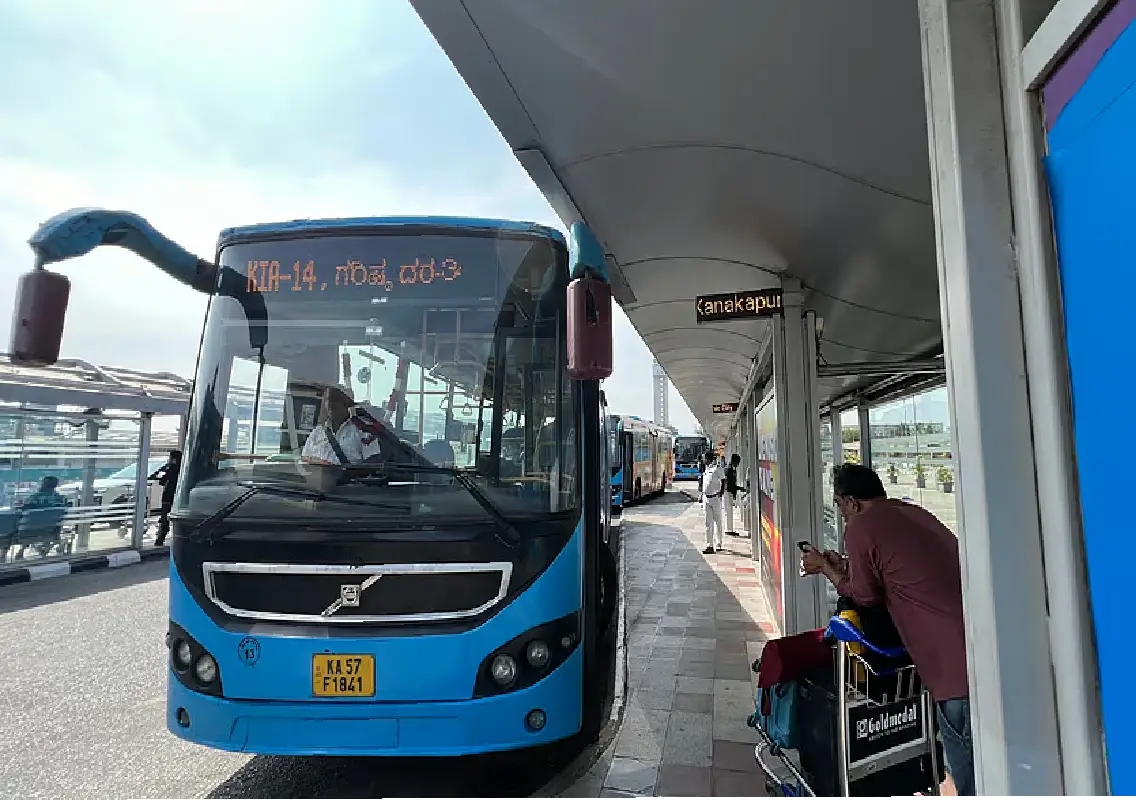


Bengaluru: Bangalore International Airport Limited (BIAL) has come under sharp criticism for significantly reducing the on-ground space allotted to Vayu Vajra airport bus services at Terminal 1 (T1) of Kempegowda International Airport, a move that has led to congestion, inconvenience to passengers, and operational strain on drivers.
Vayu Vajra buses, operated by the Bengaluru Metropolitan Transport Corporation (BMTC), have long been considered the most affordable and accessible mode of transport to and from the airport. Since the airport began operations in 2008, these buses have also remained the only form of public transport directly serving air travellers. However, recent changes in the allocation of bus bays at T1 have disrupted the system that catered to thousands of passengers daily.
Bus bays reduced drastically
Earlier, Vayu Vajra buses operated from 14 dedicated bays at T1, allowing an average waiting time of around 30 minutes and sufficient halting time for passengers to board comfortably. This arrangement has now been curtailed to just six bays, with buses reportedly allowed to halt for barely 10 minutes before being asked to move.
According to BMTC officials, until May 2025, T1 had two lanes designated for Vayu Vajra services, each accommodating six to eight bays. This has now been reduced to a single narrow lane with only six bays. The space earlier used by Vayu Vajra buses has reportedly been taken over by cab aggregator Quick Ride, further fuelling criticism that public transport is being sidelined in favour of private operators.
Impact on passengers and ridership
With just six bays handling 156 daily Vayu Vajra schedules across 22 routes, congestion has increased sharply. BMTC staff say the reduced halting time has affected the ability of buses to operate at full capacity.
“The entire system is now rushed. Earlier, buses could wait for 20 to 25 minutes and leave the airport full. Now, they get less than 10 minutes. If a passenger is even two minutes late, they miss the bus and have to wait 30 minutes to one hour for the next one,” said a BMTC staff member deployed at the airport.
BMTC data reflects the impact of this change. Daily ridership, which earlier averaged around 12,000 passengers, has dropped by approximately 1,000 since the reduction in bus bays. During a recent visit to the airport, several passengers were seen enquiring about bus schedules, but many chose not to wait, opting instead for costlier cab services.
Passengers have complained that the reduced space has made boarding confusing, with multiple routes now sharing the same bays and announcements often drowned out by the general airport noise.
Drivers under strain
The decision has also added to the workload and stress faced by Vayu Vajra drivers. With limited parking space at T1, drivers are now required to move their buses to Parking Zone 7 (P7), located about 2–3 km away, after each trip.
“Since we can’t park at T1, we have to keep moving to P7. With this constant movement, we don’t even get time to eat lunch properly,” said Hemaraju, a BMTC driver.
Other drivers highlighted the difficulty of manoeuvring buses in the tight lane, especially when several routes are scheduled around the same time. The lack of adequate space has reportedly increased the risk of minor accidents and added to confusion among passengers unfamiliar with the revised layout.
BMTC–BIAL standoff
BMTC officials said repeated efforts to restore the second lane at T1 have not yielded results. “We have held discussions with BIAL and submitted a formal letter outlining our concerns, but so far there has been no positive response,” a senior BMTC official said.
In response, a BIAL spokesperson stated that the reduction in bus bays at T1 was carried out after a dedicated BMTC bus stand was established at Terminal 2 (T2). “All buses that stop at T1 also stop at T2,” she said.
However, BMTC data indicates that around 80% of Vayu Vajra users are passengers travelling through T1, while T2 accounts for only 1,000 to 2,000 riders daily. This has raised questions about the rationale behind reducing facilities at the terminal that handles the majority of bus commuters.
Government intervention
Transport Minister Ramalinga Reddy, who recently visited the airport to review new cab pick-up rules and overstay charges, described the reduction of Vayu Vajra bus bays as “unacceptable.” He said the issue had been taken up with BIAL at the highest level.
It is noteworthy that the Karnataka government holds a 13% stake in the airport, strengthening calls for greater intervention to protect public transport interests. Commuter groups and transport experts have argued that weakening bus services will only increase dependence on private vehicles and app-based cabs, adding to congestion and travel costs.
Conclusion
The reduction in Vayu Vajra bus bays at Terminal 1 has sparked a broader debate on priorities in airport transport planning. While authorities emphasise infrastructure adjustments, passengers and BMTC staff argue that the move undermines an essential public service relied upon by thousands every day. With ridership falling and operational stress mounting, stakeholders are urging BIAL to reconsider the decision and restore adequate space for airport bus services in the interest of affordable and inclusive mobility.