


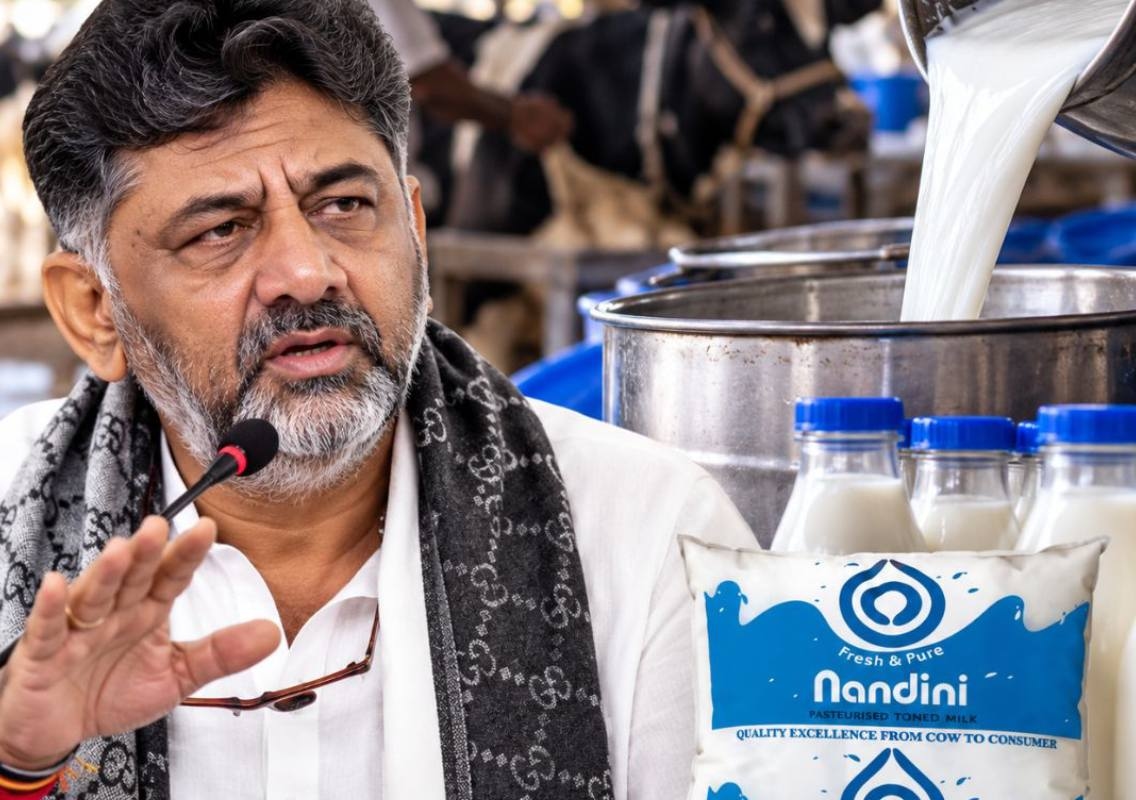


Bengaluru: Karnataka Deputy Chief Minister D K Shivakumar on Saturday defended the state government’s decision to increase milk prices by Rs 8 per litre, citing drought conditions, declining milk production and rising costs for dairy farmers. He said the revision was necessary to protect farmers’ livelihoods and ensure a steady supply of milk, while maintaining that Nandini products would remain comparatively affordable for consumers.
The Karnataka Cabinet approved the price revision on Thursday, with the new rates scheduled to come into effect from November 1. The increase applies to all categories of milk. According to Shivakumar, milk producers had initially sought a hike of Rs 12 per litre, but the government approved an increase of Rs 8.
Speaking to reporters, the Deputy Chief Minister said the decision had been taken after considering the financial difficulties faced by dairy farmers amid drought conditions. He also referred to the need to protect cattle by ensuring that farmers could afford fodder and other essential inputs.
Drought and declining milk production behind price revision
Shivakumar said drought had affected milk production across Karnataka, contributing to a decline in daily milk procurement. He added that farmers were facing pressure from rising expenses and that the existing procurement rates were making it difficult for them to sustain dairy activities.
According to the Deputy Chief Minister, milk prices in neighbouring states were higher, prompting some Karnataka producers to move their supply to those markets. He said this was also affecting the availability of milk within the state.
“Prices are much higher in neighbouring states, and farmers in Karnataka were moving their milk to those states. Milk availability is declining as well. Due to drought, milk production has come down,” Shivakumar told reporters, according to the Press Trust of India.
He argued that the government had to consider the financial position of dairy farmers while deciding the revised prices.
The Deputy Chief Minister said cattle required adequate food and fodder to maintain milk production. Farmers, in turn, needed sufficient income to meet those expenses. Without better remuneration, he said, dairy farmers could find it increasingly difficult to continue production.
“We have no other option. If we want to protect our cows, we must provide them with good food. To provide them with food, we need fodder. For fodder to be available, farmers must be in a good financial position and have money in their hands,” he said.
Shivakumar also invoked the cultural significance of cattle, saying the government had considered the drought situation and the need to protect cows before approving the increase.
Rs 7 of hike to go directly to dairy farmers
Explaining how the additional Rs 8 per litre would be distributed, Shivakumar said Rs 7 would go directly to milk producers, while the remaining Re 1 would be allocated to milk unions to meet operational expenses.
The revision will increase the procurement price paid to farmers from Rs 35 to Rs 42 per litre. When the existing government incentive of Rs 5 per litre is included, farmers will receive a total of Rs 47 for every litre supplied, according to the Deputy Chief Minister.
The government has presented the revision as a measure to improve the earnings of dairy farming households, particularly small and marginal farmers who depend on regular milk procurement for their income.
Shivakumar said Karnataka has around 28.84 lakh dairy farmers and that 67 per cent of Karnataka Milk Federation (KMF) members are small and marginal farmers.
He said the price increase was intended to ensure that these households received better returns for their work and could continue supplying milk despite the increase in production costs.
The Deputy Chief Minister also estimated that a farmer supplying 10 litres of milk daily would earn an additional Rs 2,100 per month following the revision.
Government estimates Rs 1,850 crore to Rs 2,100 crore additional income
According to Shivakumar, the revised procurement rates are expected to generate additional annual income of between Rs 1,850 crore and Rs 2,100 crore for dairy farming families across Karnataka.
He described the decision as an important step towards providing fair remuneration to producers, noting that a large share of KMF members belonged to the small and marginal farmer category.
In a subsequent post on X, Shivakumar listed the factors behind the increase. These included higher fodder and labour costs, rising fuel and packaging expenses, and a decline in daily milk procurement due to drought.
He said the government was attempting to balance the financial needs of dairy farmers with the requirement to keep milk affordable for consumers.
The price revision comes after several years without a change in milk prices, according to Shivakumar. He said the government had considered the impact on both producers and consumers before taking the decision.
Nandini milk to remain comparatively affordable, says Shivakumar
Addressing concerns about the impact of the increase on household budgets, Shivakumar said Nandini milk would continue to be priced competitively compared with products sold by major dairy brands in other states.
He said Nandini toned milk would cost Rs 54 per litre after the revision, which he described as lower than the prices of several major dairy brands across the country.
Nandini Shubham milk, which has a fat content of 4.5 per cent, will be priced at Rs 60 per litre. Shivakumar compared this with an average price of Rs 62.80 in 10 other states.
The government has maintained that the increase is intended to improve the financial position of milk producers without making Nandini products unaffordable for consumers.
The Deputy Chief Minister said the state’s responsibility was to protect dairy farmers while ensuring that households continued to receive quality milk at reasonable rates.
“Our government is committed to both protecting the interests of farmers and ensuring the supply of quality milk to consumers at affordable prices,” he said.
No direct decision on curd price, says Deputy CM
Shivakumar was also asked about the reported Rs 14 per kg increase in the price of Nandini curd.
He clarified that the state government’s intervention had been limited to milk prices and that the Karnataka Milk Federation would decide the pricing of curd.
He explained that prices of dairy products could vary depending on factors such as fat content and the corresponding rates fixed for different categories.
“We have intervened only in the price of milk. As far as the other factors are concerned, if the fat content is higher, a corresponding rate is fixed, and the price goes up accordingly,” he said.
His clarification came amid questions about how the milk price revision could affect other Nandini products. The government has not directly announced a separate curd price decision as part of the milk price hike.
Revised milk prices to take effect on November 1
The Rs 8-per-litre increase will come into force on November 1, following the Cabinet’s approval. The revision is expected to affect consumers purchasing different categories of milk, while increasing the procurement earnings of dairy farmers.
The government has justified the decision by pointing to drought-related production challenges and the higher costs of maintaining cattle and running dairy operations.
With Rs 7 of the increase going to farmers and Re 1 allocated to milk unions, the state government says the revised structure will support producers and help sustain milk procurement.
The coming weeks will show how the new prices affect consumer demand and milk procurement across Karnataka. For now, the government’s stated objective is to strengthen dairy farmers’ incomes while keeping Nandini milk competitive in the market.