







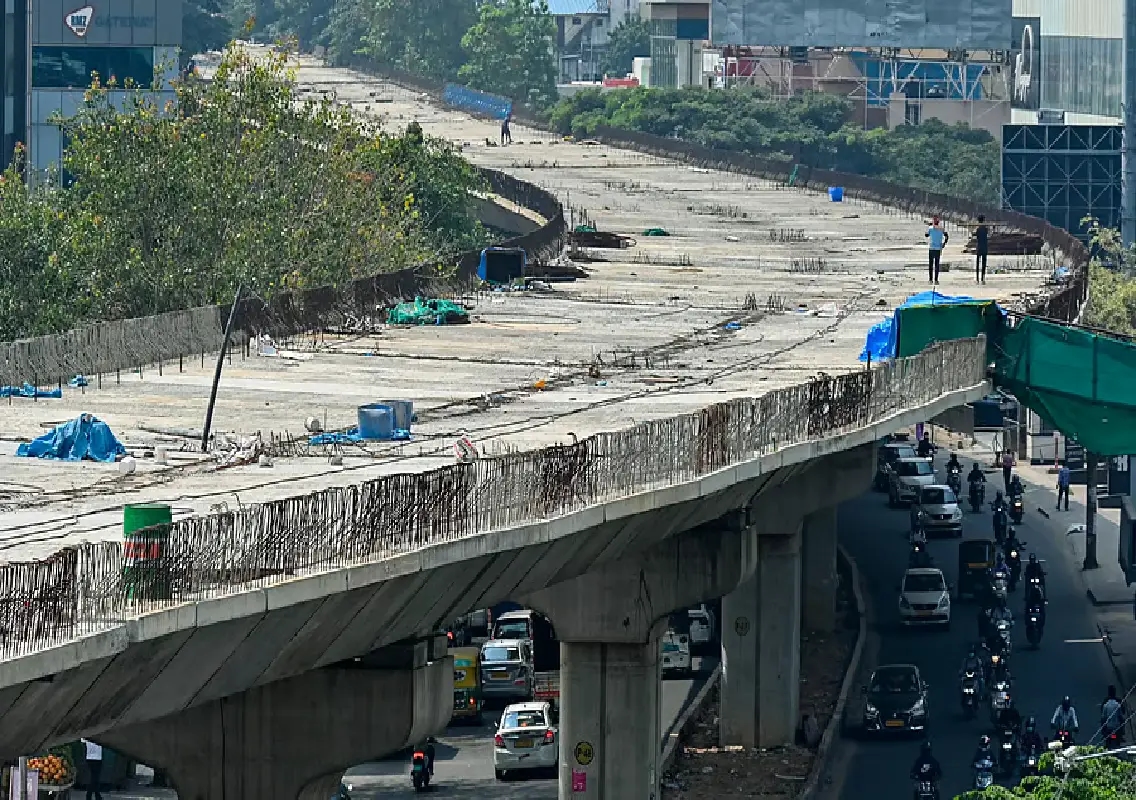


Bengaluru: The Greater Bengaluru Authority (GBA) has claimed that work on 10 out of the 12 ongoing flyovers, bridges and underpasses in the city will be completed by 2026, raising cautious optimism among commuters while also triggering scepticism due to the projects’ long history of delays.
The assurance was given in a written reply tabled during the recently concluded Karnataka Assembly session. In its response, the GBA outlined project-wise timelines and stated that most of the pending infrastructure works are expected to be completed next year, provided there are no further hurdles.
Long-pending projects nearing deadline
According to data submitted by the GBA, several of the projects that are now slated for completion in 2026 were initiated as early as 2020 and have missed multiple deadlines since then. Among the most delayed are two grade separators on the RR Nagar–Kengeri Outer Ring Road — one across Ullal Main Road and another at the HMT Road pipeline junction.
Work on these two projects was taken up by the then Bruhat Bengaluru Mahanagara Palike (BBMP) in November 2020 with the objective of easing congestion in southwest Bengaluru. More than four years later, both structures remain incomplete, causing daily inconvenience to thousands of commuters using the corridor.
Officials said that construction activity has picked up in recent months and that the remaining works are being monitored closely to ensure completion within the revised timeline.
Projects stalled due to land acquisition issues
The GBA has acknowledged that land acquisition has been a major stumbling block for several infrastructure projects in the city. Data shared in the Assembly shows that at least four of the 12 ongoing projects have been affected primarily due to delays in acquiring land.
At Jalahalli Circle, for instance, work on a proposed grade separator announced in 2019 has not progressed at all, as land acquisition issues are yet to be resolved. Despite repeated assurances over the years, the project remains stuck at the preliminary stage.
Similarly, construction of a grade separator on the Kengeri Outer Ring Road across Annapoorneshwari Nagar has been stalled since 2022. Officials said the delay was caused by a rise in project cost by about ₹1.5 crore, which necessitated preparation of a revised estimate. Approval for the revised cost was granted only recently, allowing work to resume after a prolonged pause.
Cost escalations add to delays
Apart from land acquisition, cost escalations have also contributed significantly to missed deadlines. Engineers point out that delays scepticism in land acquisition often lead to increases in material and labour costs, forcing authorities to seek fresh administrative and financial approvals.
A senior GBA official, speaking on condition of anonymity, said completing the projects by 2026 would require “ideal conditions”. “Completion is possible only if approvals are granted on time and work proceeds without interruptions. In reality, land acquisition takes time, cost escalations need fresh sanctions, and there are several overheads. These factors rarely move as per schedule,” the official said.
Public scepticism over repeated assurances
While the GBA has expressed confidence about meeting the 2026 deadline, daily commuters remain unconvinced. Many point to past experiences where deadlines were announced repeatedly but never met.
The Ejipura flyover is often cited as a prime example. Conceived to ease traffic congestion between Koramangala and Indiranagar, the flyover has seen years of stalled work, protests and shifting completion dates. “Every time a deadline passes, officials announce a new one. None of them have been honoured so far,” said Rakesh M, a software professional who commutes daily via Ejipura.
Other commuters echoed similar sentiments, saying they would believe the assurances only when the projects are actually opened to traffic.
Importance of infrastructure completion
Urban planning experts have pointed out that timely completion of flyovers and underpasses is crucial for Bengaluru, which continues to grapple with severe traffic congestion. With the city’s vehicle population crossing 1 crore, delays in critical infrastructure projects have a direct impact on productivity, fuel consumption and air quality.
They have urged the GBA to adopt stricter project management practices, ensure better coordination between departments, and address land acquisition issues proactively to avoid further delays.
Conclusion
While the Greater Bengaluru Authority’s claim that 10 major flyovers, bridges and underpasses will be completed in 2026 offers a ray of hope, the city’s residents remain cautious. Given the history of missed deadlines, experts and commuters alike say that only sustained execution, timely approvals and transparent monitoring will determine whether Bengaluru finally sees relief from some of its long-pending infrastructure woes next year.