







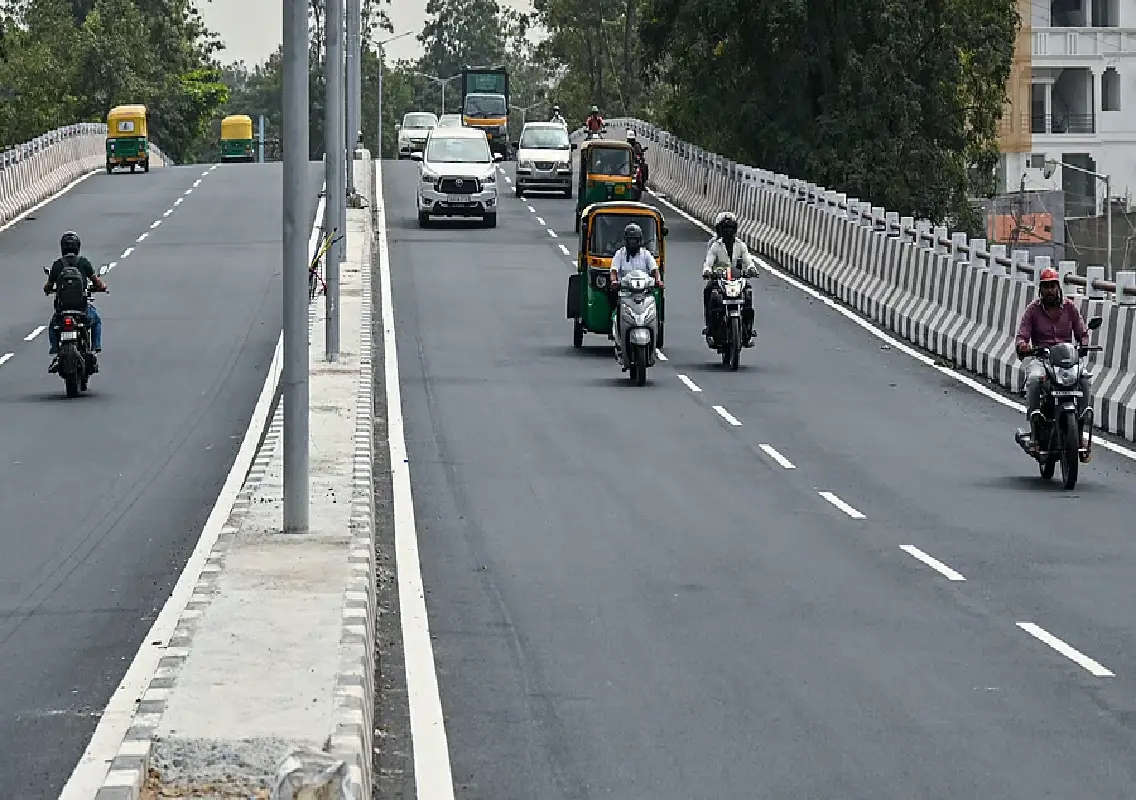


Bengaluru: The Hosakerehalli flyover near PES University, which opened to traffic on November 12, 2025, was expected to ease chronic congestion along one of south-west Bengaluru’s busiest corridors. Instead, just weeks after its inauguration, commuters and residents say the long-delayed project has failed to deliver meaningful traffic relief, raising questions about planning, execution and the overreliance on flyovers as a solution to the city’s traffic woes.
The flyover’s construction began in August 2020 and was originally slated for completion within 15 months. However, repeated delays meant commuters waited more than five years for a project that was projected as a major intervention to decongest the Hosakerehalli–Nayandahalli stretch. Now operational, the structure has become a focal point of frustration rather than relief.
Bottleneck shifts from road to flyover
During peak hours, traffic congestion is most severe on the flyover while heading towards Nayandahalli, according to daily commuters. Instead of dispersing traffic, the flyover appears to have merely shifted the bottleneck from the surface road to an elevated level.
“The flyover has transferred the bottleneck from ground to flyover. There is no actual relief and a five-year waiting period for nothing to change,” said Ramakanth, a commuter who uses the stretch daily for work. He added that traffic snarls during morning and evening peak hours are often worse than before, with vehicles crawling bumper-to-bumper.
Traffic police personnel on duty in the area acknowledged that congestion persists despite the new infrastructure, especially during peak movement hours.
Incomplete work adds to commuter woes
Adding to the dissatisfaction is what commuters describe as unfinished work at the flyover’s entrance towards Nayandahalli. A roughly four-inch layer of asphalt at the entry point has become a hazard, particularly for two-wheelers and autorickshaws.
“Are they incapable of neatly finishing the project? Vehicle suspensions get damaged due to this,” said Raju K, an autorickshaw driver who frequents the route multiple times a day. He pointed out that uneven surfaces at critical points not only slow traffic but also pose safety risks.
Residents and motorists say such lapses undermine the very purpose of infrastructure projects meant to improve commuting conditions.
BWSSB work worsens congestion
The situation has been further aggravated by ongoing work by the Bengaluru Water Supply and Sewerage Board (BWSSB). The road below the flyover towards Hosakerehalli has been closed for the laying of new pipelines, forcing buses and other heavy vehicles to divert onto the flyover.
As a result, the flyover now carries traffic volumes far higher than anticipated, leading to frequent slowdowns. Commuters say this diversion has nullified whatever marginal benefit the flyover might have provided under normal circumstances.
Public transport users hit hardest
Public transport users, particularly bus commuters, say they have been disproportionately affected. Anitha M, a garments worker and resident of Veerabhadranagar, described the daily difficulties faced by residents in her locality.
“The buses go on the flyover and the Veerabhadranagar bus stop is closed because of this. Only some drivers stop near the entrance of the flyover for us to get down, which is risky,” she said. “If they do not stop there, we next have to get down near PES and walk almost two kilometres.”
She added that residents have repeatedly borne the brunt of poorly coordinated infrastructure works. “We are always the ones adjusting. The authorities never seem to plan keeping people like us in mind,” she said.
Congestion persists beyond the flyover
Even where traffic appears to move smoothly immediately after Hosakerehalli, the relief is short-lived. Shopowners and residents pointed out that traffic flows freely only till the Janata Bazar and Itmadu junction, after which congestion builds up rapidly.
“At Janata Bazar signal, traffic clogs for more than a kilometre and gets even worse during peak hours,” said a shopowner near the junction, who wished to remain anonymous. He noted that despite the presence of multiple grade separators, the problem remains unresolved.
“Including the Hosakerehalli flyover, there are two flyovers and one underpass before reaching Janata Bazar signal, but still there is congestion here. This proves that none of these are solutions. The government should focus on other means than building flyovers,” he said.
Traffic police cite structural issues
A senior traffic police officer confirmed that congestion at the Janata Bazar junction is an everyday occurrence. “The traffic from Gorguntepalya reaches Janata Bazar without any signal in between. Because of this uninterrupted inflow, there is an overflow of vehicles at the junction, which causes the jam,” the officer explained.
He added that unless traffic distribution and signal planning are addressed holistically, isolated infrastructure projects such as flyovers are unlikely to provide sustained relief.
Conclusion
The Hosakerehalli flyover, conceived as a solution to traffic congestion, has instead highlighted deeper issues in Bengaluru’s urban transport planning. Incomplete finishing work, lack of coordination between agencies, disruption to public transport and failure to address downstream bottlenecks have left commuters questioning the effectiveness of such projects. As residents and daily travellers continue to struggle with congestion, calls are growing for the government to look beyond flyovers and adopt more integrated, people-centric mobility solutions.