







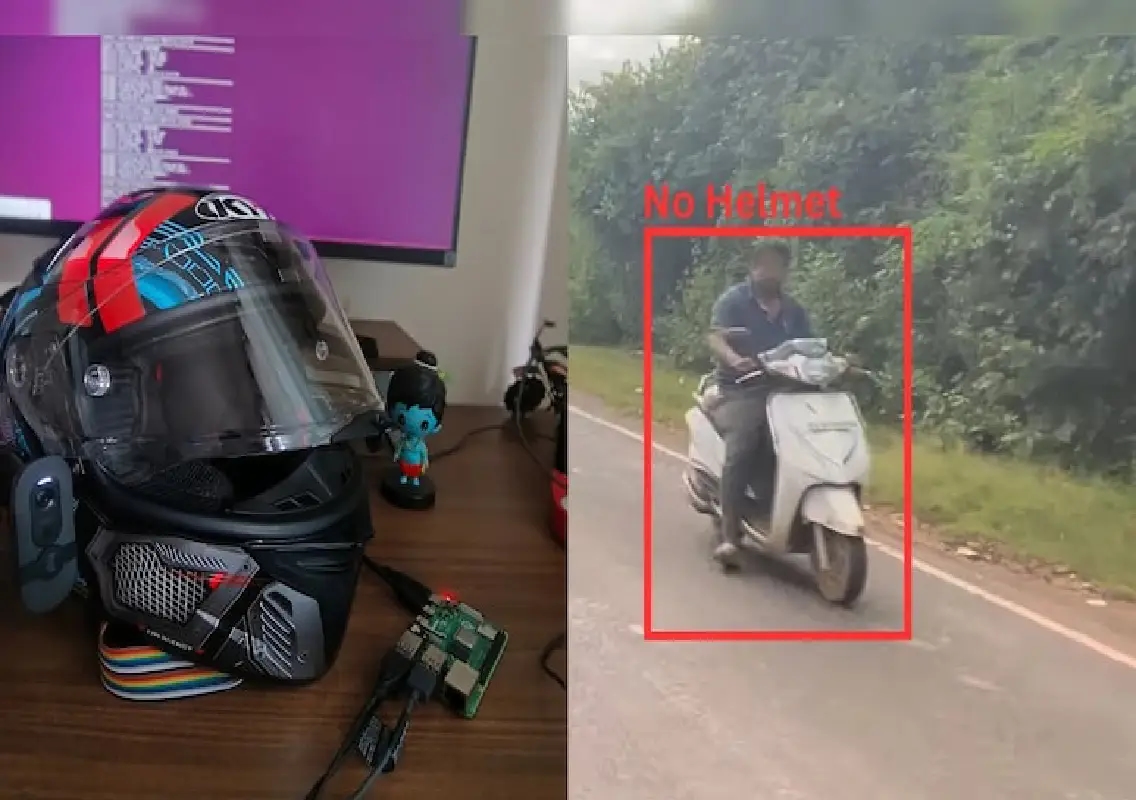


Bengaluru: Frustrated by rampant traffic violations and poor road discipline, an Indian tech professional has gone viral after transforming his helmet into an artificial intelligence-powered traffic monitoring device that can automatically detect violations and report them to authorities. The innovation, shared on social media, has sparked widespread admiration and debate, with many calling it a “peak Bengaluru” moment of grassroots technology solving everyday civic problems.
The techie, identified as Pankaj Tanwar, shared details of his invention on X (formerly Twitter), where his post quickly gained traction and crossed over 1.5 lakh views within a short span. In his post, Tanwar candidly explained the motivation behind the project, saying his daily commute in Bengaluru finally pushed him to act.
“I was tired of stupid people on road, so I hacked my helmet into a traffic police device,” Tanwar wrote, drawing instant attention from users across the country.
How the AI helmet works
According to Tanwar, the helmet is equipped with an AI-based system that runs in near real time while he is riding his two-wheeler. The system uses a camera and an artificial intelligence agent that can identify common traffic violations such as riding without a helmet, lane violations and other rule-breaking behaviour.
The AI does more than merely detect violations. Tanwar explained that once a violation is flagged, the system automatically captures proof, including images or video footage, along with the location data and vehicle number plate details, and forwards it directly to the police.
“While I ride, AI agent runs in near real time, flags violations, and proof with location & no plate goes straight to police. Bengaluru people, so now ride safe or regret it,” he posted.
To demonstrate the system’s effectiveness, Tanwar also shared an example where a scooter rider without a helmet was instantly detected and reported using the AI-enabled helmet.
Viral reaction and public praise
The post struck a chord with netizens, especially those familiar with Bengaluru’s often-criticised traffic conditions. Social media users praised the innovation as both clever and socially impactful, with many expressing hope that such technology could improve traffic discipline in Indian cities.
“Peak Bengaluru innovation. This is some cool engineering,” one user commented. Another wrote, “Love it, love it. Vehicles should come with this tech.”
Some users went a step further, suggesting that similar AI-based systems could be integrated into car dashcams and linked to official traffic enforcement mechanisms. One suggestion proposed offering incentives to citizens whose dashcams or AI devices help report violations.
“That’s a fantastic idea! Maybe the dashcams can be hooked to a cloud service, and if a state gives 10 per cent of challan incentive to the person whose dashcam reported the incident, it would be a good reason for people to sign up,” a user commented.
Others reacted with a mix of admiration and humour. “Bro turned road rage into a production system. Not sure whether to be impressed or scared. If it works, traffic discipline might finally level up,” another user wrote.
Bengaluru’s traffic woes and citizen-led innovation
Bengaluru, often referred to as India’s Silicon Valley, is known both for its thriving tech ecosystem and its chronic traffic problems. With increasing vehicle density, frequent violations and limited enforcement manpower, traffic discipline has long been a point of frustration for residents.
Tanwar’s AI helmet has therefore resonated as an example of citizen-led innovation, where technology is applied at an individual level to address systemic civic challenges. Several users urged him to consider scaling the project and making such helmets available across the country.
Creator responds to overwhelming attention
Reacting to the overwhelming response and the post “blowing up” online, Tanwar said he never expected such widespread attention. He described himself as someone who enjoys experimenting with unconventional ideas.
“I just love building weird, fun projects,” he said, while also sharing glimpses of some of his previous experiments with technology.
While it remains unclear whether the AI helmet complies fully with existing traffic laws or data protection norms, the concept has undeniably triggered conversations around community-driven enforcement, responsible use of artificial intelligence and the future of smart traffic monitoring.
Conclusion
Tanwar’s AI-powered helmet has not only showcased the creative potential of Indian tech talent but also highlighted the growing role of technology in addressing civic issues. As debates continue around legality, scalability and privacy, the viral innovation has already succeeded in drawing attention to the need for better traffic discipline and smarter enforcement mechanisms in cities like Bengaluru.