







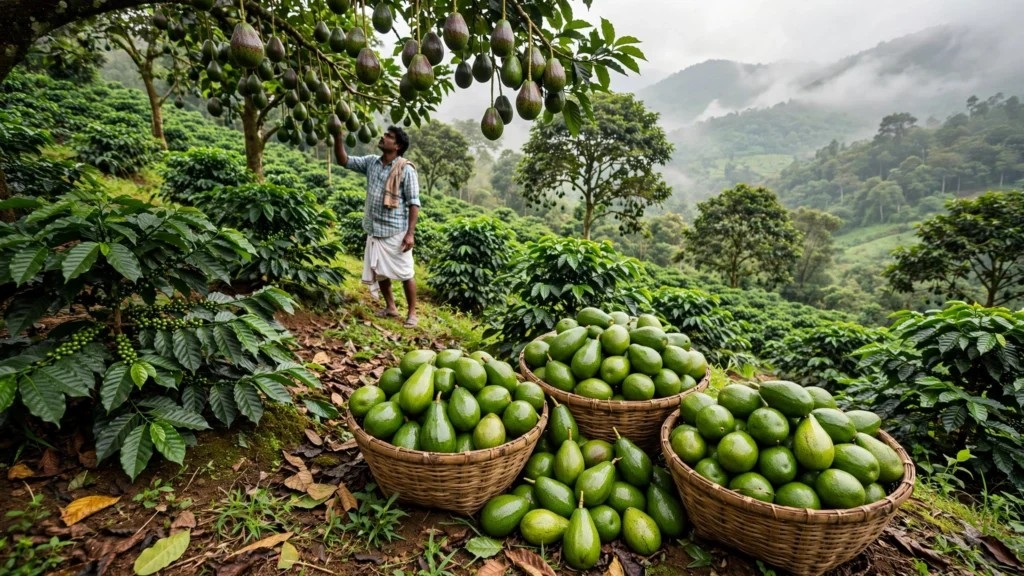


Bengaluru: Avocado, once an unfamiliar fruit in most Indian households, is rapidly becoming a sought-after food in urban markets, restaurants and health-conscious homes. But as demand rises, Indian farmers are struggling to produce enough fruit of consistent quality to meet the country’s growing appetite.
The transformation has been striking. Around 15 years ago, avocados had very little commercial value in India. In parts of the country, ripe fruit was reportedly left to fall from trees and was even eaten by animals. Today, the fruit has become an increasingly valuable crop, with farmers exploring dedicated orchards and diversification opportunities.
India’s avocado market is still heavily dependent on imports. Industry estimates cited in the BBC report suggest that the country imports around 15,000 tonnes of avocados annually, while domestic production is estimated at only 8,000–9,000 tonnes.
The gap represents a significant opportunity for Indian growers.
From forgotten fruit to premium produce
The avocado’s rise in India has been driven by changing food habits, greater awareness of nutrition and its growing presence in restaurants and cafés.
The fruit is now commonly associated with salads, sandwiches, toast, dips and other contemporary dishes.
Its popularity has also been boosted by India’s expanding health-conscious consumer segment.
The result is a market that looks very different from the one farmers knew a decade or two ago.
In Wayanad, Kerala, for example, Cottanad Plantations originally introduced avocado trees as shade trees for coffee plantations. The company later recognised their commercial potential and expanded cultivation to around 40 acres. Its harvest was between 10 and 15 tonnes last year, with plans to increase production substantially over the next few years.
Farmers see an alternative to traditional crops
For farmers growing coffee, pepper and other traditional plantation crops, avocado is emerging as a possible diversification option.
Changing weather conditions have placed pressure on several conventional crops, increasing the need for farmers to consider alternative sources of income.
Industry participants believe the country’s supply gap could provide farmers with an attractive opportunity if cultivation is supported by proper technical guidance and reliable markets.
Recent developments show that avocado cultivation is expanding across several parts of India, including Karnataka, Kerala and Tamil Nadu.
Farmers in Chikkamagaluru, for instance, are incorporating avocados into coffee plantations alongside crops such as black pepper.
Karnataka emerges as an important growing region
Karnataka has long had a connection with avocado cultivation, particularly in coffee-growing areas.
Government agricultural information has identified Coorg, Chikkamagaluru and parts of Dakshina Kannada among areas where avocado has traditionally been grown as a homestead crop or intercrop. Increasing demand has also encouraged expansion around Bengaluru.
The state’s combination of suitable growing conditions and established plantation agriculture could give farmers an advantage as commercial cultivation expands.
For coffee growers, avocado can also provide an opportunity to diversify rather than completely abandon existing plantation systems.
Growing an avocado orchard is not simple
The increasing price and demand for avocados may make the crop look attractive, but establishing a successful commercial orchard requires considerable technical knowledge.
Farmers cannot simply plant avocado seeds and expect a uniform commercial crop.
Professional orchards generally use grafted plants, combining a suitable rootstock with a selected variety that determines the fruit characteristics.
Farmers also need to understand pruning, spacing, irrigation, drainage and disease management.
Avocado roots are particularly vulnerable to certain diseases, making soil and water management critical.
Growers who learnt through trial and error have had to adopt techniques such as raised beds, wider spacing and specialised planting methods.
Pollination can make or break a plantation
One of the less obvious challenges is pollination.
Different avocado varieties have complementary flowering behaviour, meaning growers need to plan the combination and arrangement of varieties carefully to achieve reliable fruit production.
If the planting pattern is poorly designed, trees may grow strongly but produce disappointing quantities of fruit.
This makes professional orchard planning particularly important for new growers.
Farmers therefore need more than good soil and water. They need access to reliable planting material and technical advice from agricultural experts.
Demand for imported varieties remains strong
Although Indian-grown avocados are improving, imported varieties continue to dominate some premium markets because of their consistency.
Mumbai-based chef Hussain Shahzad told the BBC that restaurants have experimented with Indian varieties but currently find imported avocados more reliable in terms of flavour, texture, size and ripening.
For restaurants, consistency matters.
A chef needs to know that the fruit arriving in the kitchen will have the right texture and ripeness for the dish being prepared.
This creates an important challenge for Indian farmers.
Increasing production alone will not be enough. Domestic growers must also be able to supply fruit that meets the expectations of organised retailers and professional kitchens.
Scientists work on better Indian varieties
India’s avocado industry also faces a problem caused by the country’s long history of growing trees in home gardens.
According to Dr Ganeshan Karunakaran of the ICAR-Indian Institute of Horticultural Research in Bengaluru, many Indian backyard avocado trees are genetically different.
The result is considerable variation in fruit quality, size and production.
Researchers have therefore been working to develop more uniform planting material.
IIHR has released varieties based on Indian avocado trees, with the aim of providing farmers with high-yielding and good-quality plants suitable for commercial cultivation.
Such standardisation could become increasingly important as India’s avocado market develops.
The danger of poor-quality saplings
For farmers considering avocado cultivation, planting material is one of the biggest decisions.
Unregulated nurseries can potentially sell unidentified or diseased plants.
A tree may appear healthy during its early years before problems emerge later, resulting in significant financial losses for the farmer.
This is particularly important because avocado is a long-term investment.
Farmers cannot necessarily recover their investment quickly.
Choosing suitable varieties and obtaining healthy, verified grafted plants can therefore make a major difference to the eventual success of an orchard.
Farmers need assured markets
Market access is another critical issue.
A farmer may successfully grow high-quality avocados but still struggle if there is no reliable buyer nearby.
Wayanad farmer Shiju Sebastian, who has dedicated two acres to avocado cultivation, told the BBC that farmers are willing to grow the fruit but need proper guidance and assured markets. He is currently harvesting around 3,500 kg and selling the produce in Bengaluru.
His experience demonstrates the importance of connecting growers with urban markets.
Bengaluru, with its large population and growing demand for premium food products, has become an important destination for avocado growers.
A new opportunity for plantation farmers
The avocado boom is also attracting entrepreneurs beyond farming.
In Bhopal, entrepreneur Harshit Godha established a nursery after training with farmers in Israel. His business has supplied thousands of avocado plants to farmers across India, including international varieties such as Hass and Pinkerton.
His experience illustrates the emerging ecosystem around avocado cultivation.
Nurseries, agricultural consultants, growers, distributors and retailers can all benefit as the market expands.
However, the development also means that farmers need access to trustworthy information before committing land and capital.
Indian farmers are already proving the potential
The opportunity is not merely theoretical.
In Andhra Pradesh, farmer Karpa Varadaraj turned to avocado cultivation after facing difficulties with conventional crops. He harvested nearly four tonnes and found a local market for his produce.
Farmers in Kodaikanal and Chikkamagaluru are also exploring avocado as an additional income source alongside existing agricultural activities.
These examples suggest that avocado could become an increasingly important diversification crop in suitable regions.
Climate change adds another dimension
The rise of avocado comes at a time when many farmers are facing increasing uncertainty from changing weather patterns.
Coffee and pepper growers in parts of southern India have experienced climate-related pressures, making crop diversification an increasingly important strategy.
However, avocado itself is not immune to climate risks.
Farmers need to carefully assess water availability, soil conditions, temperature and local weather before establishing an orchard.
A crop that performs well in one region may not necessarily succeed in another.
Supply gap creates a major opportunity
India’s continuing dependence on imported avocados indicates how quickly demand has outpaced domestic production.
The country imported just a small quantity of avocados a few years ago, but imports have risen sharply as the fruit has become more popular. Recent reporting puts domestic production at roughly 8,000–9,000 tonnes, against imports of around 15,000 tonnes annually.
That supply gap is both a challenge and an opportunity.
If Indian farmers can increase production while maintaining quality, a greater share of the growing market could potentially be supplied domestically.
From exotic fruit to Indian farm opportunity
The avocado’s journey in India is an unusual agricultural success story.
A fruit once considered almost worthless in some farming communities has become a premium commodity sought by urban consumers.
But the next stage of the avocado boom will require more than simply planting trees.
Farmers need scientific guidance, healthy planting material, suitable varieties, efficient cultivation methods and assured markets.
Agricultural institutions also have an important role in developing varieties suited to Indian conditions and helping farmers adopt commercial cultivation practices.
For Karnataka and other southern states with suitable agro-climatic conditions, the growing market could provide an additional avenue for agricultural diversification.
The road ahead
India’s avocado industry is still developing, and its future will depend on whether domestic growers can close the gap between demand and supply without compromising quality.
The experience of farmers in Wayanad, Chikkamagaluru, Kadapa and other regions suggests that the potential is considerable.
For consumers, the growth of Indian avocado farming could eventually mean greater access to locally grown fruit.
For farmers, it could represent a new source of income at a time when traditional agricultural markets face mounting challenges.
The avocado may have once been dismissed as a forgotten fruit in India. Today, it is increasingly being viewed as a promising crop — and the race is on to ensure Indian farms can keep up with Indian appetites.