







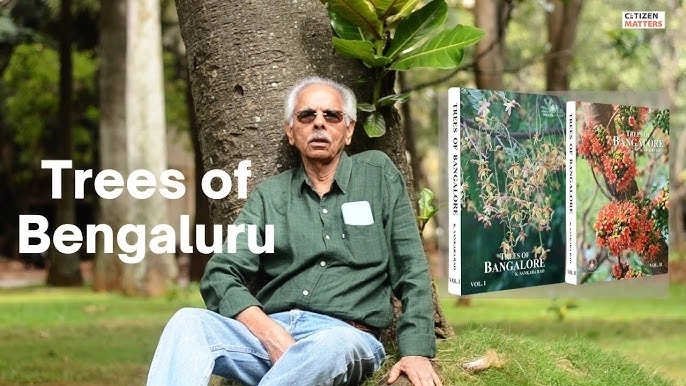


“I have always been fascinated by trees. Documenting Bengaluru’s trees became an addictive journey. The more I recorded, the more I yearned to do it,” said K Sankara Rao, author of Trees of Bangalore. A former professor at the Department of Biochemistry, Indian Institute of Science (IISc.), Rao’s deep love for nature and his extensive background in Plant Biology have shaped his lifelong dedication to the city’s green heritage.
Trees of Bangalore, published in two volumes, serves as a comprehensive one-time documentation that showcases Bengaluru’s rich ecological diversity. It also acts as a valuable guide for policymakers aiming to protect the city’s greenery.
Post-retirement, Rao transitioned to the Centre for Ecological Sciences, IISc., where he focused on biodiversity informatics, landscape ecology, and conservation science. He is known for pioneering digital resources for floral diversity documentation in India and has worked extensively to educate the public about the natural world through books and websites.
Rao’s journey began in 2009 when he documented the trees on the IISc campus, which led him to expand his research into a larger project focused on Bengaluru’s trees. His documentation effort, started in the early 1990s, spans multiple seasons, climatic variations, and urban challenges, ensuring that Bengaluru’s trees are well-recorded for future generations.
The book details over 800 species, including 527 trees, 94 woody climbers, 113 large shrubs, 43 palms, and 18 conifers and cycads. It offers readers a journey through Bengaluru’s lush neighbourhoods and serves as a significant historical record. Released on November 8, 2024, by Ajay K. Sood, Principal Scientific Adviser to the Government of India, the book emphasizes the importance of nature-based urbanism. Its goal is to instill pride in the city’s botanical beauty and inspire careful, ongoing preservation efforts.
Read also: