







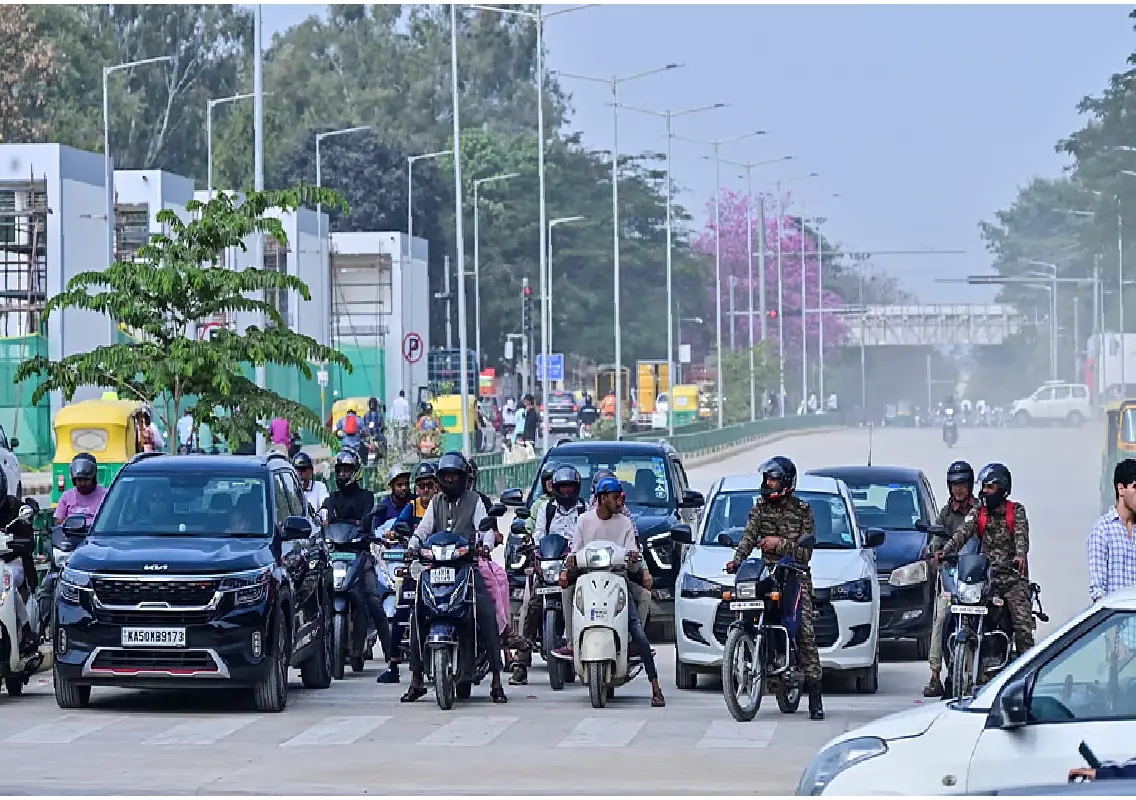


Bengaluru: After remaining partially shut for nearly six-and-a-half years due to underground metro construction, Kamaraj Road, a crucial arterial stretch in Bengaluru’s Central Business District (CBD), has been fully reopened to traffic. The reopening marks a significant milestone for commuters and businesses in the area, promising smoother connectivity and substantial relief from chronic congestion.
The stretch of Kamaraj Road between Cubbon Road and MG Road was closed on June 15, 2019, to facilitate the construction of the MG Road underground station of the Namma Metro Pink Line. With the east carriageway reopening on Friday, traffic movement has now been restored on both sides of the road, bringing an end to prolonged diversions and bottlenecks.
A long wait ends for commuters
The 220-metre stretch connecting Cubbon Road to the Cauvery Emporium Junction had turned into a major choke point for daily commuters and commercial traffic. For over six years, motorists were forced to take long detours via Dickenson Road, Queen’s Road or Infantry Road, significantly increasing travel time and fuel consumption.
While the west carriageway of Kamaraj Road was reopened earlier on June 14, 2024, the reopening of the east carriageway has now completed the restoration of the entire stretch. The delay in full reopening was attributed to complex underground construction works associated with the metro station and the need to ensure road safety and structural stability.
Wider road, smoother flow
According to officials, the reconstructed road spans 214 metres and has a minimum width of 11 metres on each carriageway. The improved width is expected to facilitate smoother vehicular movement, reduce conflict points and improve overall traffic efficiency in the CBD.
Urban planners said the redesign would better accommodate peak-hour traffic volumes and enhance connectivity between major commercial hubs such as Commercial Street and Brigade Road. With barricades removed, vehicles can now move directly between these areas without circuitous routes.
Major decongestion in key junctions
The reopening has already resulted in visible decongestion at critical intersections, particularly Anil Kumble Circle and BRV Junction, both of which had borne the brunt of diverted traffic during the metro construction period.
Motorists travelling from Commercial Street to Brigade Road no longer need to navigate detours through Dickenson Road or Queen’s Road. Traffic police estimate that the direct connectivity has reduced peak travel time by 10 to 15 minutes, a significant saving in one of the city’s busiest commercial zones.
Commuters welcome the move
Regular commuters have welcomed the reopening, describing it as a long-awaited relief. Sunil Kumar, a commuter from Ulsoor, said the detour via Infantry Road had been exhausting. “It used to take much longer, especially during peak hours. This reopening saves me both fuel and time,” he said.
Autorickshaw drivers, who were among the worst affected by the prolonged closure, also expressed relief. Ramesh, an autorickshaw driver operating in the Shivajinagar–Brigade Road corridor, said, “Earlier, taking a passenger meant a 2-km detour. Now, it is a straight route. It makes our work much easier and saves fuel.”
Traffic police cautious about Monday rush
While traffic movement remained smooth on Friday, traffic police officials cautioned that the real impact of the reopening would be evident only after the New Year holiday weekend.
The Assistant Commissioner of Police (Central, Traffic) said, “As it is the New Year holiday and a weekend, traffic is currently normal. The true test will be on Monday, when officegoers return after the break and regular weekday traffic resumes.”
Traffic personnel are expected to closely monitor vehicle flow and make necessary adjustments to signal timings and lane management to ensure smooth movement during peak hours.
Impact on businesses and urban mobility
Local businesses along Kamaraj Road and adjoining areas are optimistic that the reopening will improve footfall and accessibility. Many shops and offices had reported reduced patronage during the prolonged closure, as customers found it difficult to reach the area.
Urban mobility experts said the reopening underscores the importance of minimising disruptions during large infrastructure projects and completing surface restoration promptly. They added that while metro expansion is essential for Bengaluru’s future, balancing construction with the city’s immediate traffic needs remains a critical challenge.
Conclusion
The full reopening of Kamaraj Road after more than six years marks a major relief for Bengaluru’s CBD, restoring a vital traffic artery and easing long-standing congestion. While the coming weekdays will test the road’s capacity under regular traffic conditions, the development is being seen as a positive step towards improving urban mobility in one of the city’s busiest zones.