







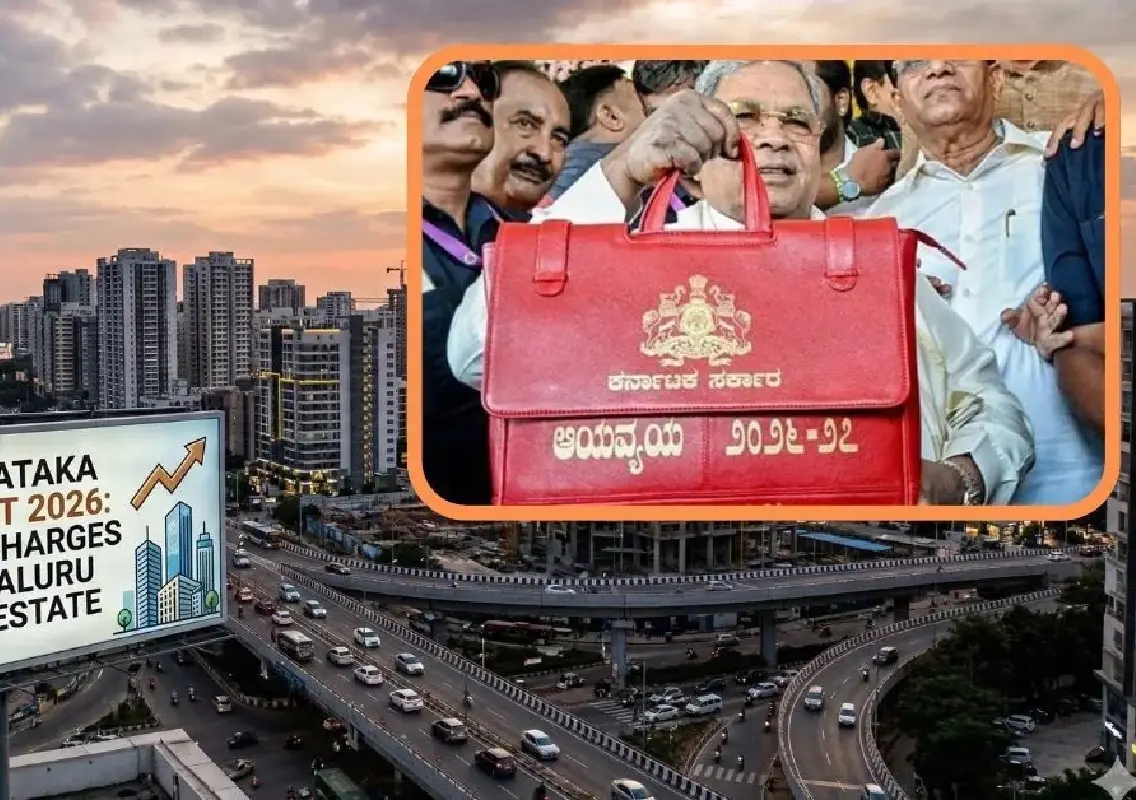


Bengaluru dominated the spending blueprint when Karnataka Chief Minister Siddaramaiah presented his record 17th state budget, announcing an ambitious set of infrastructure projects aimed at tackling the city’s long-standing challenges of traffic congestion and flooding.
The 2026–27 Karnataka Budget outlines large-scale investments in tunnel roads, metro expansion, suburban rail networks, stormwater upgrades, and civic infrastructure, with the goal of transforming Bengaluru into what the Chief Minister described as “the world’s most liveable city.”
₹40,000 crore tunnel road project
One of the most significant announcements in the budget is a ₹40,000 crore underground tunnel road project designed to reduce traffic congestion across the city.
Two major corridors covering around 40 kilometres will be constructed under the Build-Own-Operate-Transfer (BOOT) model, a public-private partnership where private firms build and operate infrastructure before transferring it to the government.
The proposed corridors include:
- North–South corridor: Hebbal Junction to Silk Board in HSR Layout
- East–West corridor: KR Puram to Mysore Road
If implemented successfully, these routes could significantly shorten travel time between Bengaluru’s major residential and technology hubs.
Additionally, a tunnel and elevated road between Hebbal Junction and Mekhri Circle will be built by the Bengaluru Development Authority (BDA) at a cost of ₹2,250 crore.
Major upgrades to road infrastructure
The budget also proposes significant improvements to Bengaluru’s surface road network.
The Outer Ring Road stretch between Silk Board Junction and KR Puram Metro Station will be upgraded into a global-standard corridor at a cost of ₹450 crore.
Other key road infrastructure plans include:
- 158 km of roads to be white-topped at ₹1,700 crore
- 450 km of additional white-topping over three years costing ₹3,000 crore
- 175 traffic junctions to be redesigned and beautified
- 500 km of footpaths to be upgraded
- 100 skywalks to be constructed across the city within three years
These projects aim to improve traffic flow while making the city more pedestrian-friendly.
Metro and suburban rail expansion
Public transport expansion remains central to the city’s long-term mobility strategy.
Namma Metro, which currently operates 96 kilometres of network and serves around one million passengers daily, will see 41 kilometres of additional lines completed in 2026–27.
A 9-kilometre pedestrian walkway along the metro viaduct on Outer Ring Road will also be constructed at a cost of ₹160 crore.
The Bengaluru Suburban Railway Project is also progressing, with land acquisition completed for Corridor 2 (Benniganahalli–Chikkabanavara) and ongoing for Corridor 4 (Heelalige–Rajanukunte).
The state has allocated ₹500 crore this year, with the suburban rail network targeted for completion by December 2030.
Measures to tackle flooding
Bengaluru’s recurring monsoon flooding has also been addressed in the budget.
A major initiative is the Cauvery Phase VI water supply project worth ₹6,939 crore, supported by the Japan International Cooperation Agency (JICA), which will supply an additional six TMC of water to the city.
Stormwater infrastructure upgrades include:
- ₹273 crore for primary stormwater drains and lake development
- ₹2,000 crore under the World Bank-backed Karnataka Water Security and Disaster Resilience Programme
In addition, the government announced a ₹5,000 crore five-year disaster management programme to address flooding in Bengaluru.
Investments in healthcare and social infrastructure
Beyond transport and infrastructure, the budget also outlines investments in healthcare and welfare facilities.
A 1,000-bed charitable super-speciality hospital will be established at the Rajiv Gandhi Institute of Chest Diseases in partnership with the Azim Premji Foundation.
Other initiatives include:
- A regional centre of Sri Jayadeva Institute of Cardiovascular Sciences and Research at the BBMP hospital in Govindarajanagar
- New IVF centres at Vani Vilas Hospital and Gulbarga Medical College
- Working women’s hostels and student hostels
- Digital libraries for competitive exam aspirants
- Minority training centres
Through these initiatives, the government aims to address Bengaluru’s infrastructure challenges while supporting the city’s growth as India’s leading technology hub.