







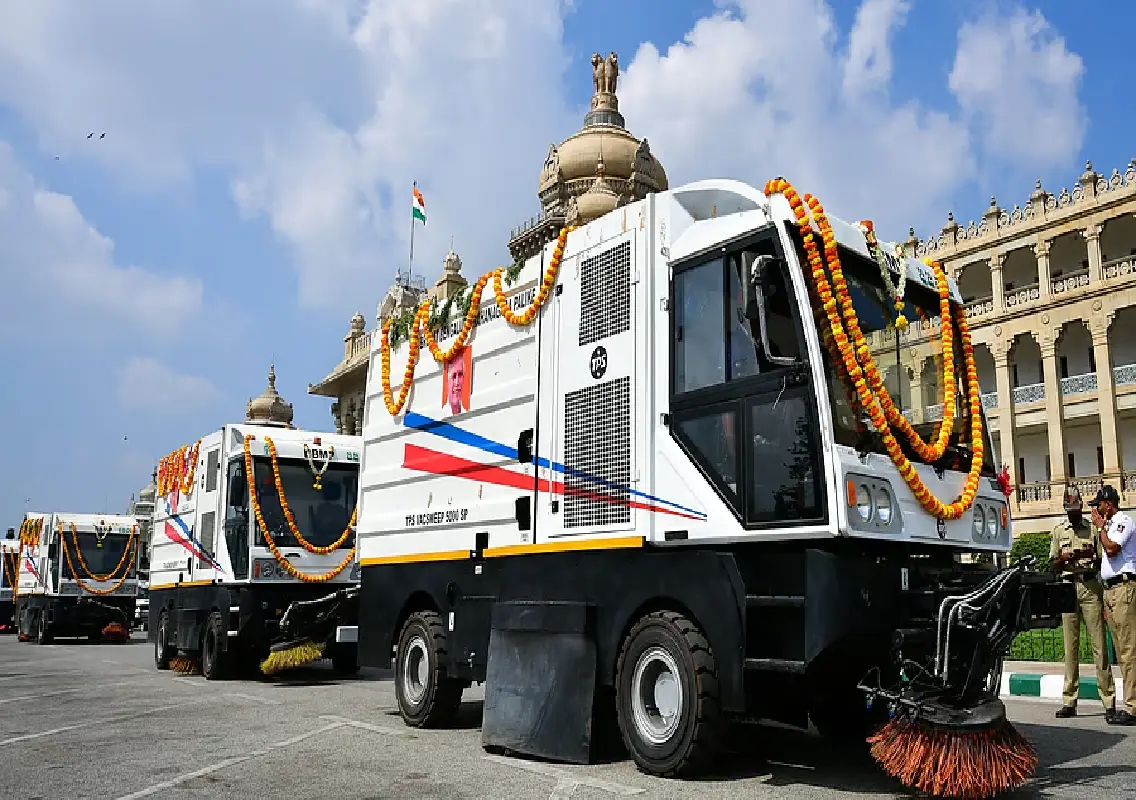


Bengaluru: The Karnataka government on Wednesday issued a formal order approving the Cabinet’s decision to rent mechanical road-sweeping machines for seven years at an estimated cost of ₹613.25 crore, even as opposition parties and civic experts continue to question the financial prudence of the model. The order places responsibility on the Greater Bengaluru Authority (GBA) and its five newly formed municipal corporations to procure and operate the machines for maintaining arterial and sub-arterial roads across the city.
Rental model cleared despite concerns
According to the government order, the GBA will hire the machines for seven years, with the rental cost capped at ₹613.25 crore. However, the order does not specify the number of sweepers to be hired. Officials familiar with the proposal said the likely requirement is around 46 machines, though the final number will depend on tender responses.
Each of the five new corporations will float separate tenders and bear the expenditure proportionate to their jurisdictions. They have also been instructed to ensure the rented sweepers do not duplicate existing efforts or overlap with future programmes, such as those under the city’s solid-waste management overhaul.
The government’s decision comes amid persistent criticism from opposition parties, who argue that the sweeping cost is “inflated” and that outright purchase of the machines would be significantly cheaper in the long run.
Opposition slams “unusually high” rental cost
The BJP and JD(S) have attacked the plan, calling the seven-year rental outlay “exorbitant”. The criticism follows a report by a three-member government-appointed committee that recommended purchasing the machines instead of renting them. A private consultant had also proposed a hybrid model—including 40% upfront payment and the remaining amount linked to performance—which was considered more cost-effective.
Despite these views, the GBA opted for a full rental model. Officials argued that the capital expenditure required for outright purchase would be too high, especially given the need for maintenance, spare parts, trained operators and storage facilities. “₹613 crore is an upper limit,” a senior official said. “Competitive bidding may bring down the final cost.”
Opposition leaders, however, contend that the rental ceiling appears unrealistic, and have demanded transparency in the tendering process. Several MLAs have also questioned whether the corporations have conducted route-mapping studies to justify the number of machines being rented.
GBA defends cost using comparative data
Defending the proposal, the GBA cited expenditure patterns from other Indian cities. An internal assessment compared per-kilometre sweeping costs across major urban local bodies, noting that Patna spends about ₹1,350 per km, Mohali ₹1,225 per km, Bhubaneswar ₹1,000 per km and Pune around ₹923 per km.
Bengaluru’s projected cost of ₹894 per km, the authority said, is among the lowest in the country, making the rental model both competitive and sustainable. Officials stressed that renting the machines allows the city to upgrade technology over time, avoid long-term depreciation costs and reduce downtime due to breakdowns—issues that reportedly plague cities that own such machines.
Industry voices back rental approach
Several urban mobility and civic-tech leaders have supported the government’s decision. Yulu co-founder R. K. Misra backed the rental model, arguing that owning and running mechanical sweepers demands specialised technical expertise that municipal corporations may not possess. He said the city must prioritise operational efficiency over asset ownership.
Entrepreneur Kiran Mazumdar-Shaw also expressed support, noting that heavy mechanised cleaning equipment requires professional operators, proper servicing schedules and real-time monitoring—tasks better handled by specialised contractors. She welcomed the government’s assurance that the outsourcing document would be made public and urged citizens to understand the practical challenges of mechanised sweeping before criticising the proposal.
Conclusion
With the government order now clearing the path for tendering, the five corporations under the GBA will soon initiate procurement processes. The political fight, however, is far from over. As Bengaluru grapples with rising dust pollution, growing road lengths and stretched civic manpower, the success or failure of the rental model will likely influence future urban service reforms. Opposition parties have already signalled that they will continue to scrutinise the financial and operational viability of the project, setting the stage for a contentious civic debate in the months ahead.