







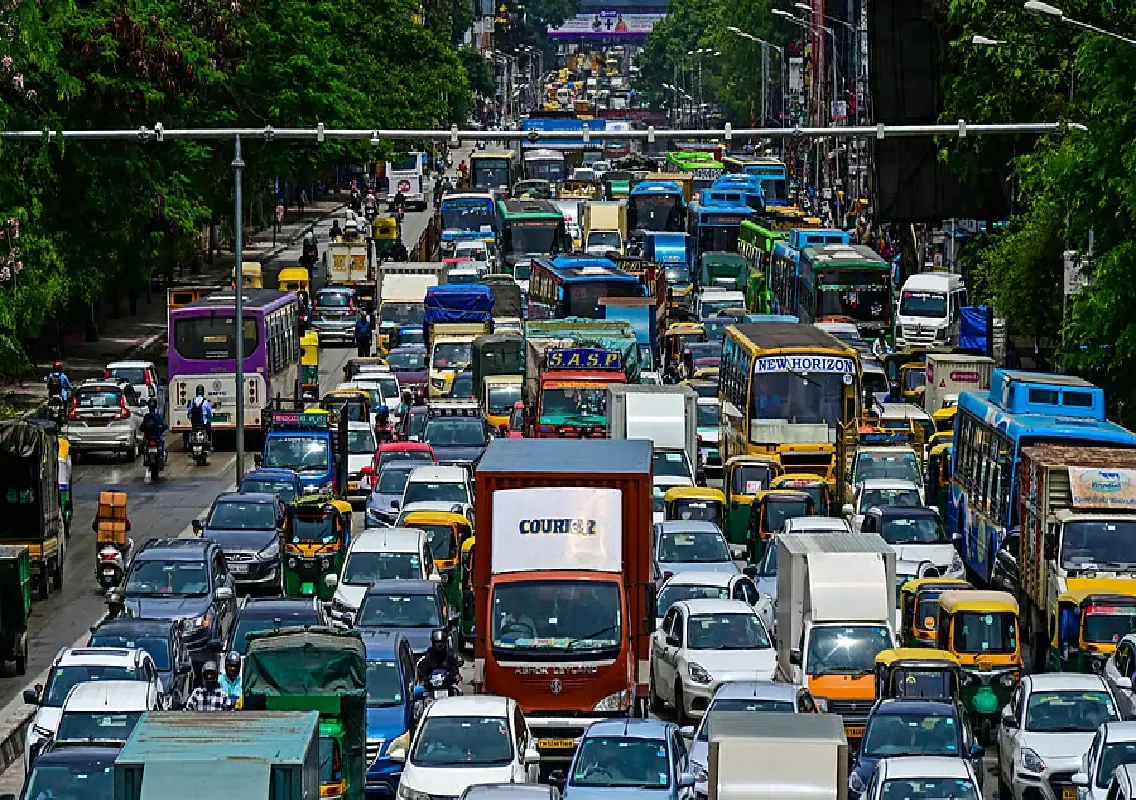


Bengaluru: The Karnataka government has approved a major infrastructure proposal to redevelop a 17-km stretch of the Outer Ring Road (ORR) between Silk Board Junction and the KR Puram metro station at an estimated cost of Rs 450 crore. The decision, formalised through a recent government order (GO), aims to decongest one of the city’s busiest technology corridors and significantly upgrade road infrastructure catering to thousands of daily commuters.
According to official documents, the project will be implemented in two packages and funded through a cost-sharing arrangement. The state government will bear 50% of the total expenditure, while the remaining amount will be shared equally by the Bengaluru East City Municipal Corporation and the Bengaluru South City Municipal Corporation.
Project split into two packages
As per the government order, the ORR redevelopment has been divided into two distinct packages based on stretch length and cost. Package 1 covers the 5.44-km stretch between Silk Board Junction and Iblur Junction, with an estimated cost of Rs 143 crore. Package 2 spans the longer 11.57-km section from Iblur Junction to KR Puram, with a projected cost of Rs 307 crore.
Together, these stretches form a critical arterial corridor connecting major IT hubs, residential clusters, commercial zones and multiple metro stations. The Silk Board–KR Puram ORR stretch is widely regarded as one of the most congested roads in Bengaluru, witnessing heavy traffic volumes throughout the day and peak-hour gridlock.
Focus on bus priority lanes
Beyond routine resurfacing and repairs, a key component of the redevelopment plan is the introduction of a dedicated bus priority lane along the corridor. Officials clarified that the lane will not be physically segregated throughout using continuous bollards.
Instead, demarcation will be achieved through a mix of digital fencing solutions, bollards at strategic locations and clearly marked road signage and lane markings. The intent, officials said, is to improve bus speeds and reliability without severely restricting other vehicular movement or emergency access.
Transport planners have long argued that a bus priority system on ORR could encourage public transport use among IT professionals and daily commuters, potentially easing congestion and reducing private vehicle dependency.
Wide-ranging infrastructure upgrades planned
The scope of the project goes well beyond road relaying. Proposed works include the reconstruction of footpaths to ensure pedestrian safety and accessibility, creation of dedicated cycle lanes, and white-topping at major junctions to improve durability and reduce maintenance frequency.
To address flooding issues that frequently affect parts of the ORR during monsoon months, the plan includes the installation of vertical gratings in low-lying areas. Overhead gantries, improved road signage and advanced traffic-management technologies are also part of the proposal.
In addition, utility ducts will be laid to organise cables and pipelines currently running haphazardly along the corridor. Beautification measures, including landscaping and aesthetic improvements, are also envisaged to enhance the overall streetscape.
The development of roads connected to the ORR has been included in the project’s scope, reflecting a corridor-based approach rather than isolated road upgrades.
Technical clearance and recommended materials
The proposal was examined and cleared by a technical expert committee comprising domain specialists, according to the government order. The committee evaluated design elements, materials and construction technologies before giving its approval.
Among the technologies recommended by the committee are stamped concrete layers for durability and aesthetics, cold plastic paint for longer-lasting road markings, and glass grids to improve visibility and lane discipline, particularly during night-time and adverse weather conditions.
Officials said the use of such materials is expected to reduce long-term maintenance costs and improve road safety.
Implementation through B-SMILE
The project will be implemented through Bengaluru Smart Infrastructure Ltd (B-SMILE), a special purpose vehicle (SPV) tasked with executing major urban infrastructure projects in the city.
A senior official from B-SMILE said tenders for the project are expected to be floated in the first week of the new year. Once awarded, work is likely to be taken up in phases to minimise disruption to traffic along the busy corridor.
Another official noted that members of the Outer Ring Road Companies Association (ORRCA), which represents several large IT and technology firms located along the ORR, would be involved during the execution phase. Their participation, officials said, is aimed at ensuring better quality control and coordination, given the corridor’s importance to the tech industry.
Concerns over duplication of work
Despite the ambitious scope of the project, some concerns have been flagged by officials. Large portions of the ORR service roads were recently asphalted by the municipal corporations, raising questions about possible duplication of work and efficient use of public funds.
Officials said efforts would be made to integrate recently completed works into the redevelopment plan wherever feasible. It has also been clarified that the current scope does not include the development of spaces beneath flyovers along the ORR.
Urban planners and civic activists have urged authorities to ensure proper coordination between agencies to avoid repeated digging and reconstruction, which have long been a source of frustration for commuters.
Conclusion
The approval of the Rs 450 crore ORR redevelopment project marks a significant step in Bengaluru’s ongoing efforts to modernise its transport infrastructure. With a focus on bus priority, pedestrian and cyclist facilities, flood mitigation and smart traffic management, the project has the potential to transform a critical tech corridor. However, its success will depend on timely execution, coordination among agencies and minimising inconvenience to the public during construction.