







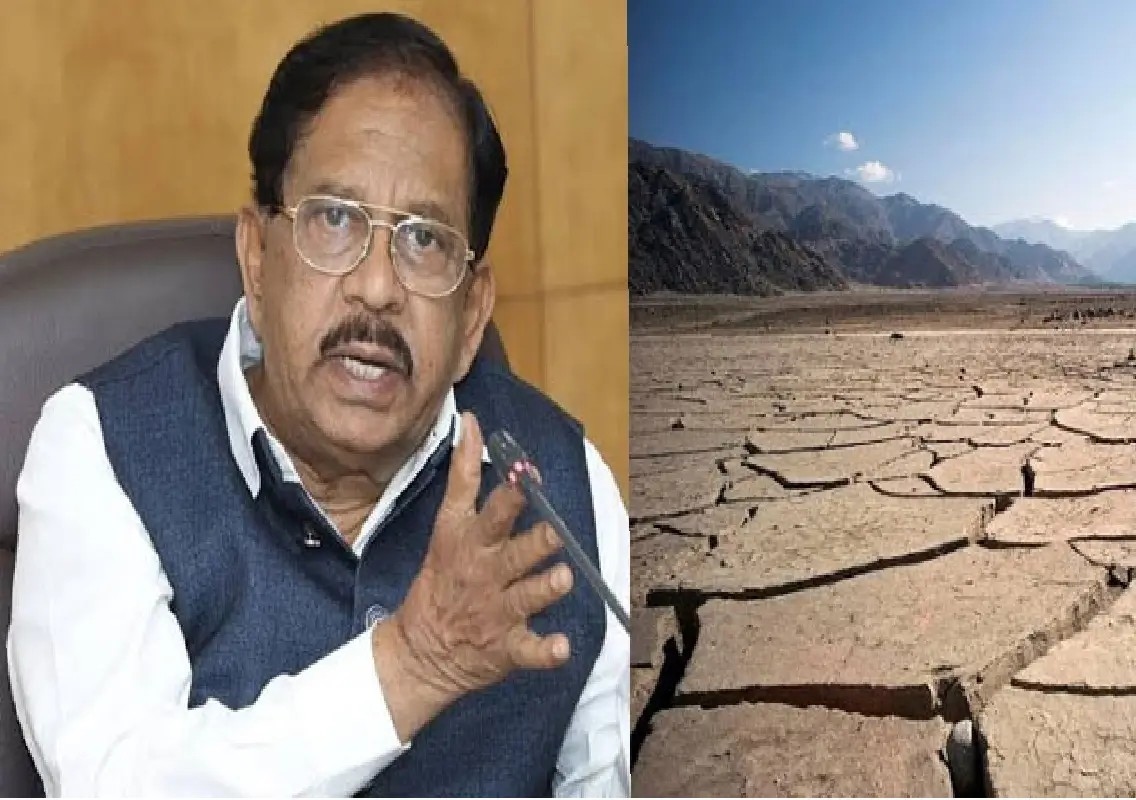


Bengaluru: Karnataka has declared 101 taluks drought-hit in the first phase as the state faces a severe monsoon rainfall deficit, falling reservoir inflows, declining groundwater levels and growing concerns over drinking water and fodder availability.
Deputy Chief Minister and Revenue Minister Dr G Parameshwara said 89 taluks had been classified as severely drought-hit, while 12 were categorised as moderately drought-hit.
The government has kept another 32 taluks under review. The drought situation in the declared taluks will be reassessed every 15 days, and additional taluks will be declared drought-hit if they meet the prescribed criteria.
State records 30% rainfall deficit
Karnataka received 465 mm of rainfall between June 1 and August 26, against the normal 666 mm for the period, resulting in a 30% rainfall deficit.
Rainfall deficiency has been reported across all 190 taluks, with 13 taluks recording a severe shortfall.
The deficit has affected agricultural activities, soil moisture, reservoir storage and groundwater availability across the state.
South Interior Karnataka has recorded the highest rainfall deficiency at 41%, followed by Malnad at 35%, North Interior Karnataka at 31% and Coastal Karnataka at 24%.
The widespread shortage has raised concerns about the availability of water for agriculture as well as drinking purposes, particularly in rural areas.
101 taluks qualify under drought criteria
Parameshwara said the government had followed the parameters prescribed under the Centre’s Drought Manual, 2020, while assessing the situation.
Under Trigger-1, a taluk becomes eligible for assessment after experiencing a dry spell lasting three or more consecutive weeks.
Trigger-2 considers several indicators, including the extent of sowing, crop condition, soil moisture, groundwater levels and the availability of water in tanks and reservoirs.
The government initially found that 134 taluks qualified under Trigger-1.
“Following ground-truthing, 101 taluks have currently qualified to be declared drought-affected. The remaining 32 taluks that qualified under Trigger-1 are under review,” Parameshwara said.
The government has decided to declare drought in phases instead of waiting for the entire state-wide assessment to be completed.
Reservoir inflows and groundwater affected
The rainfall shortage has had a significant impact on inflows into major reservoirs across Karnataka.
Lower reservoir levels have added to concerns over water availability in several parts of the state, while groundwater levels have also declined.
The government is particularly monitoring drinking water availability in rural areas, where reduced groundwater recharge could put additional pressure on existing sources.
Parameshwara said the government was taking steps to ensure that people do not face shortages of drinking water or fodder.
Funds have already been made available for drought management and precautionary measures.
Rs 635 crore allocated for relief
The state government has allocated Rs 635 crore at different stages for drought relief and precautionary measures.
Of this, Rs 117 crore has been released to Deputy Commissioners to meet drinking water requirements.
Another Rs 189 crore has been allocated for drinking water needs in Assembly constituencies outside Bengaluru.
A further Rs 329 crore has been kept with Deputy Commissioners for drought-related expenditure following the formal declaration of drought.
The government has also released Rs 25 crore towards fodder and seed kits.
These allocations are intended to help district administrations respond to immediate requirements arising from the rainfall deficit.
Fodder availability raises concern
The shortage of rainfall has also created concerns over fodder availability for livestock.
The state currently has around 151 lakh tonnes of fodder, which is estimated to be sufficient for approximately 33 weeks.
However, the situation is more concerning in 49 taluks, where available fodder stocks are expected to last for less than 20 weeks.
The government is monitoring the situation to prevent shortages and ensure that livestock owners in drought-affected areas have access to fodder.
The release of funds for fodder and seed kits is part of the measures being taken to address the impact of the deficient monsoon.
Sowing falls significantly below target
The rainfall deficit has also affected sowing activity across Karnataka.
Against the state’s target of 84.10 lakh hectares, sowing has been completed in only around 60 lakh hectares, or approximately 71% of the targeted area.
Sowing has remained below 75% of the target in 104 taluks.
In 42 taluks, the extent of sowing is below 25%, indicating the severity of the impact of inadequate rainfall on agricultural operations.
The reduced sowing area is likely to affect farm incomes and crop production if rainfall conditions do not improve.
Soil moisture stress in 178 taluks
The Moisture Adequacy Index as of August 26 showed that 178 taluks were experiencing soil-moisture stress.
Of these, 86 taluks were facing severe deficiency, while 92 were experiencing moderate deficiency.
Low soil moisture can adversely affect germination, crop growth and yields, particularly in areas dependent heavily on rainfall.
The government is therefore continuing to monitor rainfall and agricultural conditions at the taluk level before deciding on further drought declarations.
MGNREGA work increased to check migration
The state government has also taken note of increased migration from drought-affected rural areas to cities in search of employment.
To discourage people from leaving villages due to a lack of agricultural work, authorities have been directed to expand employment opportunities under the Mahatma Gandhi National Rural Employment Guarantee Act (MGNREGA).
Around 66.73 lakh person-days of employment were generated between July and August 24, according to Parameshwara.
The government expects increased employment under MGNREGA to provide an alternative source of income for rural households affected by the rainfall deficit.
Government seeks changes to drought criteria
Parameshwara also raised concerns over the existing drought assessment criteria.
He said the current system could create difficulties when a short spell of rainfall makes a taluk ineligible under Trigger-1, even though crops may subsequently fail because adequate rainfall does not continue.
According to him, the state has repeatedly requested the Union Government to revise the criteria.
“Such problems exist in the present criteria. We have repeatedly urged the Union Government to revise them as was done earlier but the Centre has not addressed the issue. Therefore, we are compelled to declare drought in phases,” he said.
The state government believes changes to the assessment methodology would allow drought conditions to be identified more accurately based on actual agricultural and water stress.
Karnataka seeks central assistance
The state is also seeking financial assistance from the Centre to manage the drought situation.
Karnataka is due to receive Rs 1,239 crore from the Centre under the State Disaster Response Fund (SDRF).
The state government is also seeking Rs 450 crore as the first instalment of assistance.
Parameshwara said a memorandum seeking financial assistance would be submitted to the Centre by the end of August.
The additional funds are expected to support measures related to drinking water, fodder and other drought-management requirements.
More taluks may be declared drought-hit
The government has assured residents of taluks that have not been included in the first list that there is no need for apprehension.
Parameshwara said the situation would be monitored continuously and drought conditions would be reviewed every 15 days.
If additional taluks meet the prescribed criteria during subsequent assessments, they will also be declared drought-hit.
With rainfall remaining below normal, the focus will now be on protecting agricultural activity, maintaining drinking water supplies, ensuring fodder availability and providing employment opportunities in rural areas.
The government’s phased approach will allow it to respond to changing ground conditions while continuing to assess the impact of the deficient monsoon across Karnataka.