







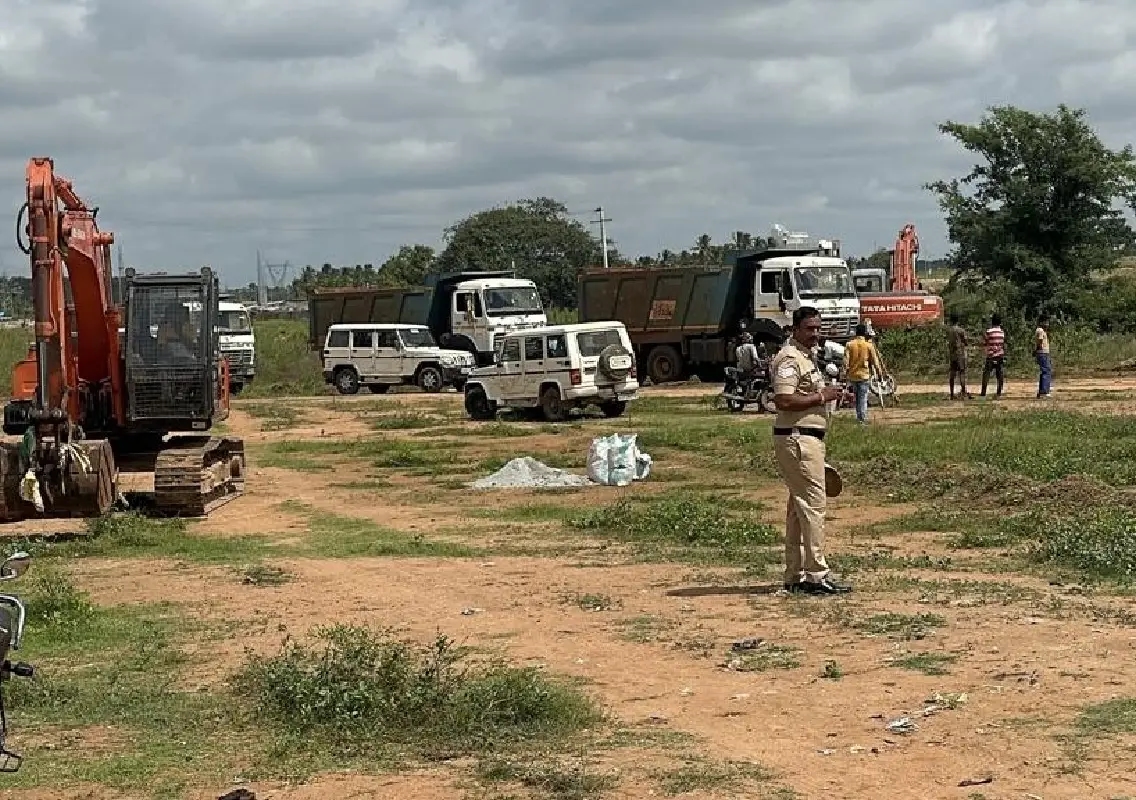


Nearly 1.5 lakh parcels of revenue land, spanning about 14.1 lakh acres across Karnataka, have been flagged as encroached over the past 18 months, according to data from the state’s Land Beat application. Officials emphasise that while these parcels are currently recorded as encroached, the actual extent may reduce after detailed surveys, as even minor encroachments currently mark an entire parcel as affected.
Digital mapping brings Jamabandi rigor back
Launched in February 2024, the Land Beat app empowers village accountants to geo-fence government land, capture photos and short videos, and record encroachment status. Previously, similar surveys were conducted under the traditional ‘Jamabandi’ system.
“We wanted to bring back the rigour of the old Jamabandi system,” said Rajendra Kataria, principal secretary of the Department of Revenue. “Unless land is digitally mapped and visited every few months, we simply don’t know who is sitting on it and why.”
Three-stage survey process
The survey process comprises three stages. The first stage, nearly complete, involves physical verification and geotagging by village accountants. Over 13.9 lakh of the 14.3 lakh identified land parcels have already been visited.
The second stage will see survey teams using drones and rovers to assess the exact extent of encroachments. Finally, revenue authorities will issue notices and evict encroachers under Section 104 of the Karnataka Land Revenue Act.
“The software for steps two and three is being tested,” Kataria said. “Once rolled out, we’ll know not only how many parcels are encroached but also the precise acreage. Eviction will follow in a structured way.”
Kataria added that high-value or large land encroachments are immediately assigned to assistant commissioners for action, bypassing the standard app process.
Early impact and statewide recognition
The impact of the digital initiative is already evident. In Bengaluru alone, special drives have helped reclaim government land worth over ₹5,000 crore in the past year. These drives are now being held twice a month.
The data collected is also used to create a digital ‘Jamabandi’—a registry updated every three to four months—ensuring ongoing monitoring of land records.
With land encroachment a pan-India challenge, Karnataka’s model has drawn attention from other states. Kataria said delegations from at least nine states, including Andhra Pradesh and Telangana, have visited Karnataka to study the system. The Centre has also encouraged states to learn from the initiative, and national e-governance conferences now highlight it as a best practice.
Wider adoption across government departments
Beyond revenue land, departments including forest, irrigation, muzrai, and public works are being encouraged to adopt the app for monitoring their landholdings. The digital approach promises to improve accountability, transparency, and enforcement across the state.
Conclusion
Karnataka’s Land Beat application represents a significant step towards tackling land encroachment through technology. By integrating physical surveys, geotagging, and real-time monitoring, the state is setting an example for digital governance and creating a model that could be replicated nationwide.