







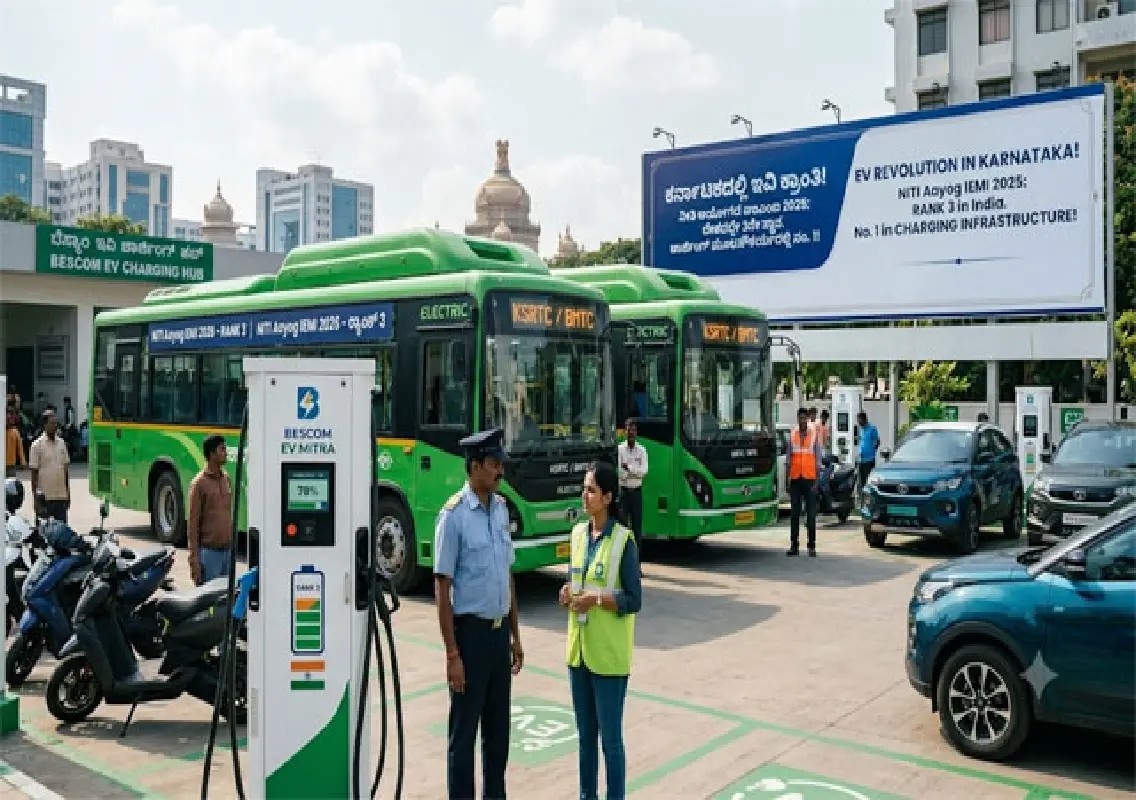


Bengaluru: Karnataka has secured the third position in the India Electric Mobility Index (IEMI) 2025 released by NITI Aayog, highlighting the state’s progress in electric vehicle infrastructure and mobility initiatives.
Karnataka scored 73 points in the index and has been included among the ‘top performers’, alongside Maharashtra. Delhi topped the index with 84 points, followed by Maharashtra with 78 points. Chandigarh secured fourth place with 71 points, while Goa ranked fifth with 65 points.
The index classifies states and Union Territories that score 65 points or above as ‘top performers’.
Karnataka leads in charging infrastructure readiness
Karnataka secured the first position nationally in the charging infrastructure readiness segment, scoring 97 points.
According to Energy Department officials, the score reflects the state’s progress in establishing infrastructure required to support the growing adoption of electric vehicles.
Charging infrastructure remains an important component of electric mobility, as the availability and accessibility of charging facilities can influence the adoption and use of electric vehicles.
Karnataka’s performance in this segment has contributed to its overall position among the leading states and Union Territories assessed under the IEMI 2025.
EV Mitra and single-window system support mobility sector
Energy Department Additional Chief Secretary Gaurav Gupta said Karnataka has introduced several initiatives to strengthen its electric mobility ecosystem.
These include Bescom’s EV Mitra, a unified electric vehicle charging application, a single-window clearance system and an EV accelerator cell.
The initiatives are intended to streamline access to charging infrastructure and facilitate the development of the electric mobility ecosystem in the state.
The EV Mitra platform brings charging-related information together through a unified application, while the single-window clearance system is aimed at simplifying approvals associated with electric mobility infrastructure.
The EV accelerator cell is another component of the state’s efforts to support the growth of the sector.
Karnataka introduced dedicated EV policy in 2017
Gupta highlighted Karnataka’s early policy intervention in electric mobility.
In 2017, Karnataka became the first state in the country to introduce a dedicated electric vehicle policy covering vehicle sales, charging infrastructure and dedicated manufacturing zones, he said.
The policy was intended to create an ecosystem covering different aspects of electric mobility, from vehicle adoption and charging facilities to manufacturing.
Since then, the state has continued to introduce initiatives aimed at strengthening electric vehicle infrastructure and supporting the transition towards electric mobility.
State accounts for 8.81% of EV registrations
Karnataka accounts for 8.81% of the country’s total electric vehicle registrations, according to the Energy Department.
The state ranks second after Maharashtra in registrations of electric two-wheelers and four-wheelers.
Karnataka also holds the third position nationally in e-bus registrations, after Delhi and Maharashtra, Gupta said.
The figures indicate the growing presence of electric vehicles across different categories in Karnataka, including private vehicles and public transport.
The state’s position in electric two-wheeler and four-wheeler registrations, along with its ranking in e-buses, adds to its broader electric mobility profile.
Five states and UTs in top performers category
The IEMI 2025 has identified five states and Union Territories with scores of 65 points or above as top performers.
Delhi leads the group with 84 points. Maharashtra follows with 78 points, while Karnataka has 73 points. Chandigarh and Goa have scored 71 and 65 points respectively.
The index provides a framework for assessing the progress of states and Union Territories across various aspects of electric mobility.
Karnataka’s overall third position and its first-place score in charging infrastructure readiness highlight two different aspects of its performance — its broader electric mobility ecosystem and its preparedness in charging infrastructure.
Focus on expanding electric mobility ecosystem
The state’s electric mobility initiatives cover infrastructure, policy, applications and institutional support.
The introduction of a dedicated EV policy in 2017 provided an early policy framework, while initiatives such as EV Mitra, the single-window clearance system and the EV accelerator cell have subsequently contributed to the state’s efforts to develop the sector.
Karnataka’s share of the country’s electric vehicle registrations and its rankings in electric two-wheeler, four-wheeler and bus registrations further indicate the scale of electric mobility adoption in the state.
With charging infrastructure readiness scoring 97 points, Karnataka has also emerged as the highest-scoring state in that segment of the index.
The IEMI 2025 recognition places Karnataka among the leading regions in India’s transition towards electric mobility, while the state’s continued focus on charging infrastructure and EV-related initiatives is expected to support further development of the sector.