







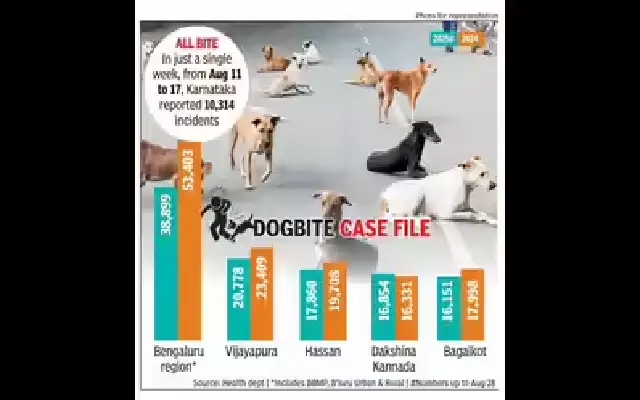


Bengaluru: Karnataka has recorded 3.1 lakh dogbite cases between January 1 and August 28, marking a steep rise from 2.2 lakh cases during the same period in 2024, according to data from the Department of Health and Family Welfare. This represents an increase of nearly 90,000 cases, placing the state at the forefront of India’s stray dog crisis.
During a single week — August 11 to 17 — Karnataka logged 10,314 dogbite incidents, underscoring the scale of the problem. Tragically, 26 rabies-related deaths have also been reported this year.
Bengaluru region leads the numbers
The highest number of cases emerged from the Bengaluru region — BBMP area, Bengaluru Urban and Rural districts — which recorded 38,899 dogbite cases. Other high-burden districts included:
-
Vijayapura – 20,778 cases
-
Hassan – 17,860 cases
-
Dakshina Kannada – 16,854 cases
-
Bagalkot – 16,151 cases
Despite ongoing Animal Birth Control (ABC) and Anti-Rabies Vaccination (ARV) drives, cases have risen consistently, with 1.6 lakh recorded in 2022, 2.3 lakh in 2023, and nearly 3.6 lakh in 2024.
Debate over reporting accuracy
Health department officials attribute the rise to increased awareness and better reporting, with rural areas now contributing more data. “People are more aware and incidents are being reported even from remote regions,” said a senior official.
However, animal welfare activists contest these figures, claiming that misreporting inflates the numbers. Sadhana Hegde, founder of Sahavarthin Animal Welfare Trust, said that vaccination data often leads to duplication.
“Instead of reporting actual bite cases, clinics report the number of vials administered. A single patient completing their vaccine schedule in multiple centres may be counted twice. Even bites from monkeys or squirrels are occasionally recorded as dogbites,” she explained.
Ongoing interventions and new proposals
The BBMP, with an estimated 2.7 lakh stray dogs, has floated a ₹2.9-crore tender for a community dog feeding project. While officials believe this will help, activists argue that structural interventions — such as expanding ABC and ARV programmes beyond Bengaluru and addressing garbage mismanagement — are essential to prevent food scarcity-driven aggression among stray dogs.
Recent fatal incidents spark concern
The urgency of the crisis was reinforced by recent fatal attacks, including the death of a four-year-old girl in Davanagere and a 68-year-old man in Kodigehalli, Bengaluru. Public demand for better safety measures and stricter control of stray dog populations has intensified.
Way forward
Experts suggest a multi-pronged strategy involving:
-
State-wide ABC and ARV programmes
-
Garbage and waste management reforms
-
Public awareness campaigns on vaccination and responsible pet ownership
-
Accurate reporting protocols to ensure reliable data
With cases already crossing 3 lakh by August, Karnataka risks surpassing last year’s tally by a large margin unless immediate and effective interventions are implemented.